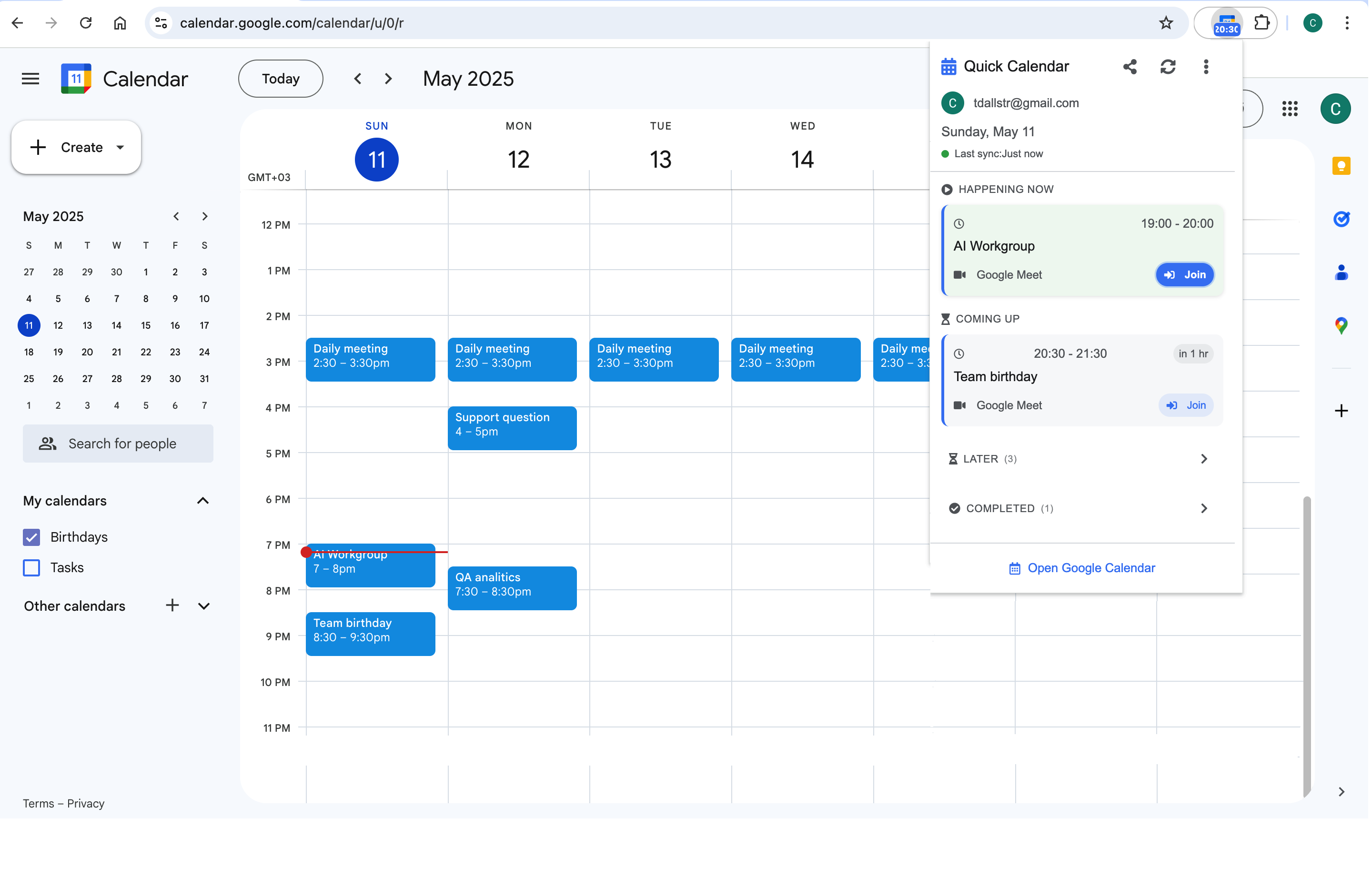
The real question users ask all day
Most calendar checks are not deep planning sessions. They are tiny questions:
- What starts next?
- How soon does it start?
- Do I still have time to stay focused?
- Do I need the full calendar, or just the next event?
A toolbar popup wins when those are the real jobs. It answers the question without making the user pay the full cost of reopening Google Calendar every time.
Why the full web app is sometimes too heavy for a tiny question
Google Calendar is excellent when you are planning, restructuring the week, or doing something complex. But for quick checks it can be more interface than the moment requires.
That mismatch creates friction: extra eye movement, extra decisions, extra time before you even reach the information you wanted.
What makes a toolbar workflow feel good
1. It gives a compact answer first
The first screen should immediately show what matters right now: the next event, the time until it starts, and whether the user still has room before it.
2. It preserves time awareness
A list of events is not always enough. A timeline view works better because it shows spacing and density, not just order.
3. It makes transition moments cheaper
The minutes before a meeting are often where friction shows up. A good popup reduces that friction by keeping the next event close and actionable.
4. It stays honest about when the full app is still better
The best compact calendar experiences do not try to replace Google Calendar completely. They make the fast checks better and leave a clear path back to the full interface.
How Schedule Calendar fits this model
Schedule Calendar is useful because it is designed around these small, frequent moments:
- Day, week, and month views for quick orientation
- Time-to-event chips for instant urgency awareness
- Quick add for small scheduling moves
- A direct “Open Google Calendar” path when the task grows
When a toolbar workflow is the best choice
- You check the calendar many times a day in small bursts.
- You care about the next few hours more often than the whole month.
- You want lighter transitions into calls and meetings.
- You prefer not to keep Google Calendar visually open all day.
That is why a compact extension can feel faster than a permanent full-tab calendar setup. It is not only about speed in milliseconds. It is about lowering cognitive cost in the moments that repeat constantly.