The difference in one sentence
A time block promises a task will get time: you work on it during the slot, and if it needs more, it gets more later. A timebox promises a task will get only this time: when the slot ends, the work ends, finished or not.
| Time block | Timebox | |
|---|---|---|
| What it guarantees | The work happens | The work stops |
| End condition | Task reaches a natural stopping point | The clock, no exceptions |
| Typical failure | Overruns cascade into the next block | Work stops at 90% and never resumes |
| Best for | Drafting, coding, design — work with a completion point | Email, admin, reviews — work that expands to fill any container |
| Calendar setup | Slot + 25% buffer after it | Slot with a hard alarm at the end |
A Tuesday that uses both
Here is how the two methods share one real day. Notice that the boxes cluster around the edges and the blocks own the middle:
- 8:40 – 9:00 · Timebox: inbox pass. Twenty minutes, then it closes. Anything needing more than a two-minute reply becomes a task, not a longer session.
- 9:00 – 11:00 · Block: feature spec draft. This has a completion point — a reviewable draft. If it lands at 10:40, the block ends early. If it needs 20 more minutes, the buffer absorbs it.
- 11:00 – 11:30 · Buffer. Unscheduled on purpose. This is what stops a block overrun from knocking over the rest of the day.
- 13:00 – 13:30 · Timebox: expense reports and ticket triage. Nobody has ever needed open-ended time for expenses. Thirty minutes is a policy, not an estimate.
- 14:00 – 16:00 · Block: code review backlog. Completion point: queue at zero or block ends, whichever comes first — a block with a box-style ceiling, which is fine. The methods are tools, not religions.
- 16:30 – 16:45 · Timebox: tomorrow's plan. Planning is the classic expanding task. Fifteen minutes produces a plan; sixty produces a prettier plan.
Where each method breaks
How blocks fail
Blocks fail by cascading. A 90-minute draft takes 130 minutes, which eats the next slot, and by 15:00 the calendar is fiction. The fix is structural, not motivational: schedule buffers after any block longer than an hour, and treat the buffer as load-bearing — it is not free space for meetings.
How boxes fail
Boxes fail at the quality cliff. A hard stop on creative work can cut off the exact ten minutes where the idea was about to land. If you keep hitting the cliff on the same kind of task, that task wanted a block — you boxed it because it felt safer, not because it fit.
Three rules for choosing
- If you postponed it twice, box it. A task that keeps sliding is a task you are avoiding; give it a 30-minute box today rather than a noble 2-hour block someday.
- If it has a deliverable, block it. Anything ending in a noun — a draft, a fix, a design — gets a block sized at your honest estimate plus 25%.
- Cap boxes at 90 minutes. Past that, a "box" is just a block wearing a stopwatch, and the hard stop stops meaning anything.
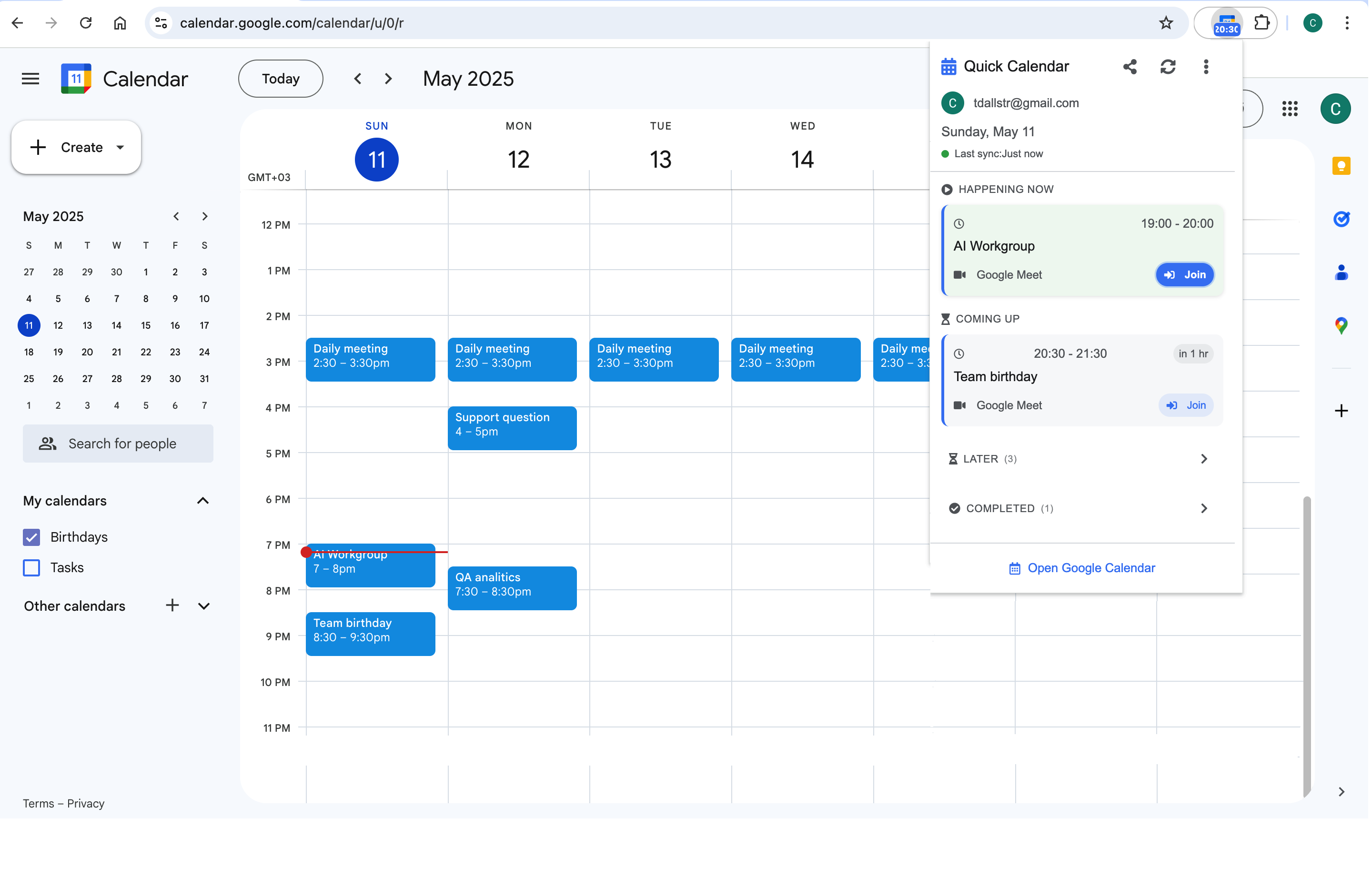
Running the system day-to-day is mostly a matter of knowing where you are in it. A toolbar calendar like Calendar Extension for Google Calendar™ shows the minutes left in the current slot without opening a tab — which is exactly the glance a hard stop needs.
Frequently asked questions
Pomodoro is one specific timeboxing pattern: fixed 25-minute boxes with 5-minute breaks. Timeboxing in general lets you size each box to the task — 15 minutes for planning, 45 for a review pass. If the 25/5 rhythm fights your work, drop Pomodoro and keep the boxes.
Meetings are already timeboxes — they have a hard scheduled end. The useful move is enforcing it: end recurring meetings at 25 or 50 minutes instead of 30 or 60, and the recovered margin becomes your buffer between real blocks.
Strict enough that you believe it. A practical compromise is the two-minute rule: when the box ends you may finish the sentence, not the section. If your stops routinely stretch past five minutes, your boxes are silently becoming blocks.
Start with 30 minutes for admin and email, 15 for daily planning, and 60–90 for bounded review work. Then adjust from evidence: if you consistently finish with 10 minutes spare, shrink the box — Parkinson’s law works in both directions.