Why deep work blocks disappear
Deep work blocks fail for predictable reasons. They get scheduled as the last thing, in the leftover gaps between meetings. They are marked as Free, so they accept new invites without resistance. And they carry generic names like 'Focus time' that offer no accountability when you sit down to start.
The result: by Wednesday, the deep work session you planned is gone — moved for a 'quick call', filled with email catch-up, or simply never started because the day got busy.
Choosing the right time for your deep work block
Most people have a natural cognitive peak — a 2–4 hour window when concentration is sharpest. For many, it's early morning before the day fragments. For others, it's late morning after a light startup routine.
Protect this window before anything else. Schedule your deep work block before opening your inbox, before checking Slack, and before accepting any new meeting invites. The block should claim the best hours on your calendar, not the remaining ones.
Useful constraint: schedule your deep work blocks on Sunday or Friday for the following week. The further in advance a block exists, the less likely it is to be displaced by something that feels urgent in the moment.
Making the block structurally resistant
Mark it as Busy
A block marked Busy does not accept meeting invites silently. Anyone who tries to schedule over it sees the conflict. This does not make the block permanent — you can still move it — but it adds friction to the wrong decisions.
Name it specifically
A block named 'Write API documentation section 3' is harder to skip than one named 'Deep work.' The specific name creates a commitment. When you sit down, you know what you're doing. When you're tempted to scroll instead, the name is a mild accountability signal.
Give it a minimum length
Blocks shorter than 60 minutes rarely produce deep output. The first 20 minutes often goes to orientation and context recovery. Protect a minimum of 90 minutes for work that requires sustained attention.
Defending blocks from meeting pressure
The most common threat to deep work blocks is a meeting invite that arrives mid-week and fits exactly over your scheduled focus session. When this happens, the path of least resistance is to accept the meeting and absorb the loss of the block.
A better response: check whether the meeting genuinely requires your presence and real-time participation. If it does not, decline or ask for an async alternative. If it does, find a different slot for both the meeting and the block — rather than simply removing the block.
Internal deep work time is easier to protect if your calendar is visible to teammates. When colleagues can see that 9–11am is blocked, they tend to schedule around it.
How Schedule Calendar helps
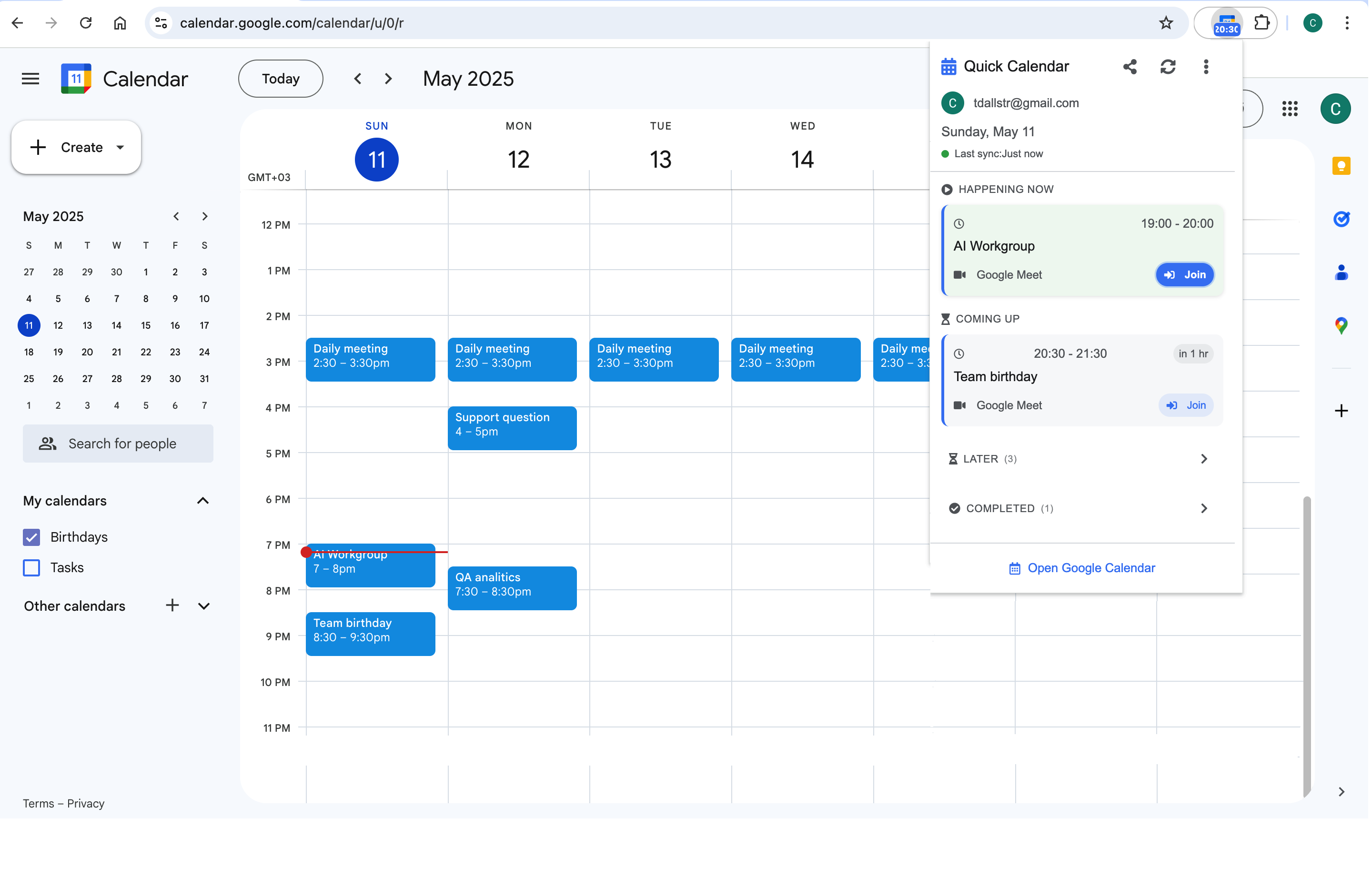
Monitoring a deep work block means checking in periodically: how much time is left, is a meeting approaching, do I have enough runway to start something new. These quick questions usually mean opening Google Calendar — which interrupts focus.
Schedule Calendar surfaces time-to-next-event in the browser toolbar. You see how much of your current block remains without switching tabs. When a meeting is 20 minutes away, you know to wrap up rather than start something new. The block stays intact while the awareness stays low-friction.
The measure of a successful deep work block is simple: did sustained, uninterrupted work happen? Not whether the block was 'perfect', or whether you followed a specific method. Just: did the thinking that matters actually occur?
Frequently asked questions
A deep work block is a scheduled period of uninterrupted, focused work on a cognitively demanding task. Unlike shallow tasks that can be done amid distractions, deep work requires sustained concentration — making the calendar reservation and protection of that time essential.
90–120 minutes is the effective range for most people. The first 15–20 minutes typically go toward orienting and recovering context. Blocks shorter than 60 minutes rarely allow for meaningful deep output before they end.
During your personal cognitive peak — the 2–4 hour window when your concentration is naturally sharpest. For many people this is early morning, before meetings and messages fragment attention. The key is to schedule deep work before other commitments claim that window.
Set the block status to Busy in Google Calendar so it shows as unavailable. Make your calendar visible to teammates so they can see the conflict before sending an invite. When a meeting does land over a block, evaluate whether it truly requires your real-time presence before accepting.
Usually because they are scheduled last (in leftover gaps), left as Free (accepting invites), named vaguely (no accountability), or scheduled too far into the day when energy is already depleted. Moving the block earlier and naming it specifically resolves most of these patterns.
A browser-based calendar extension helps with the monitoring side — checking time remaining in a block, seeing when the next meeting starts, deciding whether there is enough runway to start something substantial. This reduces the number of times you need to open a full calendar tab during a session.