What time blocking means in practice
Time blocking means assigning a specific calendar slot to a specific task — not just meetings. A focus block at 9am on Tuesday is treated the same as a meeting: it shows up in your calendar, it has a visible duration, and it crowds out other things that might try to fill that space.
The key difference from a to-do list: a to-do item sits waiting to be done whenever time appears. A time block defines when the work happens. That shift from reactive to intentional is the entire value of the method.
The three types of blocks worth creating
Deep work blocks (90–120 min)
Deep work blocks are for tasks that require sustained concentration — writing, coding, analysis, design. Protect these from interruptions by marking them Busy. Choose your highest-energy window of the day.
Shallow work batches (30–45 min)
Shallow work batches group low-cognitive tasks: email, Slack catch-up, admin, form-filling. Batching them into one or two windows prevents them from fragmenting your day.
Buffer blocks (15–20 min)
Buffer blocks are transition gaps — a 15-minute window after a dense meeting or before a difficult task. They give you room to decompress, prepare, and avoid the cost of abrupt context switches.
How to set up time blocks in Google Calendar
Create a new event in Google Calendar and give it a specific task name — not just "Focus time" but "Draft Q3 report" or "Review product spec." Vague block names force you to recall context every time you see them.
Set the event color to something distinct from your meetings. Most people use blue for meetings; orange or green for work blocks makes the visual difference immediate. Enable the Busy status so the slot shows as unavailable to people who can book your calendar.
For recurring blocks, use the repeat function. A daily deep work block at 9am is more resilient than one you have to recreate each week.
Rule of thumb: block 60–70% of your available hours, not 100%. The remaining time absorbs the unexpected — a delayed meeting, an urgent request, or a task that ran longer than estimated. An over-blocked week collapses the moment anything changes.
The mistakes that make time blocking fail
Over-blocking is the most common error. When every minute is scheduled, one disruption cascades through the day. Leave white space.
Vague naming is the second mistake. A block called 'Work' tells you nothing when you arrive at 9am. The name should answer the question: what exactly happens here?
Accepting meetings over blocks is the third. Blocks need to be defended. If your calendar shows a focus block as Free, meeting invites will land inside it. Set status to Busy — and protect the blocks from your own impulse to reschedule them when the week gets complicated.
How Schedule Calendar helps
Time blocking requires regular check-ins throughout the day: how long until this block ends, is the next meeting close, do I have time to start a new task? Opening Google Calendar for each of these questions interrupts the focus you're trying to protect.
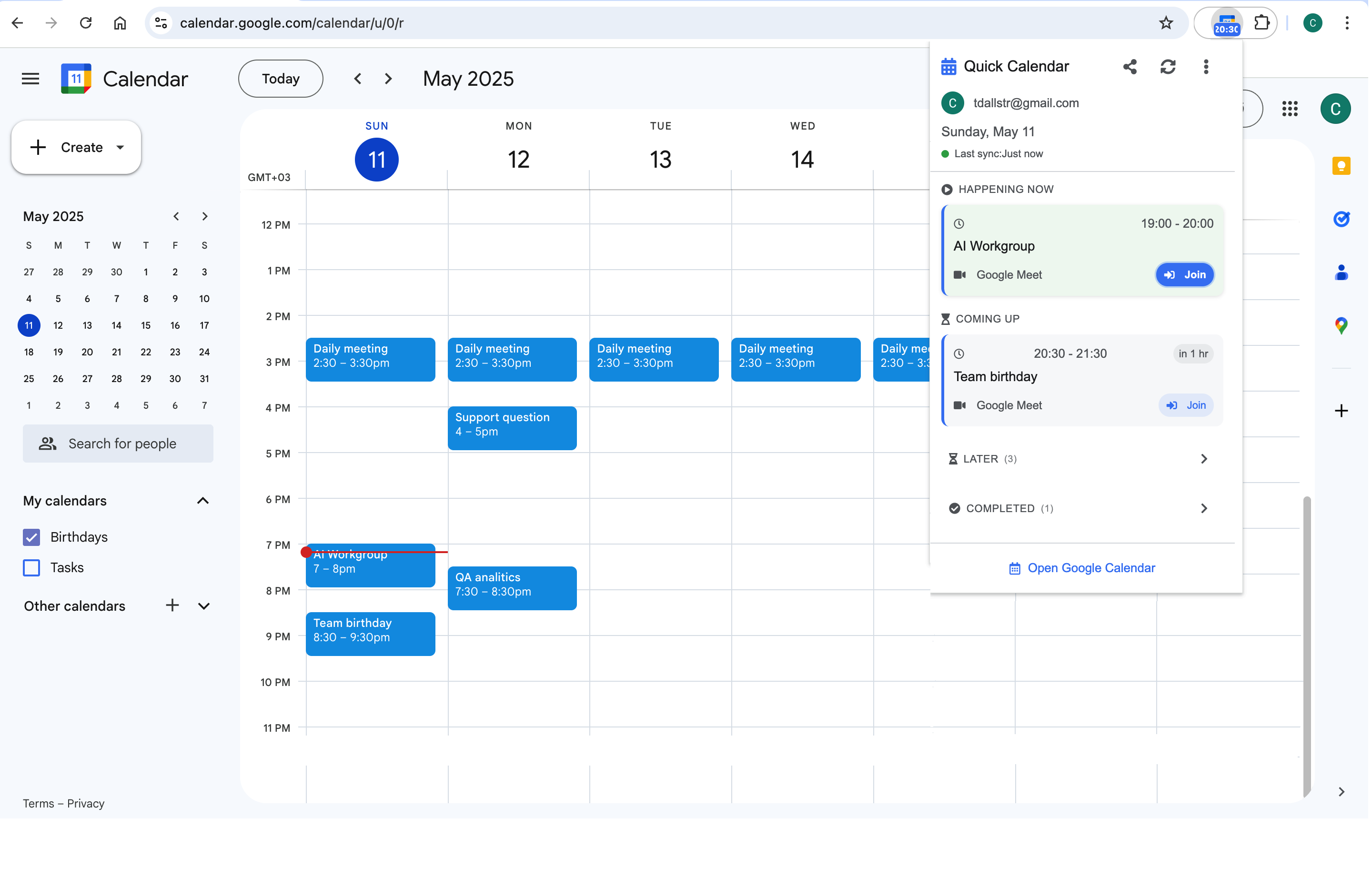
Schedule Calendar puts the answer in the toolbar. A quick glance shows the time until your next event and a compact day view without switching tabs. It does not create or manage blocks — it just makes monitoring your existing blocks lighter.
The goal of time blocking is not a perfect schedule. It is a schedule where the work that matters has a reserved slot — and that slot is honest about how long things actually take.
Frequently asked questions
Time blocking in Google Calendar means creating calendar events for specific tasks — not just meetings. Each block reserves a time slot for a piece of work, makes it visible alongside your other commitments, and makes it harder to schedule over accidentally.
Deep work blocks work best between 90 and 120 minutes. Shallow work batches (email, admin, reviews) fit well into 30–45 minute windows. The right length depends on your task type and how long you can maintain focus without a meaningful break.
No. Blocking 60–70% of your available hours is a more durable approach. The remaining time absorbs unexpected tasks, context switches, and recovery from disruptions. An over-blocked schedule breaks down the moment anything changes.
Set your focus blocks to Busy status in Google Calendar. This signals to anyone who can view your calendar that the time is taken. You can still choose to accept a meeting over a block, but the default will protect the space.
Time blocking reserves a slot for a task. Time boxing adds a strict time limit: you work on the task until the box ends, then stop regardless of progress. Time boxing is useful for tasks that tend to expand indefinitely; time blocking is more flexible about when you finish.
A compact calendar extension like Schedule Calendar helps with the ongoing monitoring of time blocks — checking how much time remains, whether a meeting is approaching, and whether you have room to start a new task. It does not create blocks, but it reduces the tab-switching cost of staying aware of your schedule.