Two tools, two different questions
A to-do list answers "what needs doing?" — it is a memory system, and a good one: capture is instant, reordering is free, nothing gets lost. A time block answers "when will this actually happen?" — it is a budgeting system, and the budget is the part lists can’t do. A list happily holds 40 hours of tasks for a day that contains six; the calendar is where that fiction goes to die.
This is why "list vs. blocks" is the wrong fight. Deleting your list makes the calendar do memory work (it’s bad at it — tasks become fake 30-minute events you drag forward for weeks). Deleting your blocks makes the list do budget work (it’s worse at it — everything is priority one until 16:45).
The handoff: five items earn time
The system that survives contact with a real week is a nightly handoff from list to calendar:
- Capture everything to the list, all day. Zero discipline required — the list’s job is to be a safe dumping ground so your head doesn’t have to hold anything.
- At day’s end, pick at most five items for tomorrow. Not the five oldest — the five that matter. The other thirty stay on the list, unjudged.
- Give the top two real calendar blocks, sized honestly (estimate +25%), placed in your best hours. These are commitments now, not intentions.
- Batch the remaining three into one "small tasks" block after lunch — they share a slot because they don’t deserve individual ones.
- Anything that misses its block goes back to the list — not to tomorrow’s calendar. Rolling unfinished blocks forward automatically is how calendars rot into lists.
The whole handoff takes about ten minutes, and step 5 is the load-bearing rule: the calendar stays a plan you believe, because failures return to the memory system instead of accumulating in the budget.
When the list should win
Days with fewer than two hours of unclaimed time — heavy meeting days — are list days. Blocking three scraps of twenty minutes creates schedule-babysitting overhead that costs more than it protects; keep a three-item list next to the meetings and use gaps opportunistically. The same is true for roles that are genuinely interrupt-driven (support rotations, on-call): the calendar can hold the anchors, but the minute-to-minute belongs to a triage list.
When blocks should win
Any task you have rewritten onto three consecutive daily lists is announcing that it will never volunteer to happen. Deadline-critical work, creative work that needs a warm-up runway, and anything you are avoiding — these get calendar time precisely because the list has proven it cannot make them real.
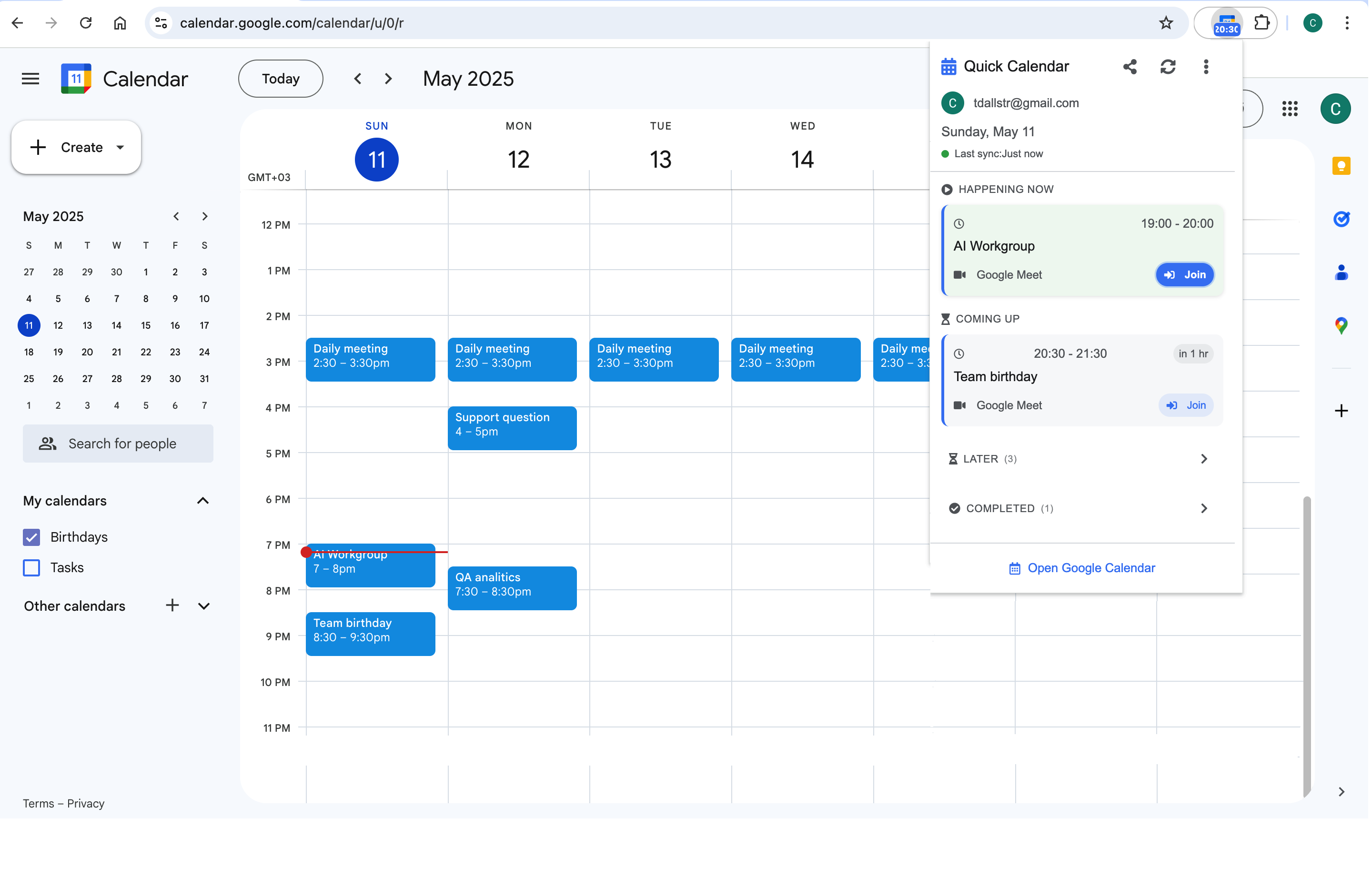
The handoff system runs on one glance: "how much unclaimed time does tomorrow actually have?" That is the question a toolbar calendar like Calendar Extension for Google Calendar™ answers in two seconds at the end of the day — the timeline shows the gaps, and the five-item pick sizes itself to reality.
Frequently asked questions
Five is a ceiling, not a target — two committed blocks plus a batched shallow-work slot. Three works fine on meeting-heavy days. Ten stops being a selection at all: if everything from the list moves to the day, you have just rewritten the list with extra steps.
It removes friction — Tasks appear in a side panel and can be dragged onto the grid, which is literally the handoff. The caution: dragging is so easy that unfinished tasks get rolled forward instead of returned to the list. Keep step 5 manual and deliberate.
Never individually. Sub-15-minute tasks either happen immediately when captured (if the context allows) or go to the batched block. A calendar with nine 10-minute events is noise wearing a system’s clothes.
Resist the reflex. Finishing early is the system working, not slack to be filled — use the margin for the walk, the water, the code review you owe. Pulling work forward on every early finish teaches your estimates to stay padded.