Size from entry cost, not availability
Deep work has a fixed entry toll: loading the problem state into your head — 10–20 minutes for most state-heavy work (code, writing, analysis). That toll is why session length is not linear: a 45-minute block yields ~25 productive minutes; a 90-minute block yields ~70; a 3-hour block yields diminishing returns as focus decays past two hours. The sweet spot for most practitioners: 90–120 minutes, one to two per day maximum — deep work capacity is 3–4 hours daily even for the trained, and calendars pretending otherwise produce decoration, not output.
The entry ramp (first 10 minutes, scripted)
Sessions die at the start — the blank first minute is where the inbox reflex strikes. Script it away: the block’s description carries tomorrow-you’s instruction, written the evening before ("Continue §3 from the pricing table; outline is done"). The opening sequence is then mechanical: close the channels (status set, notifications shushed — Focus time does this on Workspace), open the named artifact, re-read yesterday’s last paragraph, begin. Ramps beat willpower because they remove the decision the willpower was for.
One problem per block
The block holds one named deliverable — "Draft §3", "Fix the pagination bug", never "work on the project". Two reasons beyond focus hygiene: a single target makes the entry ramp writable (you can only leave instructions for a specific task), and it makes the session auditable — the block either produced §3 or it didn’t, which is the data your weekly planning runs on. Multi-goal blocks produce the worst outcome: busy sessions with nothing attributable.
The exit ramp (last 10 minutes, the part everyone skips)
Hard-stopping mid-thought poisons the next session’s entry. The last ten minutes are the ramp down: write the "next three moves" note into tomorrow’s block (this halves tomorrow’s entry toll), capture any loose threads to the task list, and stop at a downhill point — mid-section with known next steps, not at a completed unit. Hemingway’s trick, and it survives because it works: sessions that end downhill restart themselves.
Protecting the interior
Two interior rules keep 90 minutes actually deep. The parking lot: intrusions ("email Dana", "check the metrics") get four seconds — written to a capture note — and released; the alternative is each intrusion becoming a ten-minute excursion. The one-breach policy: if something truly urgent lands, the session ends honestly (note the state, exit by the ramp) rather than degrading into half-attention. A cleanly ended 50-minute session beats a contaminated 90 every time — and the block’s remaining time becomes visible recovery.
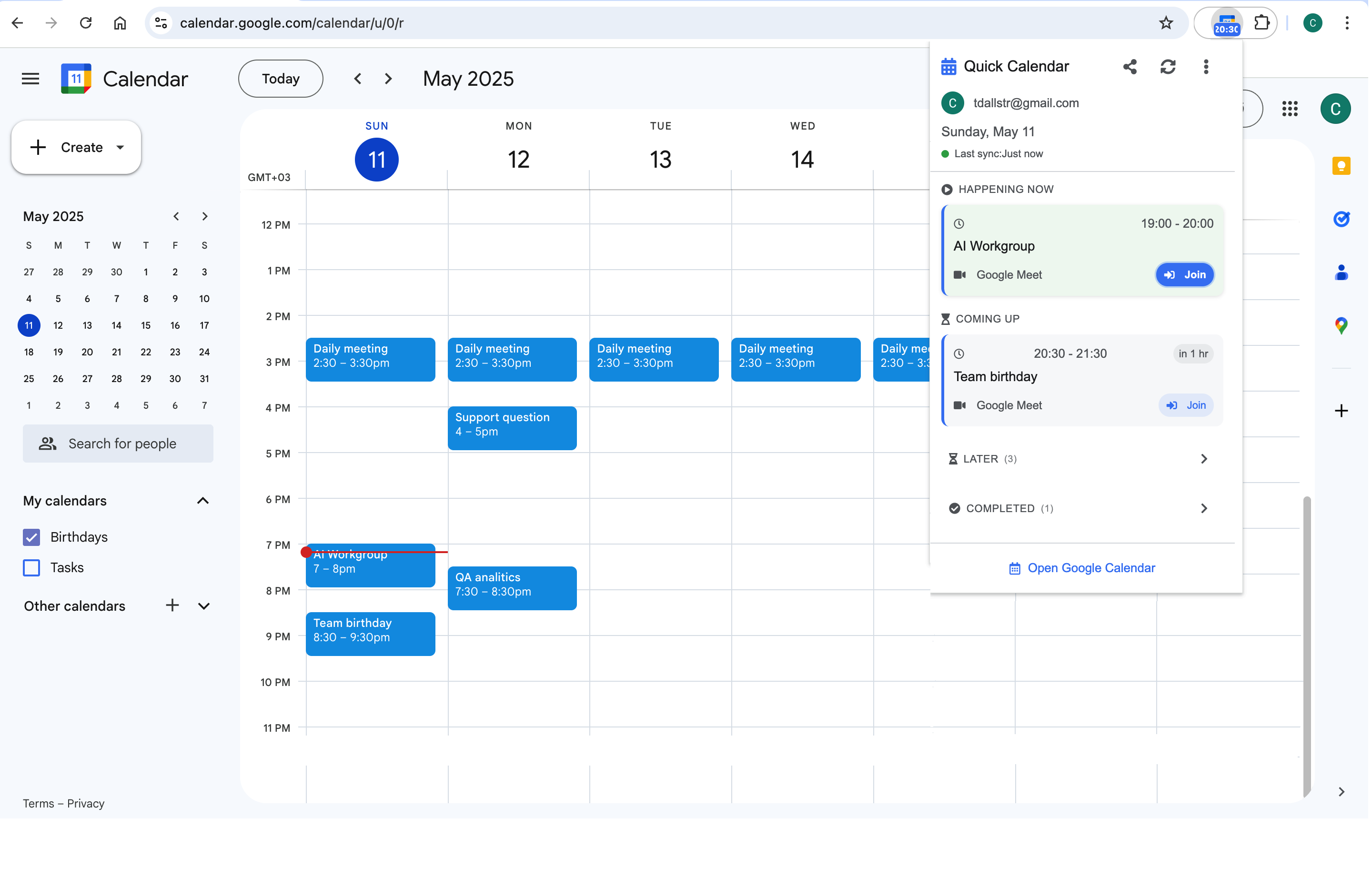
Session discipline runs on one ambient number: minutes remaining. Glancing at a clock breaks nothing; opening a calendar tab to check breaks everything. The time-to-event chip in Calendar Extension for Google Calendar™ keeps "the block ends in 25" in the toolbar corner — the exit ramp starts itself on time, and the 11:00 meeting stops ambushing your best work.
Frequently asked questions
It matters exactly as much as your energy curve says: most people hold a 2–3 hour morning peak where deep work is 30% cheaper, a real minority peak late. Two weeks of logging beats any default — then place blocks in your peak and defend that placement specifically.
Bank it, don’t backfill: run the exit ramp early (next-moves note, downhill setup for the next named problem) and take the surplus as recovery or gap-list work. Grabbing a second deep problem mid-block pays a second entry toll for a fragment — the economics rarely work.
For most, two or three — a daily double is elite-athlete territory that survives only with unusual control over meetings and evenings. The audit is output-per-block over a month: when doubles produce less than singles did, you found your ceiling and overshot it.
They raise the entry-toll stakes, which argues for the structure: the household treaty (visible block = headphones = interruptible only for the agreed list), the parking-lot note for your own domestic intrusions, and honest one-breach endings. WFH deep work fails as vibes and works as protocol.