What a to-do list does well
A to-do list is a capture tool. It holds everything that needs to happen without requiring you to decide when. This is its strength: low friction to add items, clear view of what is outstanding, simple prioritization by moving items up or down.
The weakness appears during the day. A to-do list tells you what needs doing but not when you have time to do it, how long each item takes relative to your available windows, or whether your actual calendar leaves any realistic room for the work.
What time blocking does well
A calendar block gives a task a home in time. It answers the question: not just what needs to happen, but when and for how long. A block makes the work visible alongside meetings, which reveals whether there is actually room in the day to do what is on the list.
The weakness: maintaining a tightly blocked calendar takes effort. Items you did not anticipate displace blocks. And blocking every task can create rigidity that makes the week feel more stressful, not less.
The insight: use a to-do list to capture everything, and use calendar blocks to decide which items will actually happen this week. The list is infinite; the calendar is finite. Putting tasks on the calendar forces you to make real tradeoffs.
A practical combined system
Weekly: turn the list into calendar blocks
Once a week, review your task list and block time for the items that must happen. Not every item needs a block — only the ones that require focused work or have a deadline. Meetings take care of themselves; deep tasks need explicit blocks.
Daily: use the list within the block
Within a work block, use the task list as your queue. You have a 90-minute window for project work — the list tells you what to work on, in what order. The calendar determines when you are working; the list determines what you are working on.
End of day: sync what moved
At the end of the day, note which tasks you did not finish and whether they need a new block or can slide to the list's next review. This prevents the list from silently growing while the calendar looks clear.
When to reach for each tool
Use the to-do list when something needs capturing immediately, when you are brainstorming without knowing timing, or when a task is small enough to do in under five minutes whenever a gap appears.
Use a calendar block when a task requires sustained attention, has a deadline that affects sequencing, or tends to get crowded out by the day's reactive demands. If a task has lived on your to-do list for more than a week without happening, it probably needs a block.
How Schedule Calendar helps
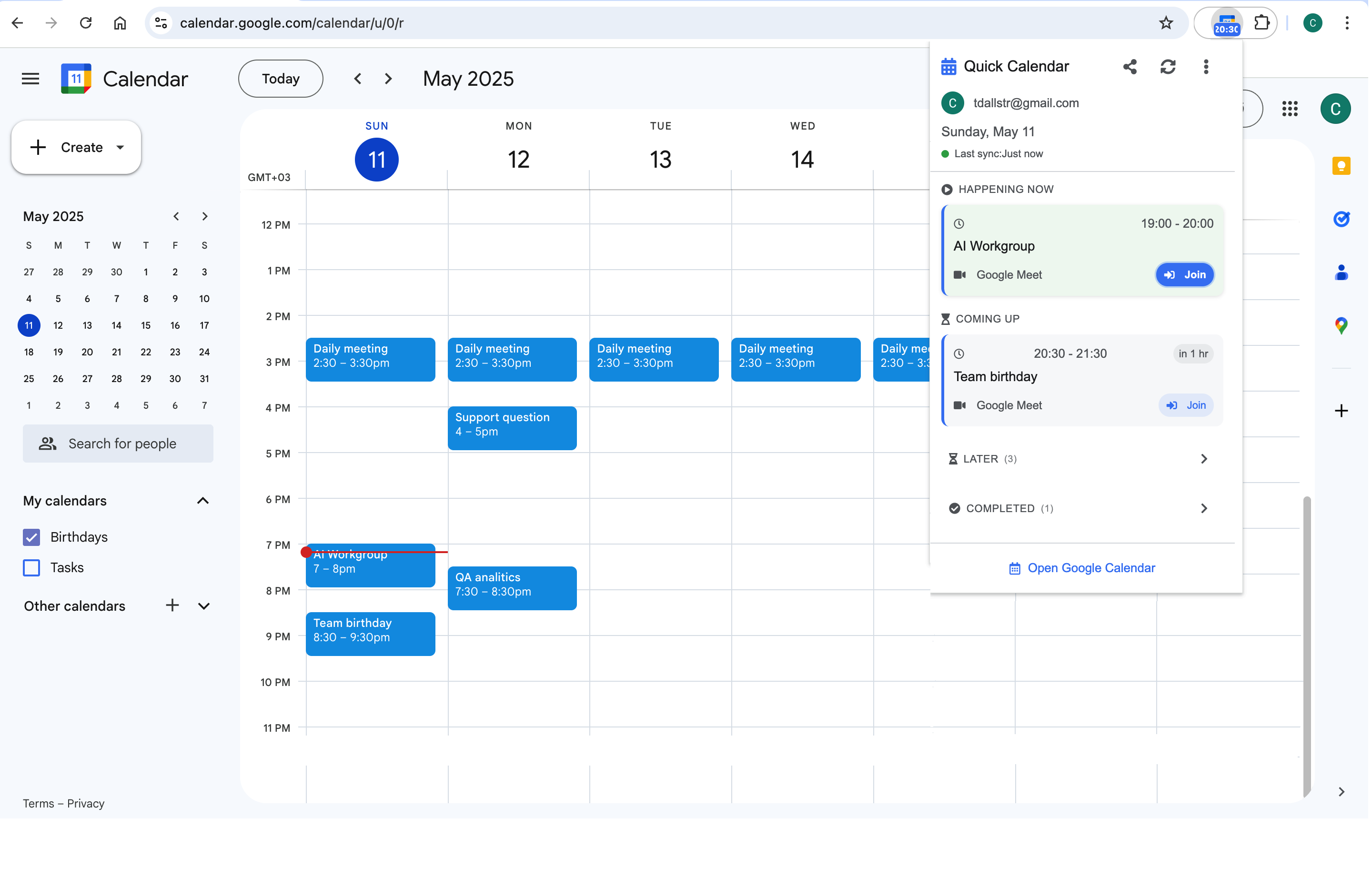
One friction point in this system is checking how much time is left in a block while you are working from the task list. Opening Google Calendar to see your schedule means switching context from the task at hand.
Schedule Calendar shows the time until your next event in the toolbar. You can glance at the remaining block time and decide whether to start the next task or wrap up the current one — without leaving your work.
Neither tool alone is sufficient. The list holds everything; the calendar decides what actually happens. When they work together, the planning system is both flexible and honest about available time.
Frequently asked questions
Both, for different purposes. A to-do list captures everything that needs to happen without requiring timing decisions. A calendar block assigns specific time slots to the work that matters most. The most effective system uses both: the list holds everything, the calendar decides what happens this week.
A to-do list is infinite — it can hold any number of items. A calendar is finite — it shows you exactly how many hours you have. Time blocking forces you to confront whether the work on your list can actually fit into your week, given your meetings and other commitments.
No. Time blocking determines when tasks happen; a to-do list determines what happens within each block. Trying to put every task directly on the calendar, with no list, usually results in an overcrowded, rigid schedule that breaks down when anything changes.
Once a week, review your task list and create calendar blocks for items that require focused work. During each block, use the task list to decide what to work on and in what order. At day's end, note which tasks were not completed and whether they need a new block or can wait for next week's review.
That is the value of combining both systems. When you try to put all your tasks on the calendar and run out of time, you have discovered a real constraint. The answer is to prioritize — which tasks must happen this week, and which can wait — rather than trying to fit everything.
A compact calendar extension helps with the monitoring side — seeing how much time remains in a block and whether a new task will fit before the next meeting. It keeps you oriented within your schedule without requiring a full tab switch every time you need a quick check.