Templates are starting points, not uniforms
Every template below follows the same grammar — anchors first, one or two production blocks in peak hours, shallow work batched in the trough, buffers at the seams, 30–40% unblocked — but distributes it differently per job reality. Pick the nearest, run it two weeks, then let your actual-vs-planned data reshape it. The template you end with should look about 70% like the one you started with.
Template 1 · The Maker (engineer, writer, analyst)
8:30–10:30 Production block #1 (the hard thing) · 10:30–10:45 buffer · 10:45–11:15 shallow batch #1 (unblock others) · 11:15–12:45 Production block #2 · 12:45–13:30 lunch, real · 13:30–15:00 meeting zone (steer them here) · 15:00–15:45 shallow batch #2 · 15:45–17:00 flex: overflow, review, or gap list · 17:00–17:05 daily close.
The signature move: meetings live in one afternoon zone. Makers who let meetings scatter pay the entry toll on every fragment; the zone is worth actively negotiating recurring meetings into.
Template 2 · The Manager-Hybrid (leads, PMs)
8:30–9:00 daily prep + inbox pass (your reports need answers early) · 9:00–11:00 meeting zone #1 (1:1s batched) · 11:00–11:15 buffer · 11:15–12:30 Production block (the one, guard it fiercely) · 13:30–15:30 meeting zone #2 · 15:30–16:00 buffer + notes consolidation · 16:00–17:00 shallow batch + tomorrow’s close.
The signature move: one production block, defended absolutely, beats three defended weakly. Manager calendars can’t win volume; they can win reliability — and batched 1:1s with buffers beat scattered ones for both sides.
Template 3 · The Reactive (support, ops, on-call)
9:00–9:30 queue triage · 9:30–11:00 reactive window (the job itself) · 11:00–11:45 Production block — during the statistically quietest stretch, sized to survive one interruption · 11:45–13:00 reactive · 14:00–14:30 shallow/admin batch · 14:30–16:30 reactive · 16:30–17:00 handoff notes + close.
The signature move: reactive roles block the exceptions, not the day — one modest production slot placed by interrupt-frequency data, everything else left honestly open. Pretending a reactive day is a maker day produces guilt, not focus.
Template 4 · The Creative-Practice (design, content, research)
9:00–9:30 warm-up ritual (inputs, sketchbook, reading — scheduled, because "warming up" otherwise eats the morning) · 9:30–12:00 deep practice block, one project, phone elsewhere · 13:00–14:00 meetings/feedback zone · 14:00–15:30 second practice block or production admin, alternating days · 15:30–17:00 shallow + collection (references, notes for tomorrow’s warm-up).
The signature move: the warm-up is scheduled and bounded — creative blocks fail at entry more than anywhere, and a ritualized 30-minute ramp beats waiting for readiness.
Adapting without breaking the grammar
Change slots freely; preserve four invariants: production blocks sit in your peak (move them if you’re evening-peaked), density never exceeds 70%, every meeting cluster ends in a buffer, and the daily close survives every variant. When a template chronically fails in the same place — the 11:15 block always dies — the data is telling you which reality (meetings, energy, interrupts) the next iteration must respect.
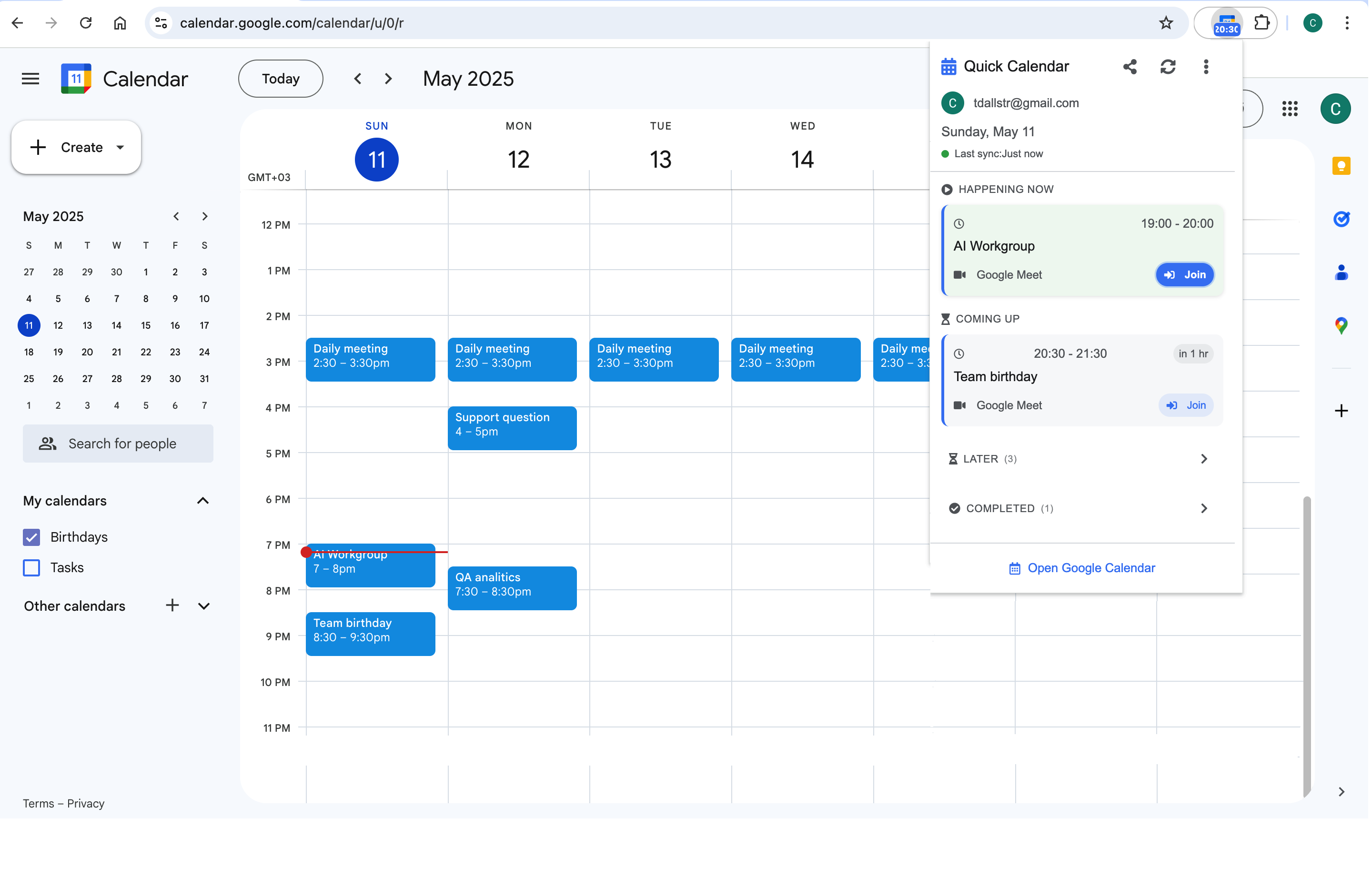
Whichever template you run, its moment-to-moment interface is the same question: "what’s now, what’s next, how long?" A toolbar strip like Calendar Extension for Google Calendar™ answers it in one glance — templates set the day’s shape; the glance keeps you inside it.
Frequently asked questions
That is often the correct design, not a compromise: batch meeting-heavy duties onto two days (manager template) and protect the others (maker template). The grammar invariants hold per-day; the week-level pattern is yours to architect.
Shift the meeting zones onto the overlap window and anchor production blocks in your non-overlap hours — the maker template with zones at 16:00–18:00 is the classic Europe-with-US shape. The overlap is scarce coordination fuel; spending it on solo work is the template fighting the job.
Empty days are where templates earn their keep — without one, open days dissolve into ambient shallow work. Run the template as printed, and treat the empty meeting zones as bonus production or genuine recovery, decided at the morning look, not drifted into.
Split literally by the rotation clock: reactive template during rotation hours, maker template outside them, with a hard 15-minute buffer at the boundary (the switch between modes is the day’s most expensive transition). Mixed roles fail on blurred boundaries more than on either mode.