What changes when the office disappears
In an office, a colleague at a desk with headphones is visibly working; interruption has a social cost. Remote, your state is invisible — so the calendar inherits the signaling job on top of the planning job. Every block you place is now doing double duty: organizing your attention and broadcasting your availability to people who can no longer see you. Remote blocking that ignores the broadcast half gets interrupted exactly as if the blocks weren’t there — because, to everyone else, they aren’t.
Blocks as broadcast: the visibility rules
- Detail-visible to your team: "Deep work — migration plan" tells colleagues what the block protects and trains their judgment about interrupting. Free/busy-only teams interrupt blindly; that is a sharing-tier decision, not a discipline problem.
- Status sync on: Slack/Teams pulling calendar state ("In focus time until 11:00") moves the signal to where interruptions originate. The ping that waits an hour because your status explained itself is the system working invisibly.
- Availability windows, published: the remote-specific structure — two or three standing "reachable" slots ("11:00–12:00, 15:00–16:30 most days") in your team’s knowledge. Predictable openness is what buys unpredictable-looking focus blocks their legitimacy.
The home front is a stakeholder
Remote blocks have a second audience with zero calendar access: the household. Two mechanics extend the system: a shared family calendar for both sides’ immovables (their appointments block your placement too — that symmetry is the treaty), and a physical signal bound to calendar state — headphones during blocks, door open otherwise. The failure mode this prevents is the one that poisons WFH focus most: the interruption that was reasonable because nothing said otherwise.
Edges: blocking the day’s frame, not just its middle
Office days end because buildings empty; remote days end because you scheduled the ending. Three frame-blocks matter more remotely than any production block: the synthetic commute (15 minutes before the first block and after the last — embodied, non-work, the state-change the drive used to force), the hard-edge anchor at day’s end (titled with the actual next thing: "Run", "Kitchen"), and lunch marked Busy — at home, unblocked lunch becomes eating over the keyboard within a fortnight. At home, the risk is boundary erosion more than workload; the frame-blocks are boundary infrastructure.
The async advantage (blocking’s remote-only payoff)
One genuine upside: remote-async cultures let you place production blocks in your true peak even when it is nobody else’s — the evening-peaked finally get their 17:00–19:00 sessions with morning compensation, legitimately. The discipline that keeps this healthy is compensation made visible (late block = late start, on the calendar) — otherwise flexible blocking silently becomes always-on, which is boundary erosion wearing autonomy’s clothes.
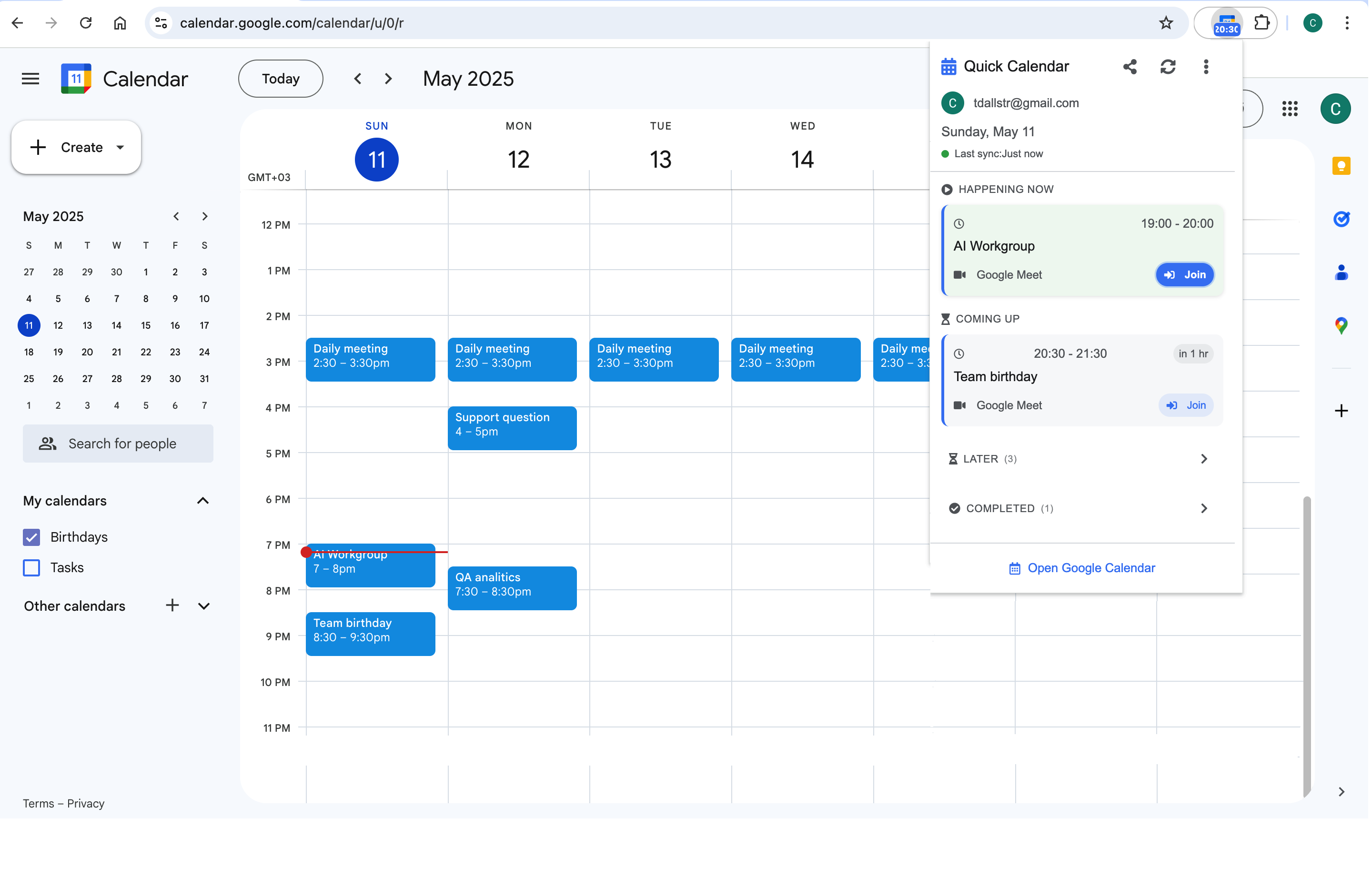
Remote blocking multiplies calendar-glances — status, next block, whether the household treaty’s window moved. Keeping the day strip one click away in the toolbar, via Calendar Extension for Google Calendar™, is what stops the glance-count from becoming tab-count; the system’s interface stays two seconds wide.
Frequently asked questions
Anchor them to the team’s overlap core (usually 2–3 hours) and publish your remainder as async-response time with an SLA ("non-overlap pings answered by your next morning"). The window’s value is predictability, not quantity — one reliable hour beats four theoretical ones.
Same parking-lot mechanics, different politics: agreed-urgent gets the one-breach honest ending; everything else gets "at 11:00" with the block’s end time visible on the shared signal. What doesn’t work is unilateral fortress rules — the treaty is negotiated or it is fiction.
Attribution, proactively: block titles that name deliverables, and a weekly one-line summary ("Tuesday/Thursday blocks produced the pricing model"). Presence-anxious managers are soothed by output trails faster than by arguments about deep work — receipts beat philosophy.
More — async removes even the meeting-skeleton that gave days shape. The template inverts: blocks provide all the structure (production, shallow batches, edges), and the discipline problem shifts from defending blocks against others to honoring them without witnesses. The frame-blocks become the whole frame.