Mistake 1 · Blocking 100% of the day
The tell: your calendar looks like a completed Tetris board by 8:00 Monday, and by 10:30 one overrun has cascaded through everything downstream — so you abandon the whole plan by lunch.
Why it happens: the planning brain treats empty space as waste. But interruptions, overruns, and genuine emergencies are not exceptions — they are a third of every knowledge-work day, statistically.
The fix: block at 60–70% density, deliberately. Two production blocks, one shallow batch, buffers after anything long — and visible empty space that absorbs reality. The empty space is the system working, not the system failing.
Mistake 2 · Estimating with your best-case self
The tell: tasks routinely burst their blocks; "write report — 1 hour" becomes two and a half; you feel behind by mid-morning every day.
The fix: the +25% multiplier applied at scheduling time, no exceptions — and for task types with a track record of bursting (anything creative, anything involving other people’s input), +50%. Two weeks of comparing block-size to actual-time calibrates you faster than any advice; the calendar’s own history is the dataset.
Mistake 3 · Blocks with vague names
The tell: a block titled "Marketing" or "Deep work" arrives, and its first fifteen minutes get spent deciding what to actually do — or worse, grazing email because nothing specific was owed.
The fix: name blocks by output, decided the evening before: "Draft pricing-page copy §1–2", not "Marketing". A block is a pre-made decision; a vaguely named block is a decision deferred to the moment of lowest willpower.
Mistake 4 · Rolling failed blocks forward automatically
The tell: the same block has been dragged to tomorrow four days straight; the calendar has quietly become a guilt archive rather than a plan.
The fix: missed blocks return to the task list — never directly to tomorrow. Re-earning calendar space through the evening selection ("is this still one of tomorrow’s five?") is what keeps the calendar credible. And a block missed twice is diagnostic, not moral: the task is too vague, too big, or being avoided — split it, respec it, or timebox first contact with it.
Mistake 5 · Defending nothing
The tell: your blocks technically exist, but they’re marked Free, invisible to colleagues, or surrendered to the first invite that lands on them. Blocking becomes decorative — a diary of intentions other people overwrite.
The fix: blocks are commitments with the same rank as meetings: marked Busy, titled legibly for detail-level teammates, and defended with reschedule-with-alternative ("that’s deep work — 14:00 instead?"). One week of consistent defense re-trains most calendar cultures around one person.
The meta-pattern
All five mistakes share a root: treating the calendar as an aspiration board instead of a budget. Budgets have slack (M1), honest prices (M2), named line items (M3), no automatic rollover of overspend (M4), and enforcement (M5). Run the blocks like money and the method stops churning.
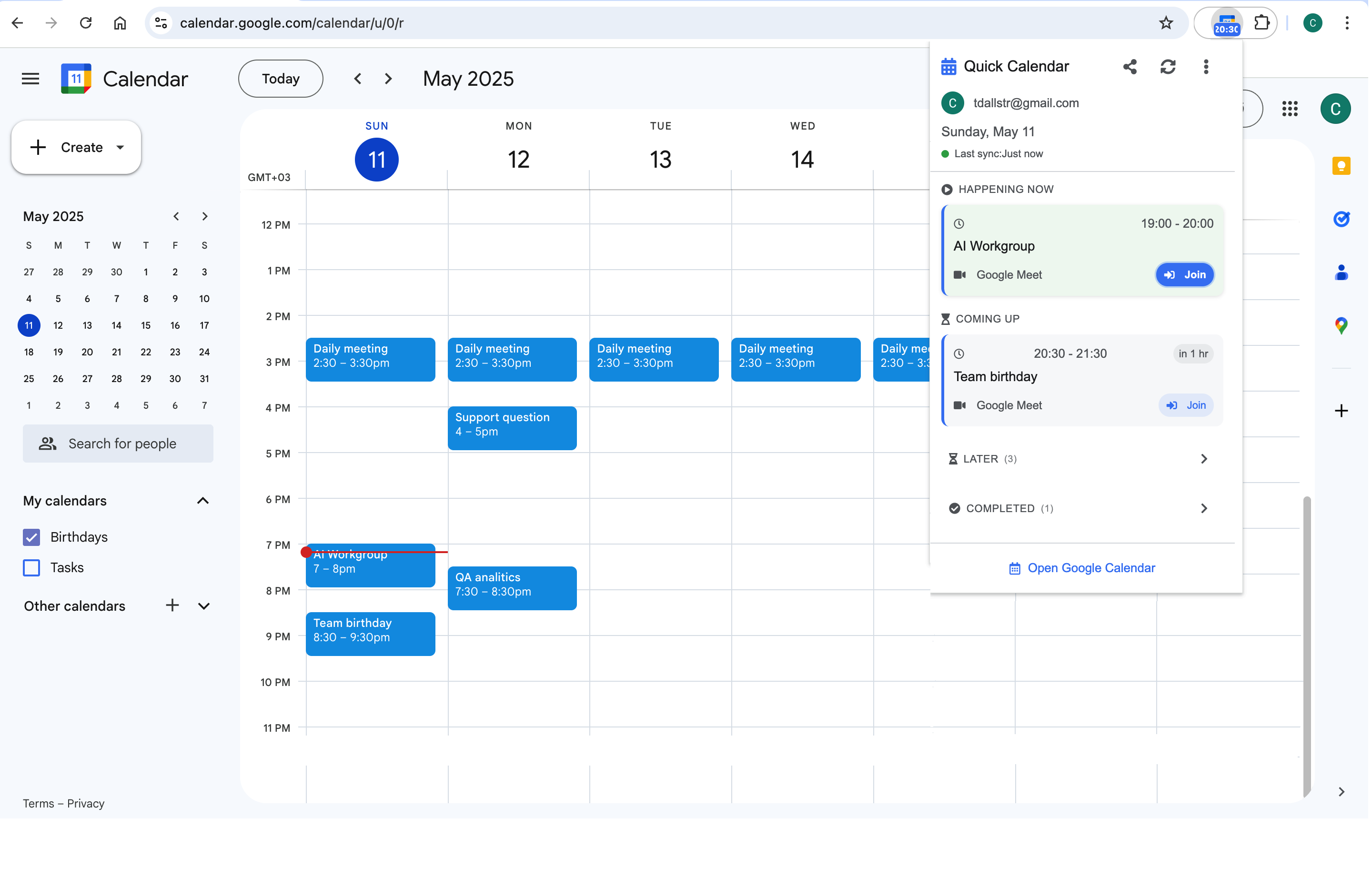
Mistakes 1 and 4 are caught by looking — density and repeated-drag patterns are visible at a glance. A toolbar timeline like Calendar Extension for Google Calendar™ makes today’s density readable in two seconds all day long, which is when there’s still time to un-cram it.
Frequently asked questions
Start with two 90-minute production blocks and one 45-minute shallow batch per day — nothing else. The classic beginner error is instrumenting the whole day on day one (Mistake 1 with enthusiasm). Add blocks only after two weeks of the minimal set holding.
The opposite: personal anchors are usually the right things to block, because they lose every unstructured negotiation with work. The mistake pattern to avoid is vagueness — "Gym 18:00" survives; "evening: life stuff" is Mistake 3 off the clock.
Lower than you think: with four meeting-hours, one 60–90 minute production block plus buffers is a full plan. Squeezing three blocks into the scraps between meetings is Mistake 1 in disguise — the scraps are recovery and shallow-work territory.
Mistakes 1–4 are entirely self-inflicted and self-fixable. Mistake 5 needs one behavior from you (Busy + reschedule-with-alternative), not permission from anyone — cultures adjust to consistently defended calendars faster than most people expect.