Planning vs. rehearsing: the line that matters
The difference is output. Planning produces decisions — blocks placed, fictions declined, a first-morning instruction written. Rehearsing produces feelings — the week experienced in advance, twice. The scan that opens week view and just… looks, is rehearsal: you live through the week’s stress before it starts, and the weekend pays for it. Every step below ends in an artifact, which is the test that keeps the routine honest.
The 20-minute sequence (finish by 19:00)
Minutes 0–5 · Collect, don’t browse
Three inputs onto one scratch note: this week’s leftovers worth carrying (from your task list, not memory), any new deadlines that landed Friday-after-you-stopped, and household immovables for the week (from the shared calendar or the person who holds them). Collection has a stop condition — three lists gathered — where browsing has none.
Minutes 5–10 · Choose the two rocks
From the collected pile: the two outcomes this week must produce, phrased as deliverables. Sunday adds one advantage Friday planning lacks — distance. Choices made away from the week’s noise skew strategic ("the proposal") over reactive ("reply to everything"). Use the distance; don’t re-derive Friday’s stress from memory.
Minutes 10–17 · Place and purge on the grid
Rocks get blocks (best hours, +25% sizing, Busy, output titles). Then one purge pass over the week: decline the known-skips tonight — organizers wake up Monday to notice instead of scramble — and repair the worst seam (a buffer after Tuesday’s cluster). Deliberately incomplete: Sunday places the skeleton; the daily closes do the fine-tuning inside the week.
Minutes 17–20 · The Monday note and the terminator
Write Monday’s first block instruction ("Start §3 — outline in doc, pricing table first"). Then the piece that makes Sunday routines survivable: an explicit finish. Close the laptop, say "planned", and do the next enjoyable weekend thing immediately. The terminator is what separates a 20-minute routine from an evening-long ambient dread session with a routine inside it.
The no-reopen rule
After the terminator, the calendar is closed until Monday. The urge to re-check at 21:30 is rehearsal wearing diligence’s clothes — and it undoes the routine’s entire benefit, because the week is already planned and the re-check can only add anticipation. If a genuinely forgotten thing surfaces, it goes on the task list note (phone, ten seconds), not into the calendar tonight.
Sunday vs. Friday — the honest comparison
Friday planning wins on logistics (colleagues can answer moves before Monday; the weekend starts clean) and remains the better default. Sunday wins for people whose Fridays are structurally unplannable — shift ends, client crunches, school runs — and for those who genuinely think better with distance. The failure mode isn’t choosing either day; it is doing neither and letting Monday plan itself, or doing Sunday’s version without the terminator and rehearsing instead.
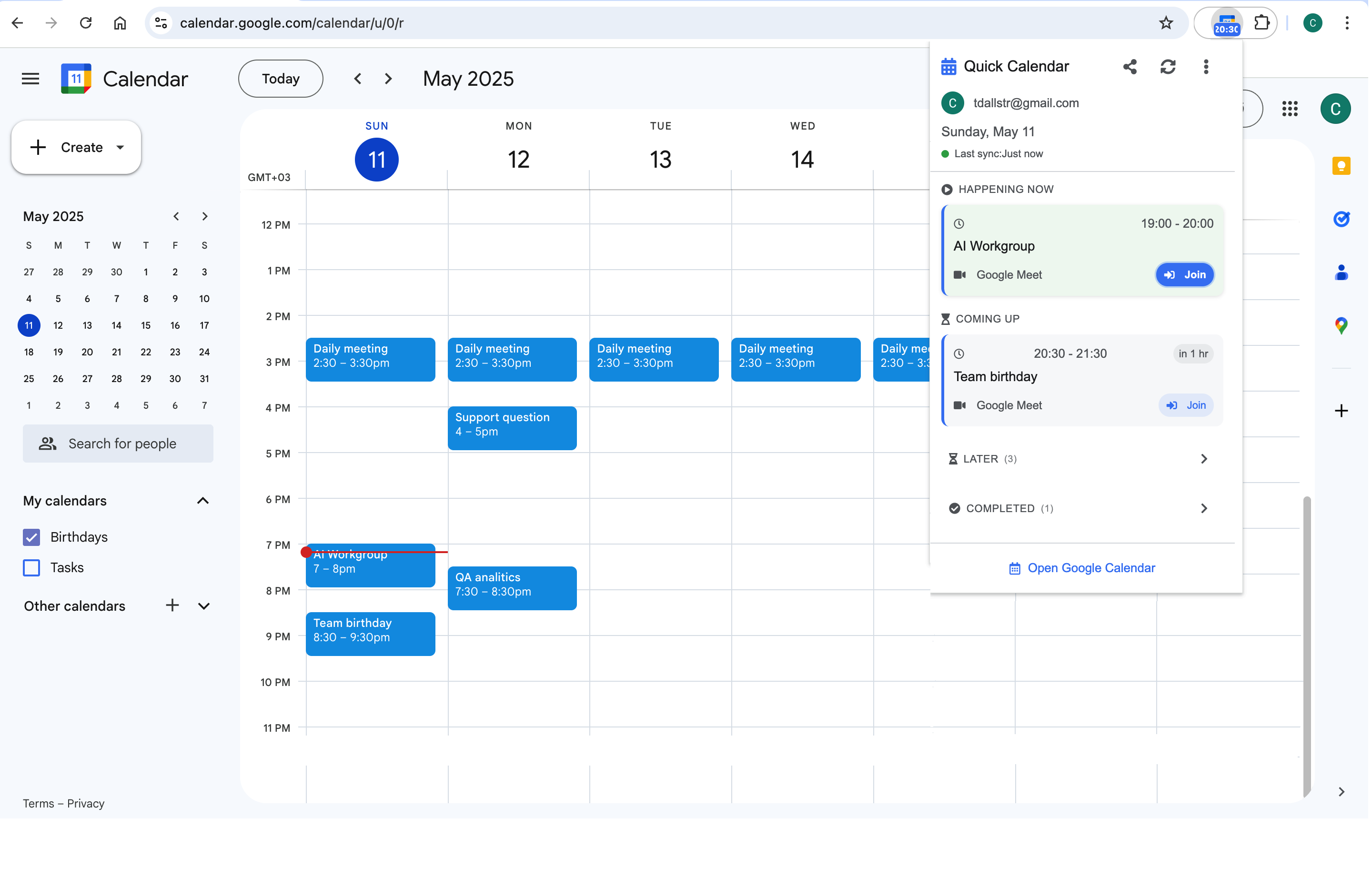
The no-reopen rule gets easier with a smaller door: if a Sunday-evening "when does Monday start?" twinge hits, a two-second toolbar glance via Calendar Extension for Google Calendar™ answers it without opening the week’s full wall — the difference between checking a fact and re-entering the rehearsal loop.
Frequently asked questions
Twenty bounded minutes that buy a calmer Monday is a trade many people take gladly — the violation is unbounded Sunday presence: the open laptop, the ambient scan, work re-colonizing the evening. The terminator and no-reopen rule are what keep the routine on the right side of that line. If even 20 minutes breeds dread, switch to Friday; the sequence is identical.
Stack them if they serve you, but sequence the calendar part first and keep its 20-minute budget separate. Lifestyle resets fail as monoliths — when the 2-hour version is impossible, everything gets skipped. Modular survives: calendar (20), then whatever else independently.
Planning with artifacts helps: naming rocks and placing blocks converts diffuse dread into specific, bounded problems. Rehearsing feeds it. The practical test mid-routine: are you producing decisions right now, or re-reading the same Tuesday? The moment it’s the latter, jump to the Monday note and terminate.
Include personal when it needs protecting: "book the flights" or "finish the tax filing" earns rock status and a block like anything else. The two-rock ceiling stays global though — four rocks across work and life is the same over-promising with better intentions.