Why Random Calendar Checking Costs More Than It Saves
Checking your calendar constantly — ten or fifteen times per day without a clear reason — creates a low-level anxiety that mirrors the experience of checking social media too often. Each check either confirms nothing has changed (relief) or surfaces something unexpected (stress). Neither outcome justifies the accumulated interruption to focused work.
Scheduled calendar checks at specific times give you the same information with a fraction of the interruption cost.
The Three Daily Calendar Checks
Morning Check: Set the Day
The morning check, ideally within the first 15 minutes of the workday, answers three questions: what is on my calendar today, when are my meetings, and do I have everything I need to be prepared? This sets the frame for the day and prevents the 'oh I forgot I had a call at 10' experience.
Midday Check: Adjust and Confirm
The midday check, around lunch or right after, answers: how is the day tracking against my morning plan, what is coming in the afternoon, and do I need to adjust anything? This is also the time to notice if a meeting was cancelled or moved and whether that creates unexpected open time.
End-of-Day Check: Close and Prepare
The end-of-day check answers: what did I actually accomplish, what is not done and needs to move, and what does tomorrow look like? This closes the day cleanly and prevents the morning check from being a stressful exercise in catching up.
If you rely on notification pop-ups instead of deliberate checks, you are letting your calendar dictate the timing of your attention rather than choosing it yourself. Both systems work — but deliberate checks give you more control.
Making the Checks Fast
Each check should take two to five minutes, not fifteen. The morning check is not a planning session — it is a confirmation. If you did a weekly planning ritual earlier (see our guide on building a weekly planning ritual), the morning check is mostly verifying that the plan still holds.
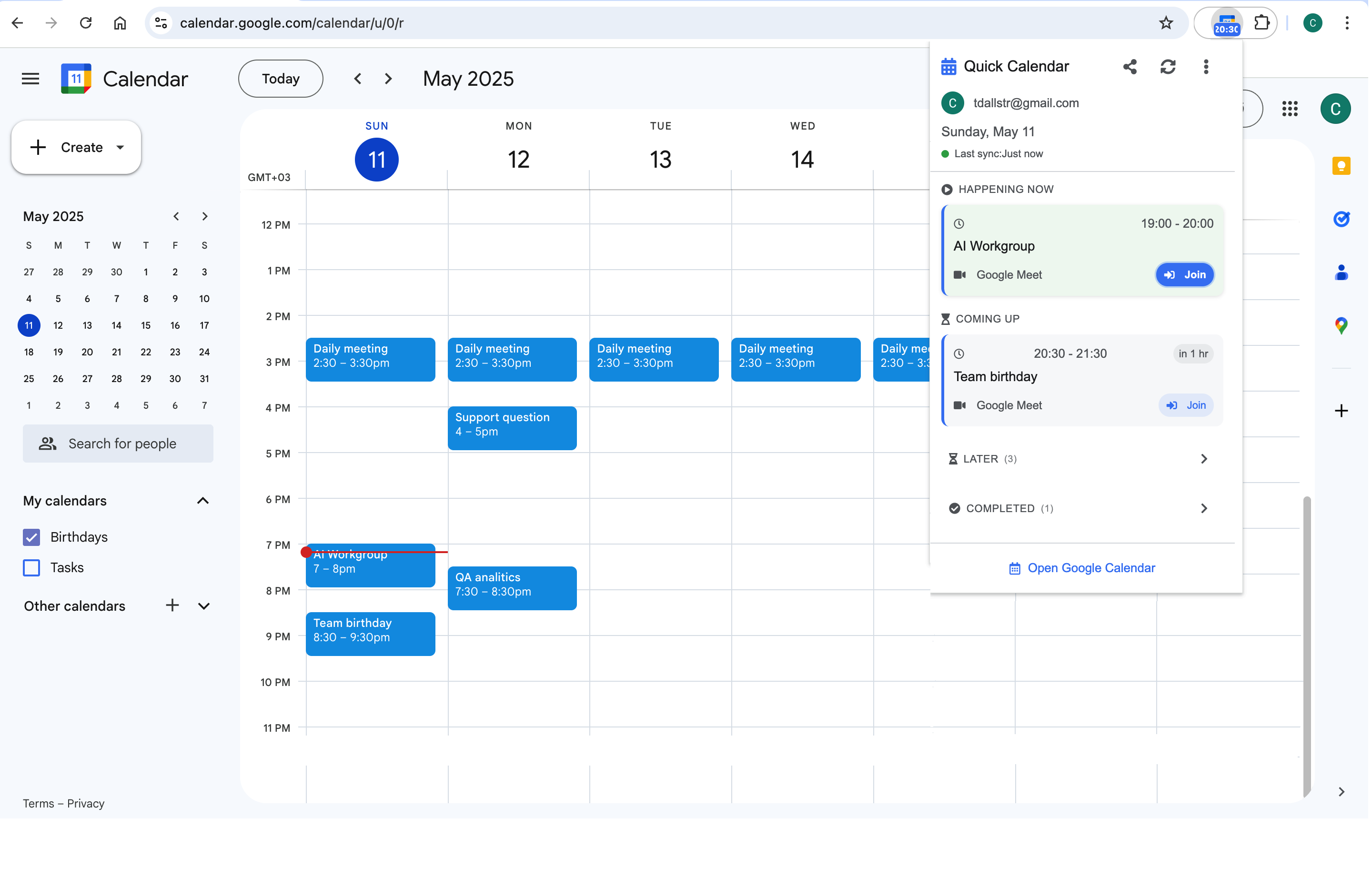
Schedule Calendar's toolbar popup makes the midday and end-of-day checks extremely fast — a click on the extension icon shows what is next without switching tabs or navigating to a different application.
How Schedule Calendar helps
Schedule Calendar turns the midday and end-of-day checks into a two-second glance. Click the toolbar icon, see what is left in the day and what is first tomorrow, and return to whatever you were working on. This makes the scheduled check habit nearly effortless to maintain — there is no switching cost significant enough to justify skipping it.
Frequently asked questions
Three deliberate checks — morning, midday, and end of day — are sufficient for most knowledge workers. Random checking throughout the day creates interruption costs without improving schedule awareness. If you have a specific reason to monitor the calendar more frequently, like a day with complex logistics, increase the frequency intentionally rather than habitually.
During a morning calendar check, confirm all events for the day, identify what preparation is needed for each meeting, note any gaps in the schedule you can use for focused work, and verify that nothing changed overnight. The goal is to arrive at the first meeting prepared and to have a clear mental map of how the day is structured.
Two to five minutes for each of the three daily checks. The morning check may be slightly longer on complex days. The midday and end-of-day checks should be very brief — scan the remainder of today and first events of tomorrow, note any changes, and return to work. If a check is regularly taking longer than five minutes, the calendar may need more upfront structure.
The end-of-day check should cover: what was accomplished today, what is incomplete and needs to carry to tomorrow, what is on tomorrow's calendar and whether preparation is needed, and whether any tasks or follow-ups from today's meetings need to be noted or scheduled. This closes the day with intention and reduces next-morning stress.
Frequent unscheduled calendar checks signal anxiety about schedule control rather than genuine need for information. The calendar rarely changes between checks, making most random checks low-value interruptions. Three scheduled checks per day provide the same information with far less accumulated distraction. If you find yourself checking more often, the root cause is usually notification habits or insufficient upfront planning.
Set three recurring calendar reminders — one for morning, one for midday, one for end of day — or tie each check to an existing habit like making coffee, eating lunch, and packing up. A recurring calendar event for the morning check is especially useful because it appears on the calendar and serves as both a reminder and a time reservation.