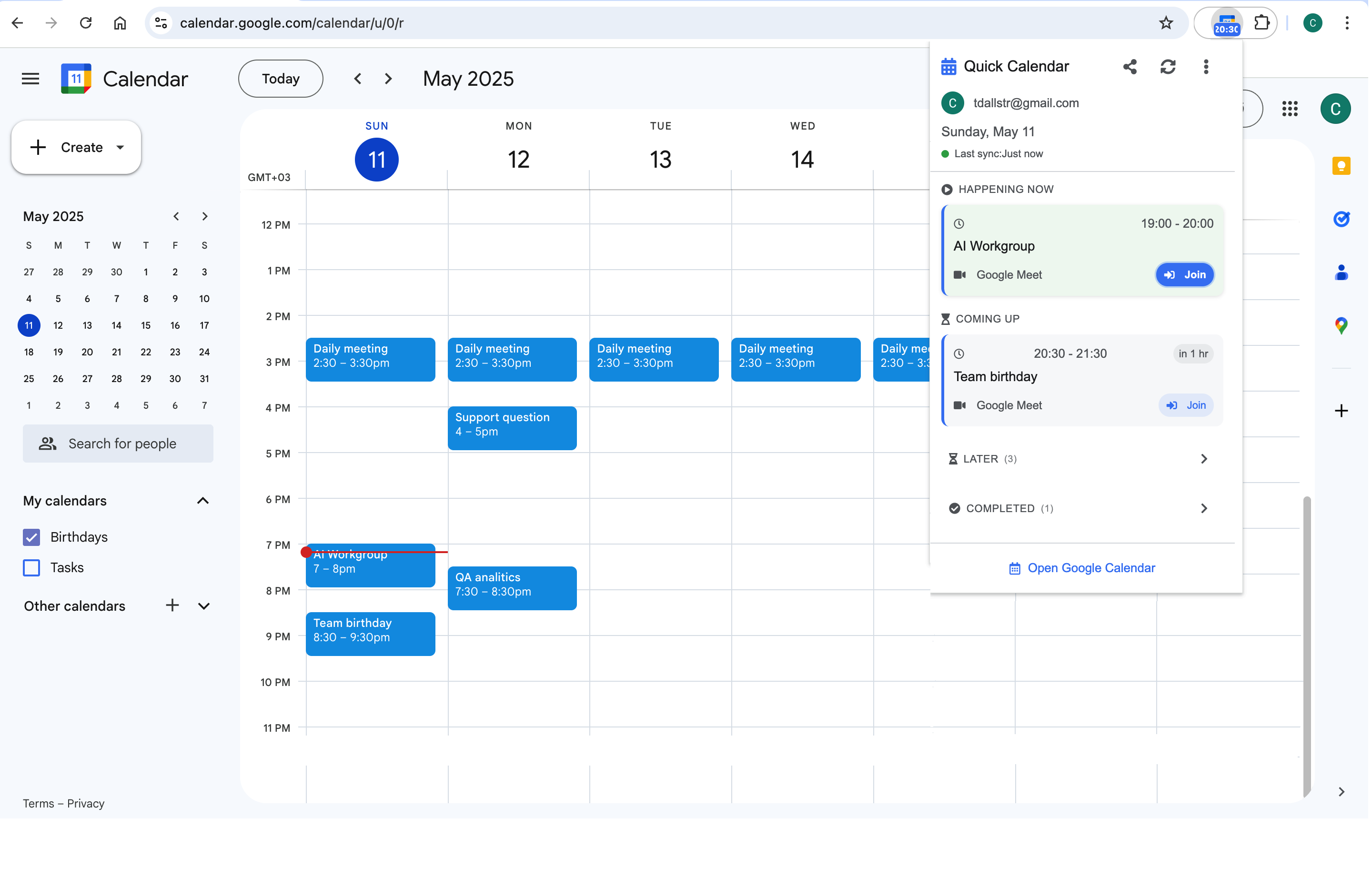
First, get the number
Overload hides in aggregate. Count last week’s meeting hours (Workspace users: Time Insights in the left sidebar does it automatically). Typical knowledge-work findings: 12–18 hours for individual contributors, 20–28 for managers. Write yours down — every fix below gets measured against it, and "felt lighter" is not a metric.
Source 1 · Meetings that shouldn’t exist (yours)
Start with the invites you send, because you control them outright. Apply the decision test to each standing meeting you own: if the last three instances produced status updates but no decisions, convert it — a shared doc updated by Thursday noon, comments async, meeting reserved for genuine conflicts. Teams typically find a quarter of their owned meetings convert cleanly, and cancelling your own meetings buys the credibility for everything below.
Source 2 · Meetings that shouldn’t include you
The silent-attendee audit: list meetings where you spoke under two minutes last time. For each, one move — downgrade to Optional-with-notes ("Notes cover me; ping if my part comes up"), send a delegate who is closer to the work, or exit the series with the standard note. This is the highest-yield pass: 2–4 hours a week for most people, at near-zero social cost, because audiences are never actually missed.
Source 3 · Meetings that run too long
Two settings and one habit. Settings: Speedy meetings (ends at :25/:50) and default duration 25 — length inertia now works for you. Habit: when accepting others’ hour-long invites where you own part of the agenda, counter-propose: "My part needs 10 — happy to join the first 15 if that helps you keep the hour." Partial attendance, normalized, cuts your hours without touching anyone’s meeting.
Source 4 · Meetings that recur past their purpose
The zombie audit, quarterly, fifteen minutes: for every recurring meeting, one question — what decision did this produce in the last month? Kill or shrink the silent ones (weekly → fortnightly halves cost with rarely any loss). Then install the prevention: every new series gets an eight-week end date, making renewal a decision instead of a default. Zombies are the only overload source that regrows automatically; the end-date rule is the only fix that fires automatically too.
Defend the reclaimed hours
Freed time gets recolonized within three weeks unless it is visibly occupied. Convert the wins immediately: the recovered Tuesday morning becomes a recurring Busy focus block titled with real work. And re-run the count monthly — if the number climbs two months straight, one of the four sources reopened, and the audit above tells you which.
Lighter weeks change the day’s texture — longer gaps, more room to actually use. A toolbar glance like Calendar Extension for Google Calendar™ makes the reclaimed structure legible in two seconds: what’s next, how big the gap is, whether there’s room for a real session before it.
Frequently asked questions
Bring the count, propose a trade: "I’m at 19 meeting-hours; to hit the Q3 deadline I need 6 back — which of these three am I safest to drop or half-attend?" Framing it as a resourcing decision with named candidates converts a complaint into a choice managers know how to make.
It is rapidly normalizing — but announce it at accept-time ("joining for the first 15 for my item"), not by vanishing mid-call. The rude version is the surprise exit; the professional version is a declared scope that organizers can plan around.
Keep the deadline, move the medium: same doc, updated by the same time the meeting would have met, with a named owner pinging gaps. Accountability lives in the deadline and the visibility, not in the synchronous hour — and conflicts that surface in comments get a 15-minute call, on demand.
No — it distinguishes seasons from defaults. A launch week at 25 hours is a season; three ordinary weeks at 25 is a default that crept. The monthly re-count is what tells the difference, which is exactly why the number matters more than the feeling.