The division of labor
Pomodoro has two layers that people conflate. The session — "90 minutes on the report this morning" — is a scheduling decision, and that belongs on the calendar where it blocks bookings and survives glances. The intervals — 25 on, 5 off, repeat — are execution rhythm, and they belong to a timer (phone, kitchen timer, tomato-shaped or otherwise). A calendar full of micro-events does the timer’s job badly and ruins the calendar’s legibility doing it.
Setup that takes five minutes
- Block sessions, not pomodoros. Create 60–120 minute focus blocks titled by outcome ("Draft §2 of proposal"), set to Busy. A 90-minute block holds three clean pomodoros (25+5 ×3); two hours holds four.
- Guard the block’s exit, not its interior. No notification at the block’s start (you planned it), one notification 10 minutes before whatever follows — the alert’s job is stopping pomodoro #4 from crashing into your 11:00.
- Run intervals on a real timer. Any countdown works. The only requirement: it is not a browser tab (tabs get buried; buried timers end sessions silently).
- Log honestly, lightly. After the block, edit the event description with one line: "3 poms, finished outline". Thirty seconds, and week view becomes a truthful record of focus capacity — the input your future planning actually needs.
Interval math by work type
25/5 is a default, not a law. The pattern that matters: interval length should match the cost of re-entering the task.
- Shallow, resumable work (email passes, admin, review queues): classic 25/5. Re-entry is free, so frequent breaks cost nothing and the box-pressure helps.
- Deep, state-heavy work (writing, debugging, design): 50/10 — the "double pomodoro". Loading the problem into your head takes 10–15 minutes; 25-minute slices spend half their length on re-entry.
- Dread work (the thing avoided for a week): 15/5 to start. The interval’s only job is making the first contact survivable; upgrade to 25s once you’re moving.
Where calendar-Pomodoro fails, and the honest fixes
Meetings shred the grid. A day with five scattered calls has no room for clean cycles — run single pomodoros in the 30-minute gaps (one 25/5 fits exactly) rather than mourning the lost rhythm. Interruptions void the pomodoro. Orthodox rule, worth keeping: a broken interval restarts rather than resumes, which is precisely what makes colleagues’ "quick questions" visible as costs. The technique fights flow. When the 25 ends mid-breakthrough, the doctrine says stop; experience says the doctrine is wrong for creative peaks. Finish the thought, skip the break, and treat it as evidence you have outgrown boxes for this task — that is what focus blocks without intervals are for.
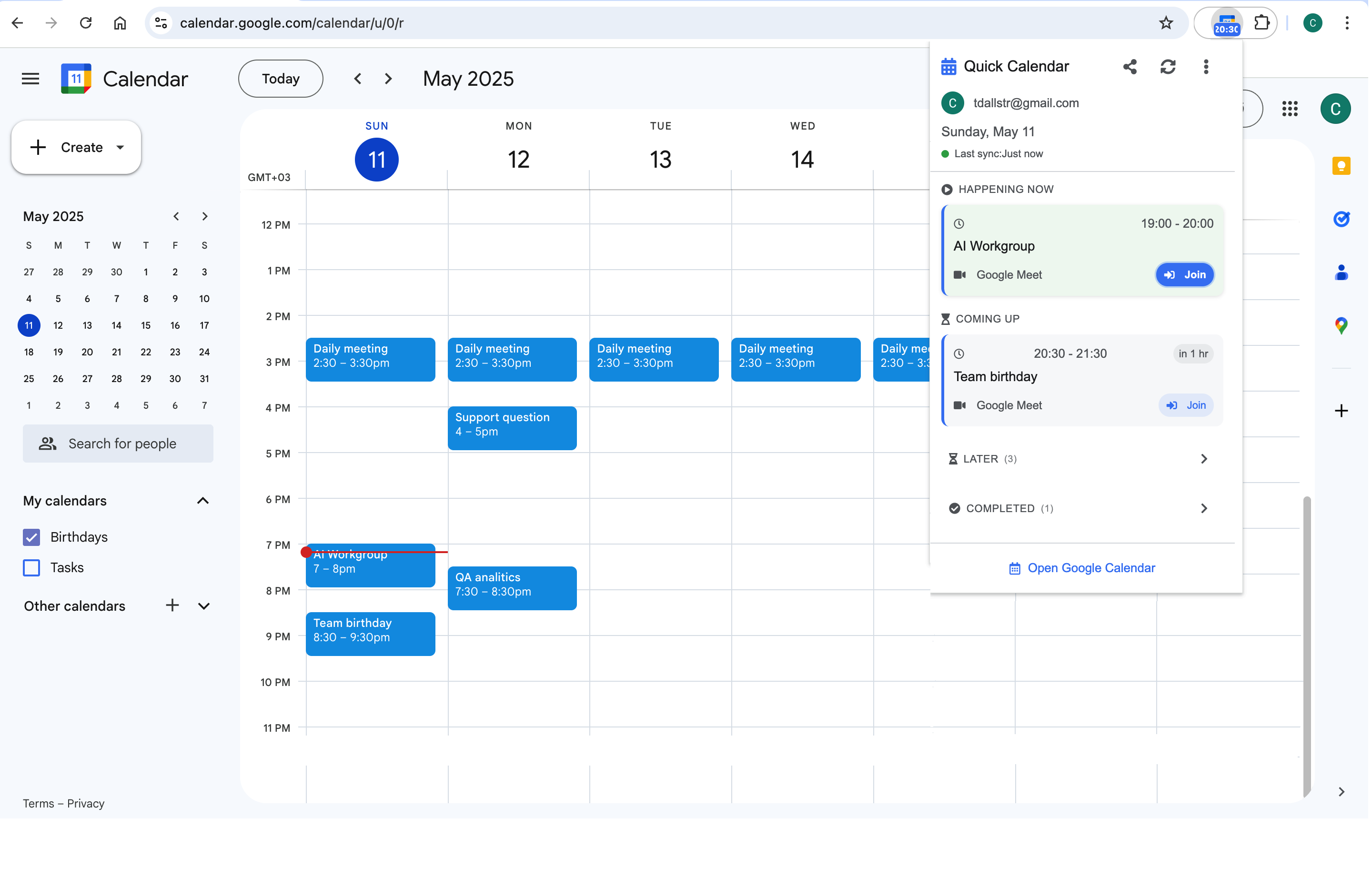
Between pomodoros, the recurring question is "do I have room for another cycle before the next commitment?" That is arithmetic against the clock — and a toolbar chip showing minutes-to-next-event, like Calendar Extension for Google Calendar™ provides, answers it in the five-minute break without opening anything that could eat the break.
Frequently asked questions
One: teaching yourself the practice for a week — seeing the 25/5 texture rendered can help it stick. Delete them after; as a permanent system, sixteen daily micro-events make week view unreadable and every schedule change a ten-edit chore.
The orthodox and still-best answer: an interval is complete only if uninterrupted; a real interruption restarts it. Two-second answers ("yes, ship it") can be absorbed with a note to yourself; anything requiring thought voids the interval — and logging the void is the data that justifies boundary-setting later.
The classic long break (15–30 minutes after four pomodoros) lands naturally between calendar blocks rather than inside them — schedule blocks of at most four cycles and let the seam be the long break. A 25-minute walk between two 2-hour blocks outperforms a heroic 4-hour block every time.
No — the tally’s value is measuring self-directed focus capacity. Meetings are externally structured time; counting them inflates the number that guides how much deep work you promise yourself tomorrow. Track them separately if you track them at all.