The three architectures
| A · Two accounts, cross-visible | B · One account, two calendars | C · Full merge | |
|---|---|---|---|
| Setup | Work and personal Google accounts; each sees the other as free/busy | One account with a second "Personal" calendar alongside the primary | Everything on the primary calendar |
| Privacy | Strongest — employer sees blocks, never titles | Good — separate sharing rules per calendar | Weakest — one sharing rule covers your whole life |
| Double-booking risk | Low, once cross-visibility is set up | Lowest — one "find a time" sees everything | Lowest |
| Main failure | Colleagues book over gym slots they cannot see — unless you mirror busy blocks | Personal data lives on an employer-owned account | Deleted with your work account when you leave |
| Best for | Corporate jobs, anything with compliance | Freelancers and founders who own the domain | Almost no one — listed for completeness |
Architecture A: two accounts that can see each other
The corporate-safe default. Two moves make it work:
- Share availability across accounts. From the personal account: Settings and sharing → Share with specific people → add your work address with See only free/busy. Your work "find a time" now routes meetings around your dentist without naming the dentist.
- Subscribe in both directions. In the work account, the personal calendar now appears under "Other calendars" — tick it so its blocks render in your week view. Repeat the mirror image on the personal side.
The residual failure: free/busy from an outside account is invisible to colleagues browsing your calendar directly (they see your work calendar, not your subscriptions). For standing personal commitments in work hours — the Tuesday school pickup — create a plain "Busy" event directly on the work calendar. Title it "Busy", nothing more; the block is the message.
Architecture B: one account, second calendar
If you own the account (your domain, your business), create the split inside it: left sidebar → + next to "Other calendars" → Create new calendar → "Personal". Route events by picking the calendar in the event editor; color the calendar distinctly and the work/life split becomes visible in week view at a squint.
What you gain over Architecture A: one account to run, zero cross-visibility setup, and scheduling tools see the whole picture natively. What you give up: if the account is employer-owned, your personal history is one offboarding away from deletion — this architecture is for people who control the domain.
Architecture C, and why it lingers
Everything on one calendar survives because it is zero-setup and double-booking-proof. It costs you the ability to share your calendar with anyone at any detail level — the moment a teammate needs "see all event details", they get your therapy schedule too. Event-level Private visibility can patch individual entries, but as a system, patching every personal event forever loses to spending ten minutes once on Architecture A or B.
Choosing in one question
Who legally owns the account your personal events would live on? If an employer: Architecture A. If you: Architecture B. If you answered "C anyway" — set the calendar’s default event visibility to Private (Settings → your calendar → Access permissions) so the merge at least fails closed instead of open.
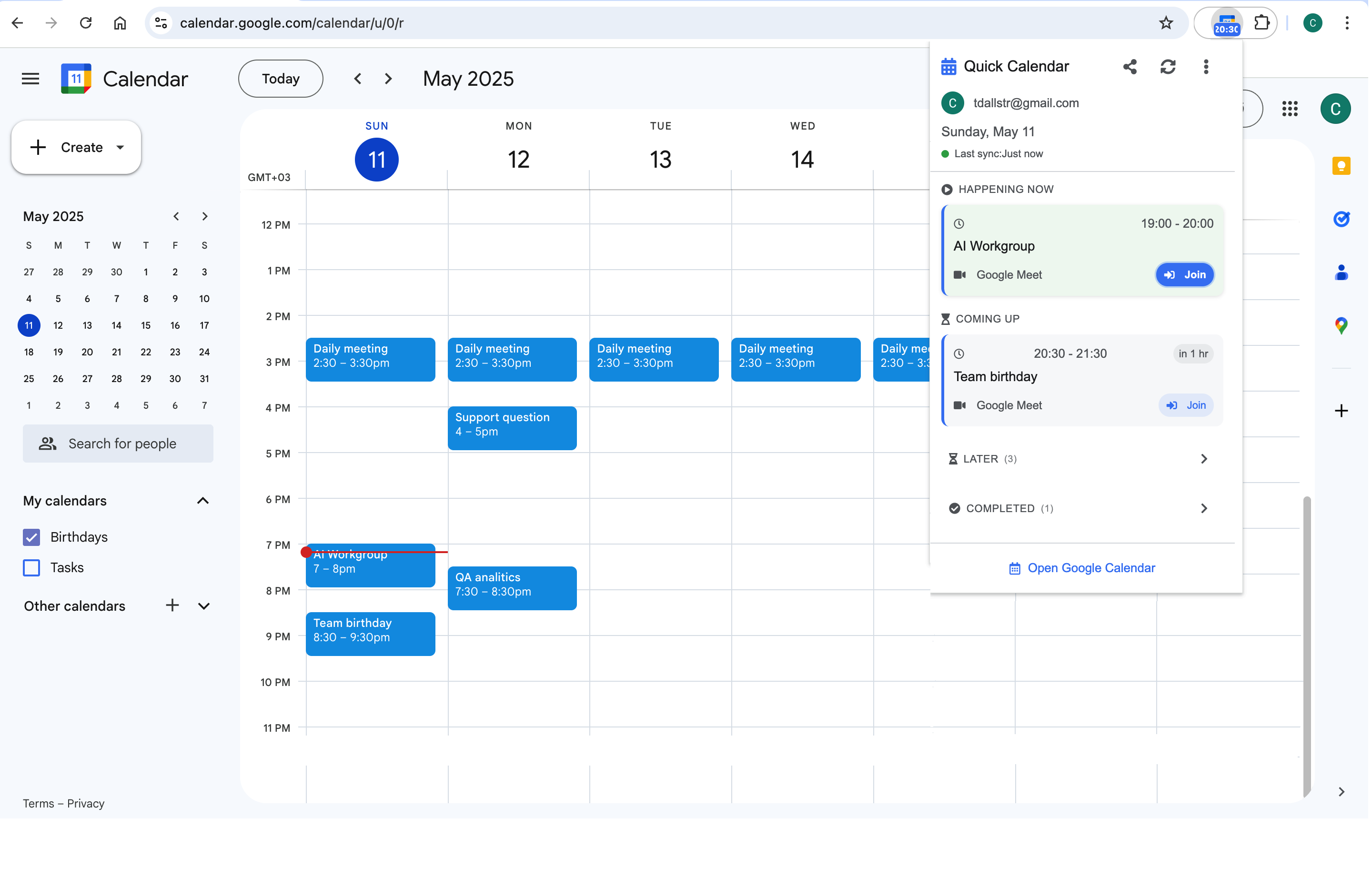
Split calendars only reduce double-booking if you actually look at the merged view before saying yes to anything. A toolbar popup like Calendar Extension for Google Calendar™ renders every subscribed calendar in one day strip — the merged glance that makes a two-calendar life feel like one.
Frequently asked questions
No — "See only free/busy" exposes blocks of busy time with no titles, guests, locations, or descriptions, and Workspace admins cannot elevate that from outside the account. What is visible is the pattern: a recurring Tuesday 16:00 block shows as shape, even if anonymous.
Subscriptions are private to you. Colleagues opening your calendar see your work calendar only — not the overlays you subscribed to. That is why standing personal commitments in office hours need a mirrored "Busy" event created directly on the work calendar.
Secondary calendars belong to the account, not to you. Before offboarding, open the calendar’s Settings and sharing → Export calendar to download an .ics you can import elsewhere — or hand ownership to an account you control while you still have access.
They can, but only calendars visible to the account that owns the schedule. Under Architecture A that means setting up the cross-account free/busy share before enabling the booking link — otherwise the link happily books over your personal life.