Turn on the location layer
The foundation is Working hours & location (Settings): set per-day locations — Office Mon/Wed, Home Tue/Thu/Fri — and update exceptions weekly. Two things happen immediately: your location shows in colleagues’ "find a time" views, and the guessing economy ("are you in tomorrow?") collapses. If your org uses resource booking, location also feeds smarter room suggestions.
The habit that keeps it honest: adjust locations during Friday’s weekly reset. A location layer that’s wrong is worse than none — people plan in-person conversations around it.
Schedule by location logic, not habit
The core hybrid principle: each work mode has a home turf.
- Office days collect the synchronous: workshops, 1:1s that benefit from a walk, anything with a whiteboard, the meetings where side-channel matters. Batch them — an office day with two anchor meetings and dead gaps wastes the commute’s price.
- Home days collect the deep: production blocks, writing, focused review. Guard them harder than office days — home-day focus is the whole reason hybrid exists, and it is exactly what drive-by scheduling erodes.
- The mixed-mode meeting is its own thing: if even one attendee is remote, run it as a remote meeting (everyone on their own camera) or accept second-class participants. Your calendar’s room + Meet link combo should reflect that choice deliberately.
Put the commute back on the grid
The commute exists again on office days — but only physically, not on calendars that spent two years assuming zero travel time. Recurring blocks on office mornings ("Commute", 8:15–9:00, Busy) prevent the 8:30 video call that has you presenting from a train. Same for the return leg: the 17:15 block is what stops office days from quietly running longer than home days.
Team agreements that make it work
Three norms, decided once in a team meeting, carry most hybrid calendar pain:
- Anchor days: the team shares 1–2 office days (say Tue/Wed) so synchronous work has a natural landing zone — and "find a time for in-person" stops being a 5-way constraint puzzle.
- Location-aware scheduling courtesy: check the location row before booking; in-person requests go on office days, everything else defaults to video regardless of where people sit.
- Home-day focus parity: a focus block on a home day is as real as a meeting in a booked room. Teams that treat home days as "the interruptible days" re-invent the open office with extra steps.
Rooms without the scavenger hunt
On office days, the room is half the meeting. If admins have populated Buildings & resources, the event editor’s Rooms tab filters by capacity and floor — book the room when you book the meeting, not when you arrive. No admin setup? Lobby for it with one line: every unbooked-room scramble costs the meeting its first seven minutes.
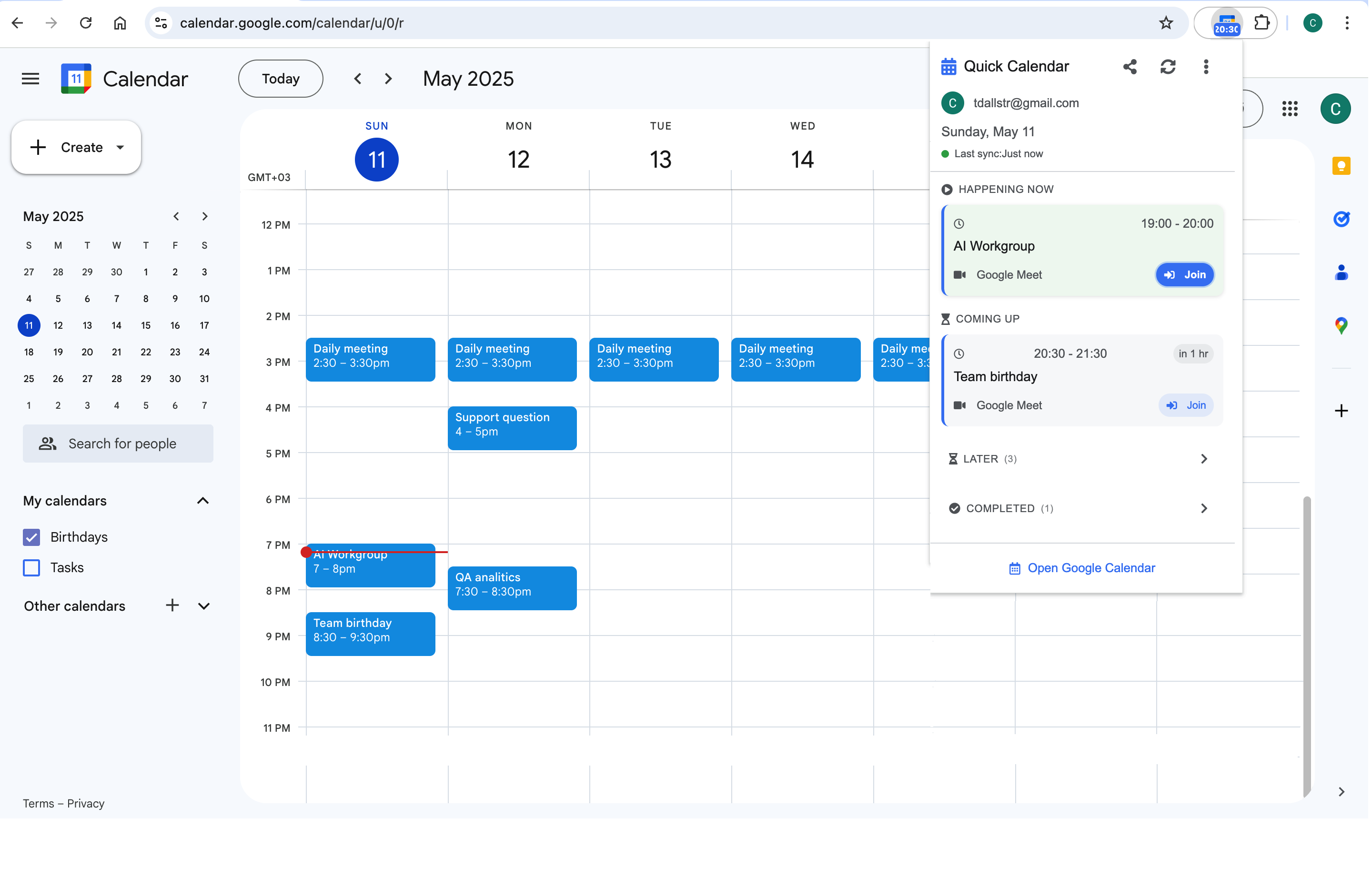
Hybrid weeks make "what’s next" location-dependent — the answer decides whether you need a laptop, a room, or a train. A toolbar view like Calendar Extension for Google Calendar™ keeps the day strip one click away in the browser you’re already in, which on mixed days is the difference between checking and re-planning.
Frequently asked questions
Make the location impossible to miss, then make the correction cheap: working location set per-day, plus a one-line auto-move ("I’m remote Thursdays — switching this to Meet, or happy to do it in person Tuesday"). After three such replies, the pattern re-trains itself.
One modest one, yes — a 60–90 minute block keeps office days from becoming pure meeting sludge. But place the week’s heavy production on home days by design; an office desk in an open plan is objectively worse focus real estate, and pretending otherwise breaks the batching logic.
Anchor days constrain which days are office days, not whether hybrid exists — two shared days plus flexible remainder preserves both coordination and autonomy. The failure mode to avoid is anchor-day creep: "since everyone’s in Tuesday, let’s also…" is how five-day office returns start.
Yes, if admins model desks as resources (Workspace supports desk booking with auto-release when your location says you’re remote). Where that’s not set up, teams improvise with a shared "Desks" calendar — workable, but push for the native version; improvised systems decay.