The display layer: see two zones at once
Settings → Time zone: set your primary honestly (where your body is most weeks) and enable a secondary — the grid renders both hour-columns side by side, labeled ("Me", "SF team"). This one toggle deletes the per-meeting conversion habit for your dominant collaboration axis. Add the world clock (Settings → World clock) for the second and third axes: collaborator cities with their live local time in the sidebar, day-boundary flagged. Rule of thumb: secondary timezone for your main counterpart zone, world clock for the rest.
The anchoring layer: per-event timezones
Every event has a timezone, visible via the event editor’s "Time zone" link — and defaulting to your primary. Three cases where explicit anchoring matters: events hosted by another zone’s constraint (the client’s 9:00 board slot stays anchored to their zone so DST asymmetries move it correctly for you, never for them); travel events (the 14:00 Singapore keynote anchored to Singapore renders right on every device as you fly); and split-anchor events — the editor allows different start/end zones, built for flights ("dep 10:20 CET / arr 14:05 ET") so the calendar shows true local times at both ends.
Travel mode: the working-location handoff
Before a trip: add your travel dates to Working hours & location (colleagues’ find-a-time then shows you in the destination), consider whether to shift your working hours for the trip’s duration, and anchor trip events per-event as above. On arrival your device’s zone change re-renders the grid — which is correct and disorienting for about a day; the "Ask to update primary time zone" prompt is worth accepting for trips over a week, declining for short hops (constant primary-zone flapping confuses recurring events’ anchors more than it helps).
The conventions layer: what settings can’t do
Three team agreements complete the system. Zone-explicit proposals: every proposed time carries both zones in writing ("Thu 15:00 CET / 9:00 ET") — the ten seconds that prevents the classic off-by-an-hour meeting. A canonical team zone for shared artifacts: deadlines, release windows, and on-call handoffs get stated in one agreed zone (often UTC for engineering) regardless of who writes them. Working hours as a contract: everyone’s set, everyone’s honest, and the out-of-hours warning is treated as a stop-and-ask, not a click-through.
Recovery moves: when time already went wrong
The three common wrecks and their fixes. The meeting that moved an hour for half the attendees (DST gap window): open the series, check its anchor zone, re-anchor to the constraint-holder’s zone, and re-state the time in both zones in the description. The event that’s wrong on your phone but right on desktop: device zone settings disagree — set the phone to automatic zone and re-open. The recurring series created mid-travel that now lives in a random zone: edit series → Time zone → re-anchor home; the instances snap back. All three take two minutes once you know the anchor model — which is the actual content of timezone competence.
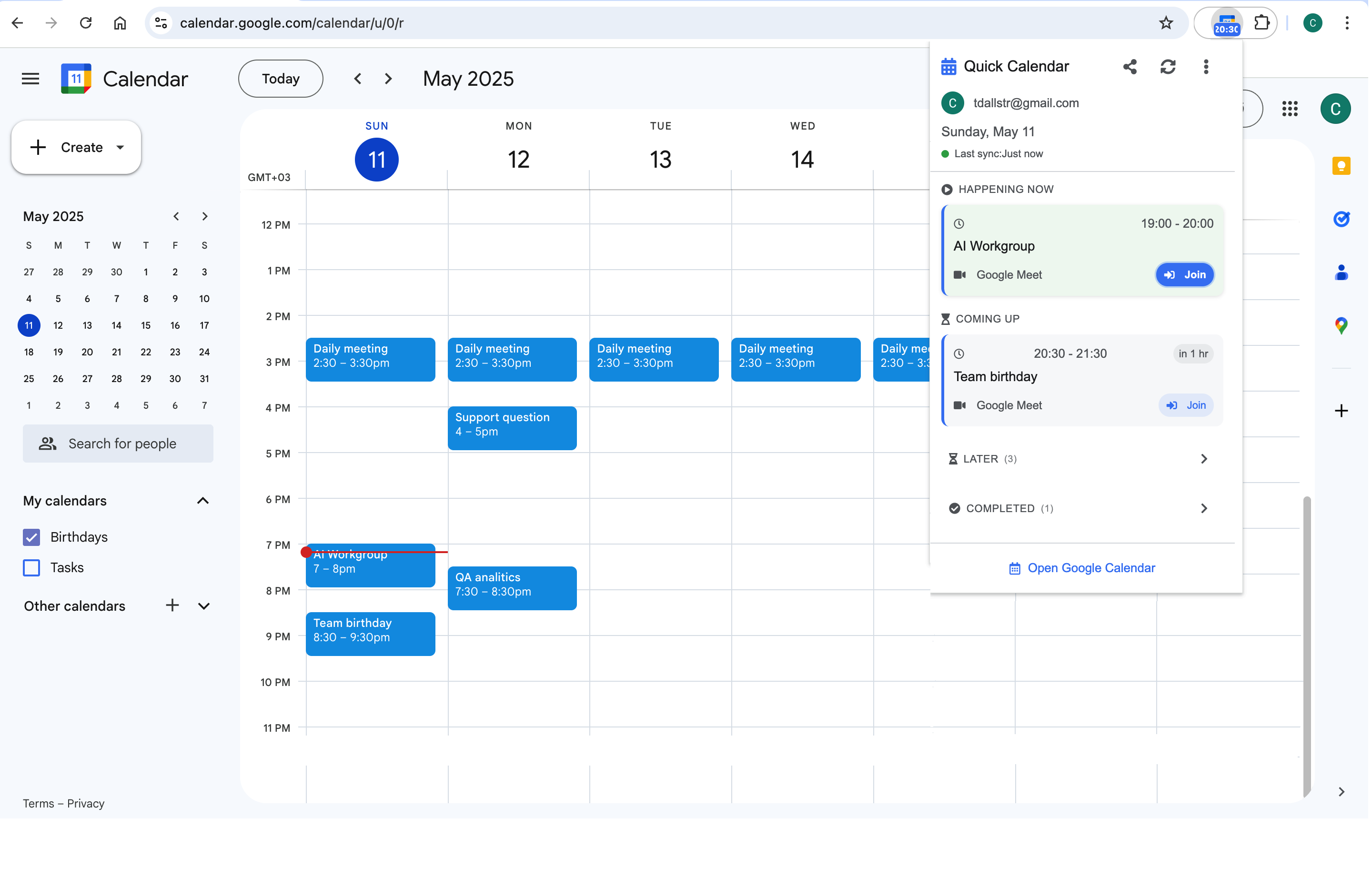
Between all the zone arithmetic, your own next commitment only ever needs one frame: local, now. The countdown chips in Calendar Extension for Google Calendar™ hold that frame in the toolbar — "in 40 min" is zone-proof — which quietly removes the last daily traces of conversion math.
Frequently asked questions
No — primary follows your body; the HQ axis belongs in the secondary column. Setting primary to HQ renders your entire grid in someone else’s frame, which reliably produces the exact off-by-hours errors it was meant to prevent. Bodies first, columns for the rest.
All-day events are date-anchored, not time-anchored — "March 14" stays March 14 in every zone, which is right for birthdays and deadlines-by-date and wrong for anything with a real clock time (a 23:00 release window needs a timed, zone-anchored event, or half the team celebrates a day early).
Device-local: a 10-minute reminder fires 10 minutes before the event’s true moment, rendered in wherever you are. The confusion cases come from events anchored wrong (see recovery moves), not from notifications — fix the anchor and the alerts follow.
For a small tribe (on-call engineers living in UTC-stated systems), yes, with eyes open: every human interaction then needs conversion. The wider-use version is UTC as the team’s canonical artifact zone while individuals keep body-local primaries — coordination clarity without grid alienation.