Scheduling: the first five rules
1. Check before you propose
"Find a time" exists; blind proposals that collide with visible commitments read as "your time is decorative". The ten seconds it takes to check is the remote equivalent of knocking.
2. Working hours are borders, not suggestions
Google Calendar warns you when proposing outside someone’s hours — treat the warning as a stop sign. Genuine cross-timezone necessities get asked, not booked: "This only fits your 18:30 — okay this once, or should we alternate?" The asking is the etiquette.
3. Agenda before attendance
An invite without a goal line asks people to donate time to a mystery. One sentence unlocks the RSVP: recipients can judge relevance, delegate, or prep. Sending agenda-less invites to seniors is career-adjacent carelessness; sending them to juniors trains them that meetings are weather.
4. Mark optional honestly
The Optional flag (person icon beside each guest) is load-bearing courtesy: it tells people the notes will cover them without making them guess the politics. Ten-person "required" meetings where three people matter is the most common etiquette failure in remote orgs.
5. Lead time scales with weight
Same-day invites for non-urgent topics announce that your planning failure is now their interruption. Working defaults: same-day = urgent only (with a chat heads-up), routine = 24h+, workshops and reviews needing prep = 3+ days with pre-reads attached.
Responding: three more
6. RSVP within one working day
A hanging invite blocks the organizer’s planning and everyone downstream. Yes, no, or "Maybe + when you’ll know" — all three are fine; silence is the only wrong answer. (Mobile notification actions make this a thumb gesture; there is no logistics excuse.)
7. Decline with a reason, cancel with a warning
Declines carry a one-liner (the note field exists for this); cancellations give at least half a day when humanly possible — remote teammates build their day around commitments they can’t see the context of. The 10-minutes-before cancellation, remote, is standing someone up.
8. Propose, don’t just refuse
"Can’t do Tuesday" ends a negotiation; "Can’t do Tuesday — Wednesday 14:00 or Thursday morning?" completes one. The Propose-a-new-time RSVP option does this natively, one click for the organizer to accept.
And the meta-rule
9. Your calendar tells the truth
All eight rules above run on trust in what calendars display — which means fake-busy blocks used to dodge colleagues, stale working hours, and locations that say Office while you’re home all tax everyone else’s courtesy. Truthful calendars are the etiquette that makes etiquette possible; if you need protection, use honest tools (titled focus blocks, Private events) rather than noise.
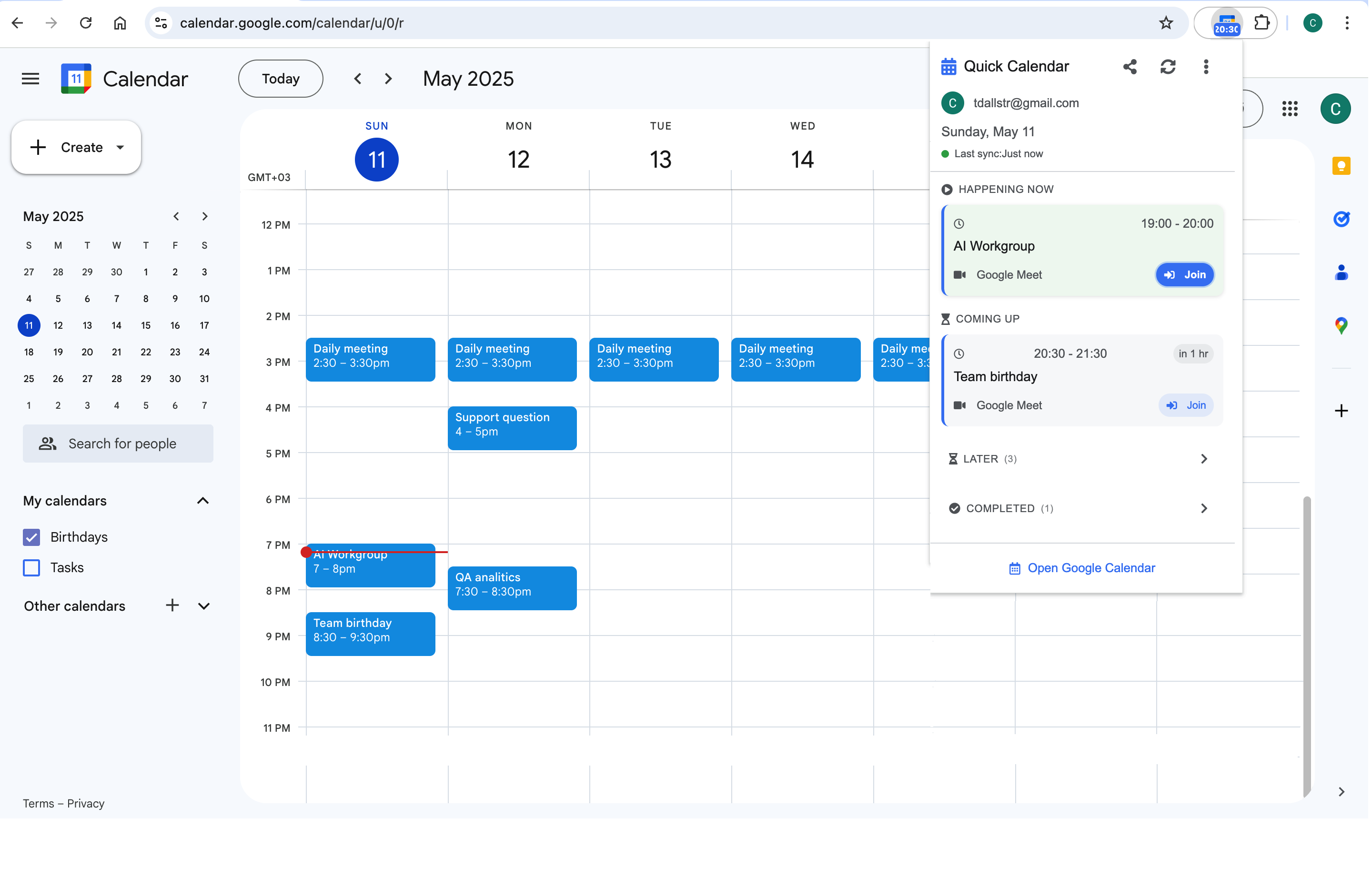
Half of these rules fire at invite-arrival time — the RSVP clock, the propose-alternative, the optional check. A toolbar view like Calendar Extension for Google Calendar™ surfaces new invites next to the day they’d land in, which is what makes the one-working-day RSVP standard effortless instead of aspirational.
Frequently asked questions
The same as anyone, plus the escape hatch: one honest reason, an alternative path, and "if you need me specifically, I can move things". Seniors mostly want the conflict made visible so they can decide; what reads badly is the silent decline or the fake acceptance.
As a signal, sparingly: an accepted-tentative on two overlapping meetings tells both organizers you are triaging, and the Maybe RSVP exists for exactly this. As a habit, it exports your prioritization work to everyone else — pick within a day.
Skip the instance, keep the ritual: "Nothing pressing this week — skipping Thursday, agenda doc still open if anything lands." Deleting the series over two quiet weeks is the remote equivalent of ghosting; instance-skips with notes preserve the channel.
The weights shift: lead-time and agenda rules get stricter (meetings are rarer, so each carries more), while RSVP speed loosens slightly across timezones. Rule 9 tightens most — async-first coordination leans almost entirely on calendars and statuses telling the truth.