What Notion Calendar actually is
Since acquiring Cron, Notion ships a fast, keyboard-driven desktop/mobile calendar client that connects to Google accounts and renders Google Calendar data — plus its differentiator: events can link to Notion pages and databases (the launch doc, the sprint board) directly on the event. It is not a separate calendar backend; your events remain Google’s. That architecture defines both its strengths and its ceiling.
Where Notion Calendar genuinely wins
- Interaction speed: the Cron DNA shows — keyboard-first creation, command menu, fast multi-account switching (personal + work Google side by side with overlay).
- Context attachment: the meeting carries its doc. For Notion-native teams, "where’s the agenda?" stops being a Slack question — the event answers it.
- Aesthetics and focus: a clean, quiet grid people actually enjoy — not nothing, for a tool consulted 30 times daily.
- Menu-bar presence (desktop): next-event visibility and join without the full window.
Where Google Calendar’s own client stays necessary
Because Workspace features live in Google’s client, not the API surface clients build on: appointment schedules (booking pages), Focus time / Out of office event types with auto-decline, Time Insights, room booking with capacity suggestions, and the full find-a-time grid with colleagues’ schedules. Notion Calendar users on Workspace teams keep a tab open for exactly these — which is fine, but it means Notion Calendar is an additional client, not a consolidation.
The deciding question: where does truth live?
Choose Notion Calendar if your team already runs on Notion — projects, docs, sprints — and meetings are satellites of that workspace. The event-to-page link is then daily value, and the speed is a bonus on top. Stay with Google’s client if the calendar itself is the coordination hub (Workspace org, heavy scheduling features, rooms and booking pages), or if adding a second client for the same data offends your tooling minimalism — a defensible instinct: every additional client is another notification policy, another quirk set, another thing that lags a feature launch.
The hybrid most people land on
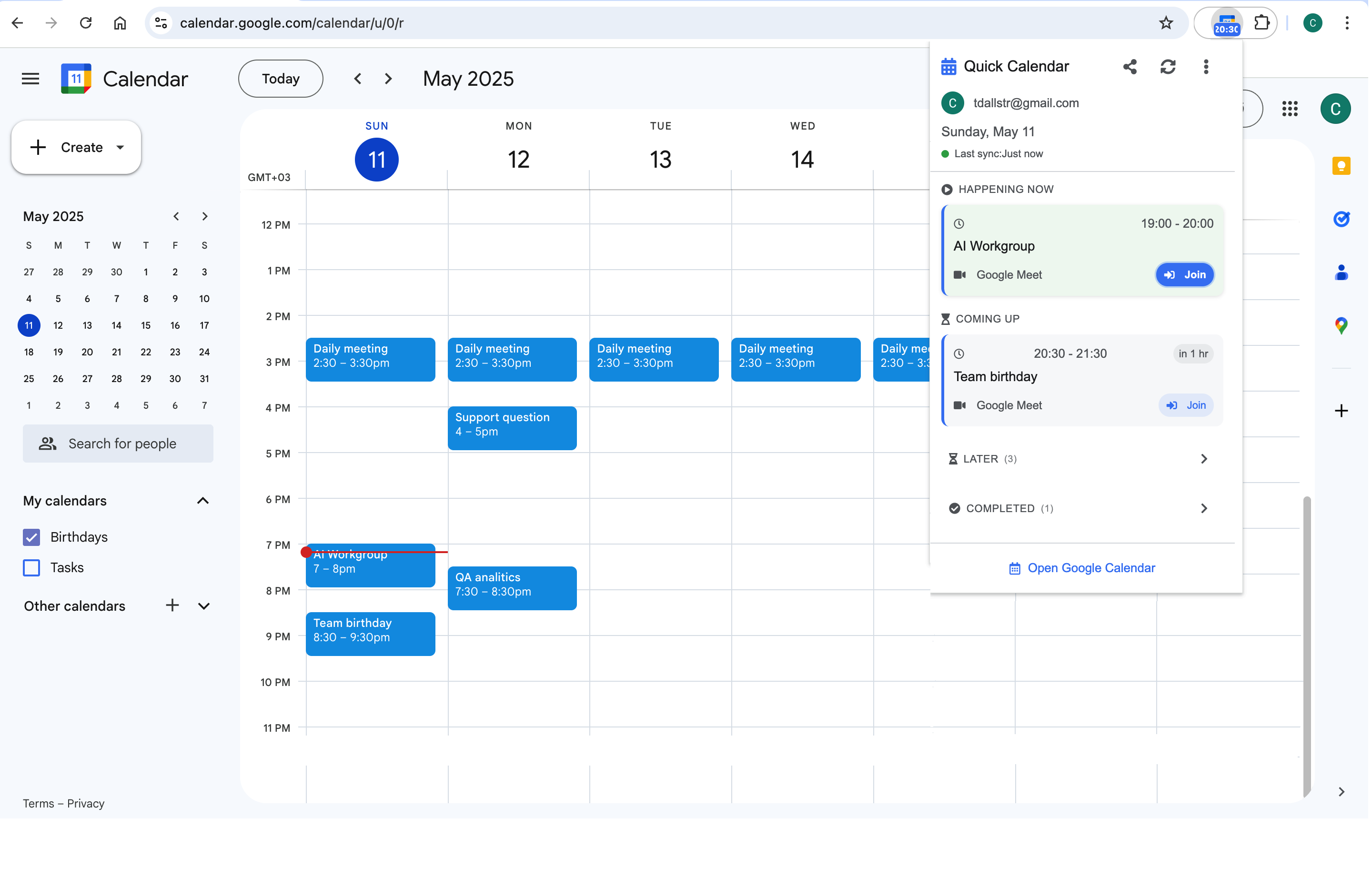
In practice, Notion-team members end up with: Notion Calendar as the desktop session client (planning, context, creation), Google’s web client for the Workspace-only features, and — the layer neither replaces — a browser-toolbar glance surface for the thirty daily checks. Calendar Extension for Google Calendar™ covers that third layer regardless of which session client wins: same Google events, one-click day strip and join buttons inside the browser where the work actually happens. The stack sounds like three tools; it behaves like one calendar with three doors sized to three jobs.
Frequently asked questions
Fully — it is a capable standalone Google Calendar client, and some users adopt it purely for the keyboard speed. But its differentiating features (page links, database context) are inert without a Notion workspace, at which point you are choosing it on client ergonomics alone versus free alternatives.
For deadlines and content schedules, database calendar views work well — they are date-shaped data. For actual scheduling (guests, rooms, RSVPs, notifications), events must live in a real calendar backend. The pattern that works: dates in databases, meetings in Google Calendar, Notion Calendar as the pane showing both.
It requests standard calendar OAuth scopes; events are processed to render and link them. Check your org’s third-party app policy first — some Workspace admins restrict which clients can connect. The tool is mainstream and Notion-backed, but "mainstream" is a reputation, not a policy; the admin allowlist is the policy.
Default to Google’s client org-wide (it is the lowest common denominator and holds the Workspace features), and let Notion-natives adopt Notion Calendar individually — the shared backend makes this costless. What to avoid is mandating the extra client for people whose work never touches Notion; they inherit the tool tax without the context payoff.