The philosophical split you feel daily
Google Calendar is calendar-first: a standalone fast web app where email is elsewhere. Outlook Calendar is email-adjacent: a pane of the Outlook client, one click from the inbox — which is either integration or contamination depending on your relationship with that inbox. This architecture difference drives more daily experience than any feature: Google users context-switch to schedule; Outlook users schedule without leaving mail, and also never quite leave mail.
Where Google is simply better
- Speed and web-nativeness: the web app is faster, the keyboard layer deeper (C/T/D/W/M), and the URL works identically everywhere — Outlook’s web calendar has narrowed the gap and still lags on feel.
- Defensive automation: Focus time and OOO event types that auto-decline, speedy meetings, invitation gating — Outlook’s equivalents exist partially (auto-decline rules are buried in legacy settings) but aren’t product-level citizens.
- Simplicity of sharing: four clear permission tiers, one sharing screen. Outlook/Exchange delegation is more powerful — and configured via a settings archaeology that generates helpdesk tickets.
Where Outlook is genuinely stronger
- Scheduling assistant depth: for big-org meeting-finding across dozens of people plus rooms, Outlook’s scheduling assistant (with Exchange room/resource machinery behind it) remains the industrial-strength version; Google’s find-a-time is cleaner and shallower.
- Delegation as a first-class concept: EA-runs-executive workflows are native Exchange culture — send-on-behalf, granular folder permissions, shared mailbox calendars. Google does delegation; Exchange was built around it.
- Offline desktop client: classic Outlook’s full offline calendar still beats Google’s enable-per-browser offline mode for the frequently-disconnected.
- Categories over colors: Outlook’s named categories (multiple per event, searchable) are structurally better than Google’s single event-color — if you actually use taxonomy.
The individual’s decision, inside and outside employment
Employer-locked: run the employer’s system for coordination (fighting it costs more than any preference is worth) and keep personal life on whichever you prefer, bridged read-only — publish/subscribe via ICS in either direction, one-way, no sync middleware. Actually choosing (freelancer, small business): default Google — the web speed, sharing simplicity, and booking pages fit individual work; choose Microsoft only if your clients live on Teams/Exchange (meeting them in their coordination fabric is worth more than app preference) or you need the offline desktop client weekly.
If you’re switching, the honest checklist
Both directions move events cleanly (.ics export/import or account-level migration tools). What doesn’t move: sharing relationships and delegations (re-grant by hand), booking pages (rebuild), categories→colors (flatten lossy), and recurring-series exceptions (spot-check the weird ones — the December-moved instances are where migrations silently lie). Budget an afternoon for the move and a fortnight of dual-running before cutting over anything shared.
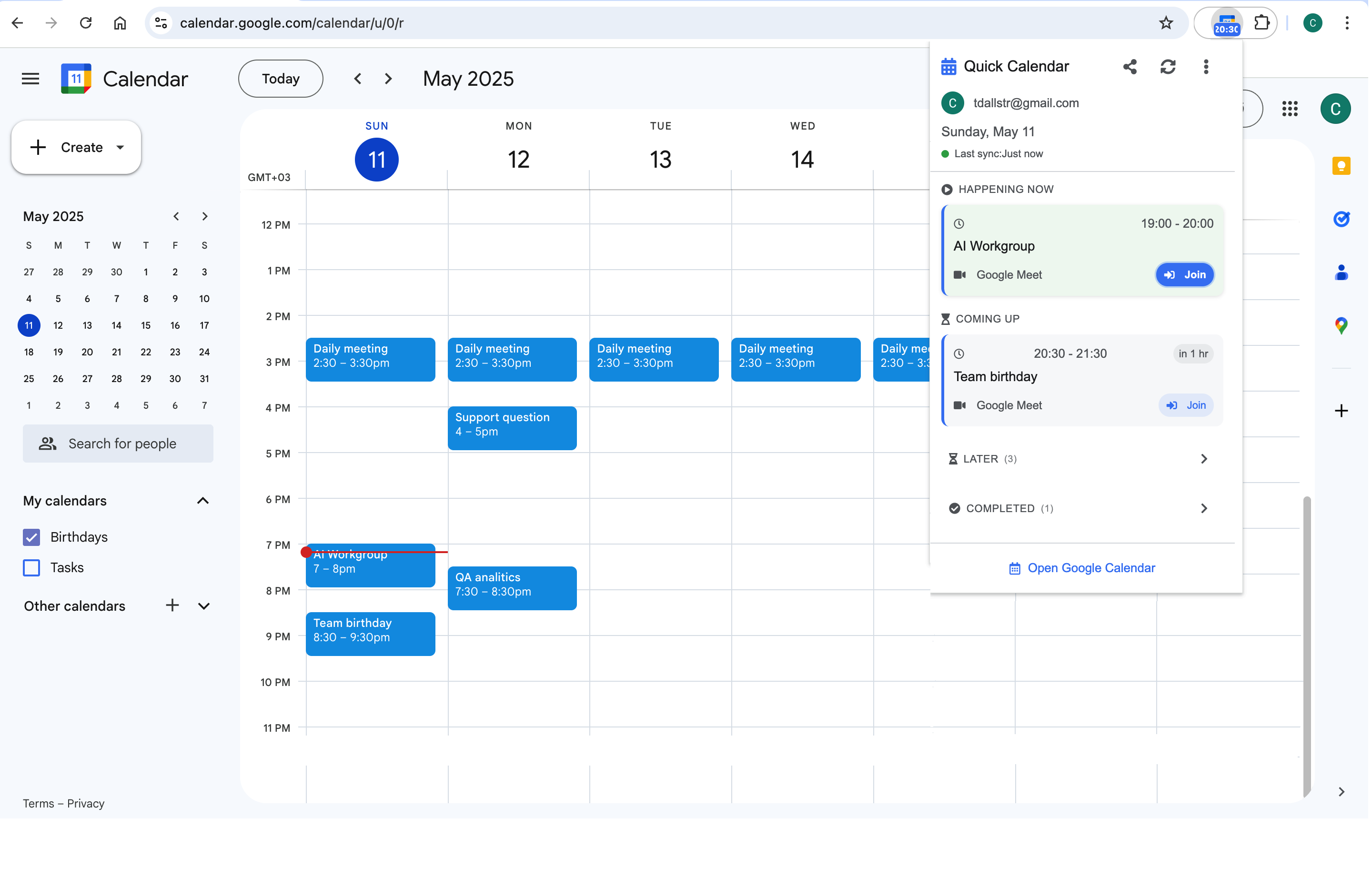
One experiential gap survives any choice: neither product’s tab answers the thirty daily "what’s next" glances cheaply. On the Google side that layer is installable — Calendar Extension for Google Calendar™ puts the day strip, countdowns, and join buttons one click into the browser — which for switchers coming from Outlook’s always-open client is the piece that makes web-first feel complete.
Frequently asked questions
Partially, and it degrades: classic Outlook syncs Google via account addition, but Exchange-native features (scheduling assistant depth, categories, delegation) don’t apply to Google data, and recurring-event edge cases sync imperfectly. Better pattern: pick a backend and use its first-party clients; render read-only in the other world via ICS.
Rough parity with different accents: both offer secondary timezones and per-event zones; Google’s working-hours warnings and world clock are friendlier, Outlook’s time-zone controls in the desktop client are more explicit. This axis shouldn’t decide anyone — settings hygiene matters more than vendor.
They anchor you to the coordination fabric your counterparts use: if every client call is Teams, Outlook creating Teams-linked events natively saves friction daily (and vice versa with Meet). For individuals, this — not calendar features — is the strongest legitimate reason to pick the "other" side.
Directionally yes: new Outlook converges on the web codebase, closing speed gaps while (so far) shedding some classic-client depth (offline, some delegation edges). The philosophies remain: email-adjacent vs. calendar-first. Re-check the offline and delegation rows if those drive your choice; the rest of the comparison is stable.