Why one default fails
A notification is a promise about lead time — "this is how long you need to switch contexts". But context switches are not uniform: joining a standup takes ten seconds, while a client presentation needs slides open, notes reviewed, and a coffee. One global default breaks the promise in both directions, which is how people end up ignoring every banner equally.
A tiered scheme that matches reality
| Event type | Notification | Why this lead time |
|---|---|---|
| Recurring internal (standups, syncs) | 1 minute | You need a nudge, not prep — anything longer trains you to dismiss it |
| Internal meetings you contribute to | 5 minutes | Enough to close the editor at a sane point and reread the agenda |
| External calls, presentations | 15 min + 1 min | The 15 is prep; the 1 is the actual "join now" trigger |
| Deep work blocks | None at start · 10 min before the next event | You scheduled it; the block needs an exit ramp, not an entrance bell |
| All-day items (deadlines, birthdays) | Email, 1 day before at 09:00 | Banners at midnight get swiped; morning email enters the plan |
Where each setting lives
- Calendar-wide defaults: Settings (gear) → click your calendar under "Settings for my calendars" → Event notifications and All-day event notifications. Up to five defaults each; new events inherit them.
- Per-event overrides: open the event → the bell row → change, add, or remove. This is where externals get their 15+1 and standups drop to 1 minute. Editing a recurring event prompts for "this event / this and following / all events" — pick All events to fix the series once.
- Delivery channel: Settings → Notification settings → choose Desktop notifications or Alerts, and whether to play a sound. Desktop notifications require the browser to be running and permitted — a prompt Chrome shows once and people decline reflexively. If banners never appear, check the site permissions for calendar.google.com first.
- Mobile is separate: the phone app has its own notification settings per calendar. The tiered scheme above assumes desktop-first work; on mobile, consider keeping only externals and all-day reminders to avoid double-banner fatigue.
The "notify me about my own focus block" trick
The counterintuitive row in the table is deep work: no notification at the start (you are the one who scheduled it), but make sure whatever follows carries one at 10 minutes. Overrunning a focus block into a meeting is the most expensive notification failure there is — it converts your best work hour into an apology.
Auditing notification debt
If you have used Calendar for years, your events carry legacy notification patterns from every previous default. The one-time fix takes fifteen minutes: set the new calendar-wide defaults first, then walk through only your recurring events (they are the ones that fire weekly forever) and align each series. One-off events inherit the new defaults automatically.
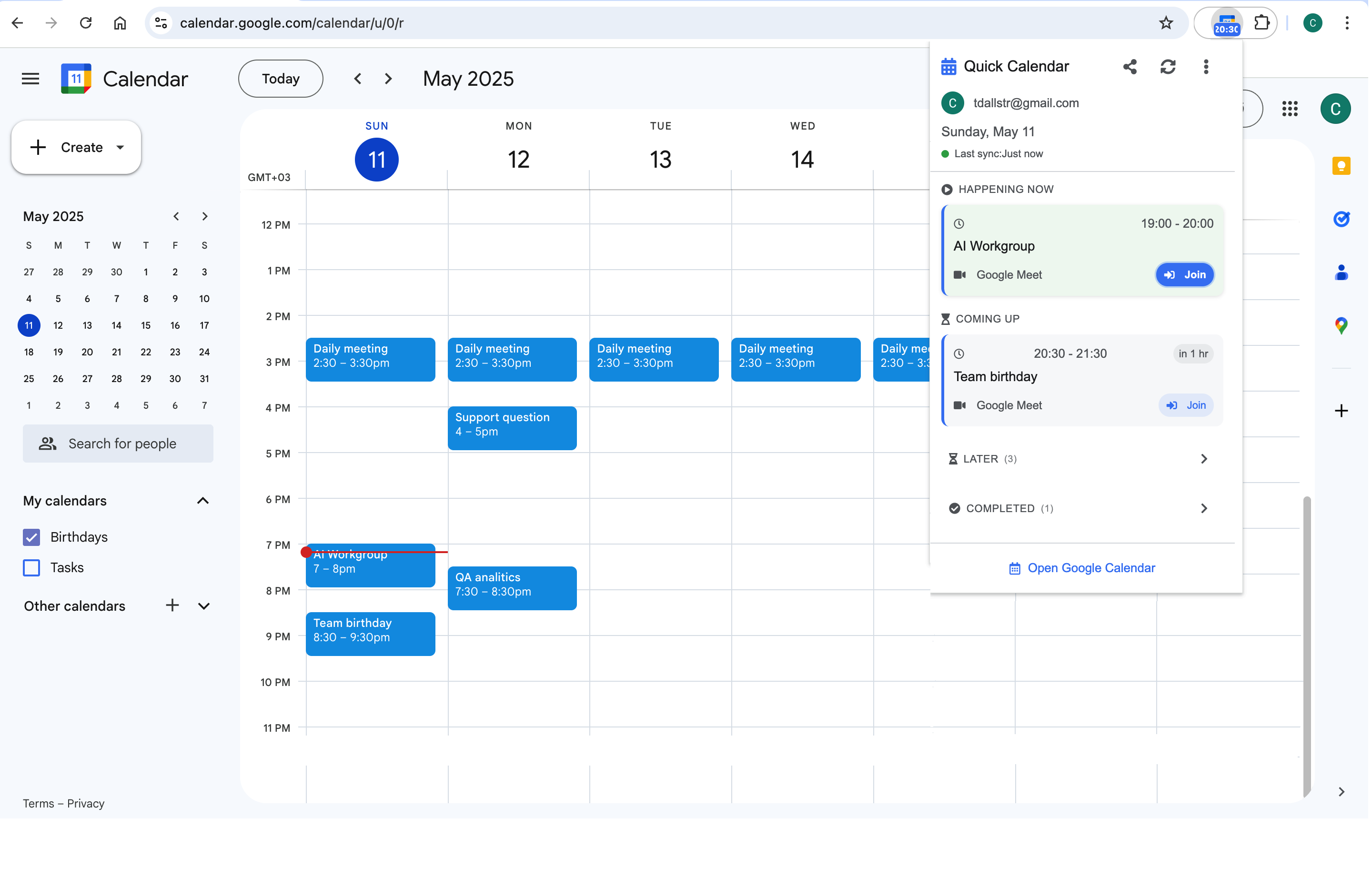
Between notifications, the question is usually softer: "how long until I need to care?" That is a glance, not an alert — and a toolbar countdown like the time-to-event chips in Calendar Extension for Google Calendar™ answers it without waiting for a banner or opening the calendar tab.
Frequently asked questions
You are receiving one from the event and one from a second source — usually the mobile app’s own settings, a second calendar containing a copy of the event, or an email notification stacked on a desktop one. Check Settings → Notification settings on each device and keep one channel per event type.
No. Notifications are per-user: changing the bell on an invite only changes your reminders. Organizers cannot set notifications for guests — if attendees keep missing a meeting, the fix is agreeing on defaults, not editing the event harder.
In order: the browser is running and signed into the right profile; calendar.google.com has notification permission (lock icon in the address bar → Notifications → Allow); system Do Not Disturb or Focus mode is off; and in Calendar’s Settings → Notification settings, "Desktop notifications" is selected rather than "Off".
Yes — defaults are per-calendar, which is an underused routing trick: keep a "Deep work" calendar with no start notifications and a "Client" calendar with 15+1, and events inherit the right behaviour just by being created on the right calendar.