The squint test
Before assigning a single color, decide what question it answers. Zoom out to week view and squint: if the blur of colors can answer "how much of this week is spoken for by other people?", the palette is working. If it just looks like confetti, you have labels, not information.
A six-color system that answers real questions
| Color | Means | Question it answers at a squint |
|---|---|---|
| Tomato | External commitments — clients, interviews, anything with outside attendees | How much of my week is promised to people who can't reschedule easily? |
| Blueberry | Internal meetings | What is my meeting load, and which days stack? |
| Basil | Deep work blocks | Did focus time survive the week, or get eaten? |
| Grape | Personal — health, family, commute | Is life getting squeezed out by work weeks? |
| Graphite | Admin, logistics, shallow chores | How much low-value time am I carrying? |
| Banana | Tentative — holds, unconfirmed plans | What might still move if something urgent lands? |
Six is a deliberate ceiling. Google Calendar offers more event colors, but every color past six halves the palette's readability — an eleven-color calendar and an uncolored one carry the same information: none.
Calendar colors vs. event colors
Google Calendar has two coloring layers, and mixing them up is the most common setup mistake:
- Calendar color — set from the three-dot menu next to each calendar in the left sidebar. Everything on that calendar inherits it. Use it for source identity: your work calendar, a shared team calendar, a partner's overlay.
- Event color — right-click any event (or open it and use the color dropdown). It overrides the calendar color for that one event. Use it for semantics — the six meanings above.
The system that scales: leave the calendar color as a neutral base, and apply event colors only when an event deviates from that calendar's default meaning. Coloring a recurring event once colors the whole series — right-click it, pick the color, and choose All events when prompted.
The two-minute Friday audit
The palette earns its keep in review. Friday afternoon, open week view and ask three questions in order: Is Basil visibly present on at least three days? Is any single day more than half Blueberry? Is Graphite creeping past roughly a fifth of the week? Each "wrong" answer maps to one concrete fix for next week — protect a block, break up a stacked day, batch the admin into one box.
What colors cannot do
Two limits worth knowing before you rely on the system. First, your colors are private — attendees see their own palette, so color carries no meaning in invites. Second, native Google Calendar cannot auto-color by rule (for example, "everything with 5+ guests turns Blueberry"). The workable native approximation is routing event types into separate calendars, which is exactly what calendar-level colors are for.
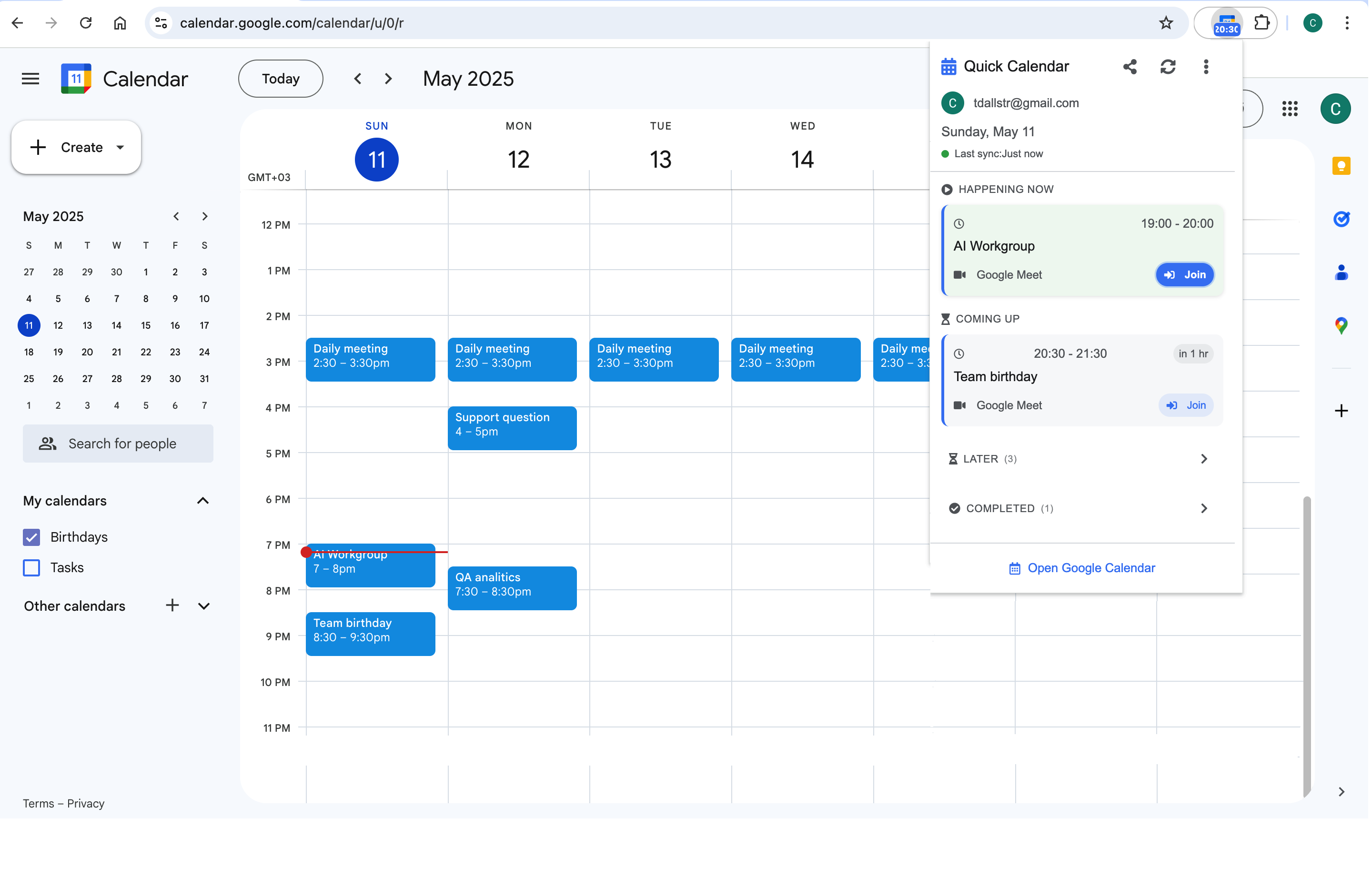
The palette also pays off at a glance mid-day: in a toolbar popup like Calendar Extension for Google Calendar™, the color strip on each upcoming event tells you whether what's next is a Tomato (prepare) or a Graphite (relax) before you read a single word.
Frequently asked questions
No. Event and calendar colors are per-user. An attendee sees the event in whatever color their own setup assigns. If a category needs to be visible to teammates, encode it in the event title (a prefix like [Focus]) or use a shared calendar instead.
The usual cause is the event moving between calendars — an event inherits the target calendar’s color and drops the override. It also happens when an organizer recreates a recurring series; your per-event overrides applied to the old series, not the new one.
Not natively. The built-in workaround is structural: create separate calendars per category and let calendar-level color do the work. Rule-based recoloring of a single calendar requires third-party tools with calendar access, which is a real privacy trade to weigh.
Roughly 1 in 12 men has some color vision deficiency, and Tomato/Basil is a risky pair. The fix is reducing to four high-contrast colors (for example Tomato, Banana, Blueberry, Graphite) and letting title prefixes carry the finer categories — the squint test works with four just as well.