Why the evening beats the morning
Planning tomorrow at 8:55 tomorrow has two structural flaws: you spend your freshest attention on logistics, and you decide under the day’s incoming fire. The same decisions made at 17:25 today cost tired attention you were about to waste anyway, and they’re made with the whole day visible and nothing incoming. Evening-you is the strategist; morning-you should just execute.
The four moves (five minutes total)
Move 1 · Close today’s ledger (90 seconds)
Scan today’s events top to bottom. Each meeting: are its action items captured somewhere real (task list, doc), or still living in your head? Each block: did it happen? Unfinished block work goes back to the task list — not dragged to tomorrow. The drag is how calendars become guilt archives; the list return is how tomorrow stays a choice.
Move 2 · Read tomorrow once (60 seconds)
Tomorrow’s shape: first commitment (sets the wake-up math), the heaviest cluster (sets where the energy goes), the gaps (set what’s actually possible). No editing yet — this is reconnaissance.
Move 3 · Fix what reconnaissance found (90 seconds)
Now the small surgeries while they’re cheap: a buffer after the 13:00–15:00 chain, the overlap you should decline tonight (organizers get evening notice instead of a morning scramble), the 9:00 meeting with no agenda that deserves a one-line "what do you need from me?" tonight.
Move 4 · Write the first block’s instruction (60 seconds)
The highest-value sixty seconds in the ritual: tomorrow’s first work block gets a concrete instruction in its title or description — "Continue §3; outline done, start at the pricing table." Morning-you opens the laptop and is moving in ninety seconds, because evening-you left rails instead of a blank page.
The shutdown line
End the review with an explicit terminator — close the laptop, write "done" somewhere, say it out loud if that’s your style. The point is a boundary event: the review’s psychological function is telling the background processes they can stop rehearsing tomorrow. Without a terminator, the review becomes just another check in the evening doom-loop.
Keeping it alive past week two
Three durability tricks. Anchor it to an existing end-of-day action — the last coffee cup wash, the 17:25 status change; free-floating rituals evaporate. Shrink it on brutal days to Move 4 alone — sixty seconds, the streak survives, tomorrow still starts on rails. Put it on the calendar as a recurring 17:25 block titled "Close the day" — five minutes, marked Busy, ended by the terminator. A ritual that owns grid space outlives one that rents willpower.
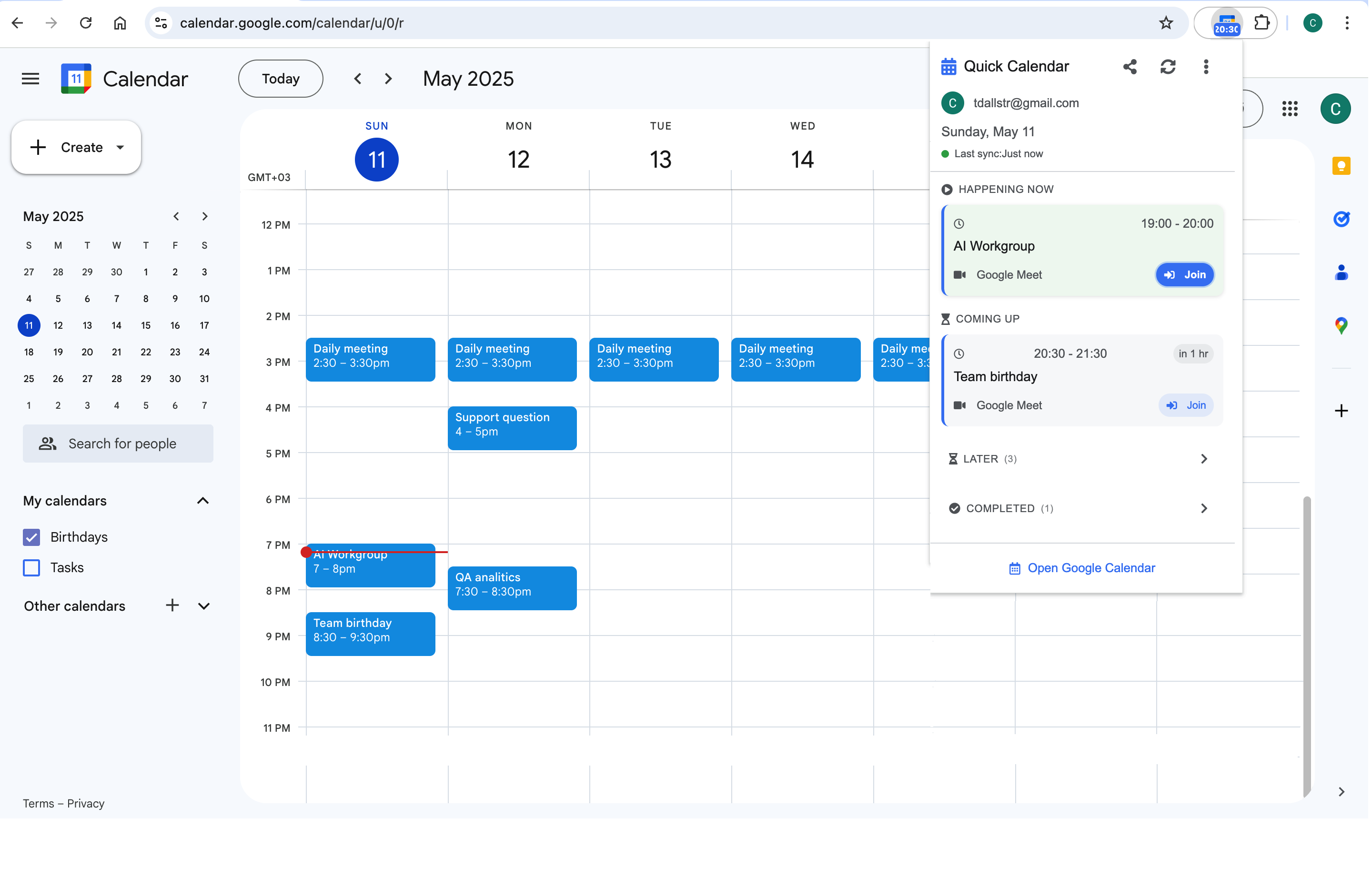
Moves 1 and 2 are scans, and scans are cheapest on a glance surface: paging today-then-tomorrow in the toolbar timeline of Calendar Extension for Google Calendar™ covers both in under a minute — no tab, no Gmail ambush on the way out, which at 17:25 is precisely the ambush that turns a five-minute close into a forty-minute relapse.
Frequently asked questions
Scale and function: the Friday reset (15 min) makes next week honest — big rocks, deleted fictions, seam repair. The daily close (5 min) makes next morning executable. They nest: Friday’s close is the daily version plus the weekly pass. Neither substitutes for the other.
The minimum rule: Move 4 only, sixty seconds, even from the phone. And if that happens three times a week, that is the diagnostic — your last hour needs a standing buffer, which is a weekly-reset fix, not a review failure.
No — that is the scope creep that kills it. Message triage is its own longer, more volatile activity; coupling them means the 5-minute review inherits the inbox’s infinity. Close the calendar first; message triage, if any, is a separate decision with its own clock.
Preference at the margins, structural at the center: people with early meetings or morning fog benefit measurably from evening rails; true larks with quiet 7:00s plan mornings fine. The non-negotiable core either way is Move 1 — days that never close accumulate open loops regardless of when the next one gets planned.