The principle: checks have jobs
A calendar check without a question is a doom-scroll with a grid. The three-check pattern assigns each look a specific decision it feeds — orientation, correction, preparation — and delegates everything between them to ambient awareness (a countdown in the corner of the screen). The result is fewer total checks and fewer surprises, which sounds like a trade and isn’t.
Check 1 · The morning look (20–60 seconds, with coffee)
Question: what shape is today, and what one thing must ship? Read the day once: first commitment (sets the tempo), the heaviest cluster (sets where energy goes), the gaps (set what’s possible), and the first block’s instruction from last night. No editing, no inbox — this is orientation, and its entire value is that decisions about the day get made before the day starts making them for you. Anti-pattern replaced: the 8:55 discovery that a 9:00 exists.
Check 2 · The midday correction (60–90 seconds, after lunch)
Question: what changed, and does the afternoon plan survive it? Mornings shed invites, cancellations, and moved meetings; the midday look catches the drift while the afternoon is still steerable. Scan for: new events landed since morning (RSVP them now — the ten-second triage), the freed slot from that cancelled 14:00 (assign it deliberately: extend a block or take the recovery), and whether the day’s one-thing still has its space. Anti-pattern replaced: discovering at 16:40 that the afternoon reorganized itself hours ago.
Check 3 · The closing review (3–5 minutes, day’s end)
Question: is today closed, and can tomorrow start without me re-deriving it? The full sequence lives in its own ritual (close the ledger, read tomorrow, cheap fixes, first-block instruction), but even the compressed version — actions captured, tomorrow’s first block armed — converts tonight’s five minutes into tomorrow’s thirty. Anti-pattern replaced: the morning archaeology session, and the evening rumination that open loops fund.
Between checks: ambient, not episodic
The three checks handle decisions; the in-between only needs one number — minutes until the next commitment — available at a glance, not via tab-switch. That distinction carries the whole system: with the countdown ambient (toolbar chip, menu-bar, widget), the "should I check the calendar?" impulse stops firing because the answer is already in peripheral vision, and the 30-visit day collapses to the three visits that had jobs. Checking behavior is habit-shaped: give the anxiety a standing answer and it stops asking.
Calibrating for your role
Meeting-heavy roles add a fourth micro-check — the pre-cluster glance (30 seconds before a meeting run: order, links, one-line preps). Reactive roles compress the pattern: morning and closing survive, midday becomes continuous by the nature of the work. Makers on protected calendars sometimes drop the midday check entirely — the fewer the moving parts, the fewer the corrections. The pattern flexes; the principle (checks have jobs, ambient covers the rest) doesn’t.
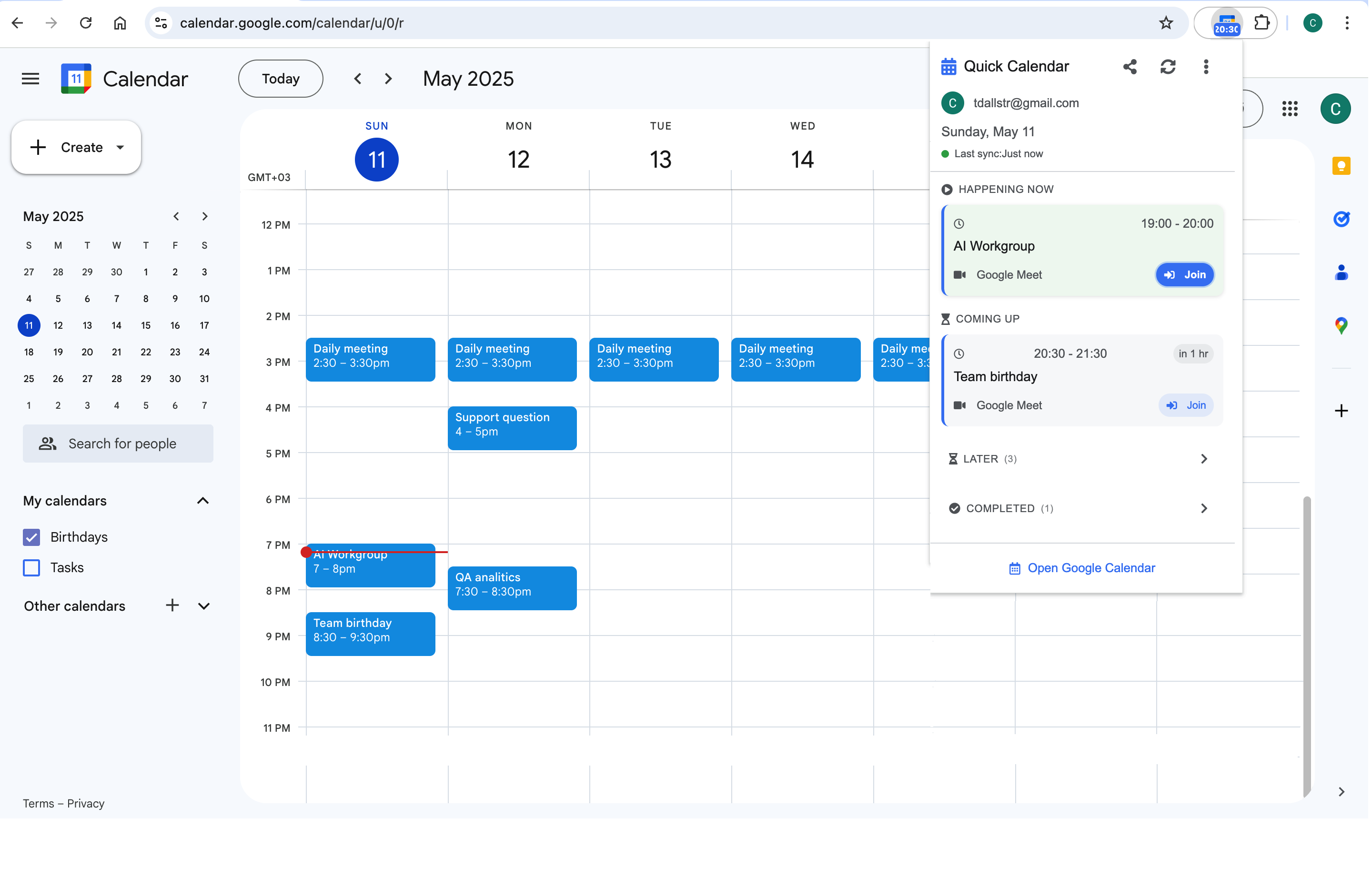
All three checks plus the ambient layer are what a toolbar surface is for: Calendar Extension for Google Calendar™ renders the day strip for the morning and midday looks, pages to tomorrow for the close, and keeps the time-to-next chip in the corner for everything between — the whole checking system, one click wide.
Frequently asked questions
Volatility argues for better detection, not more scanning: the midday check plus ambient countdown catches moves within a bounded window, and genuinely urgent changes arrive as notifications anyway. People with 15-check days aren’t detecting more — they’re re-verifying the same facts anxiety keeps un-caching.
Attach it to an anchor, not a clock: after lunch works because lunch already interrupts, and the afternoon is fully steerable from 13:00. The wrong version is "whenever I feel unsettled" — that re-opens the anxiety loop the structure exists to close.
It can, and mostly shouldn’t: bed-checking couples the day’s stress to waking and invites the inbox in behind it. The coffee-anchored desk version (or the home-screen widget at breakfast, strictly calendar-only) delivers the orientation without the cortisol side-dish.
Make the countdown ambient first — the compulsion usually can’t out-argue a number that’s already visible. For the residue: note what each urge was actually asking ("am I late for something?"), confirm the ambient layer answers it, and give the habit two weeks of the new loop. Checking is trainable in both directions.