The audit’s stance: evidence before opinion
Everyone has beliefs about their schedule ("too many meetings", "no time to think"); audits replace beliefs with counts from the last four weeks of calendar history — recent enough to reflect current reality, long enough to smooth anomalies. Workspace users start with Time Insights (left sidebar: meeting hours, breakdowns, top co-attendees, trends); everyone else counts manually in week view. Either way, the audit is four passes, each producing numbers and a decision list.
Pass 1 · The load ledger (20 minutes)
Count per week: total meeting hours, out-of-hours events, and back-to-back chains of 3+. Benchmarks for orientation: ICs typically run 10–18 meeting-hours, managers 18–28; more than 3 out-of-hours events weekly is creep; 2+ chains weekly is a buffer deficit. Write the three numbers down — they are the baseline every later decision gets measured against, and the before-photo that makes next quarter’s audit satisfying.
Pass 2 · The recurring-series trial (25 minutes)
List every recurring meeting you own or attend (search each title for the series). For each, the production question: what did the last month of instances produce — decisions, unblocks, changed actions? Verdicts: keep (and shrink a notch), re-cadence (weekly→fortnightly, the audit’s highest-yield edit), convert to async (transfer-only meetings), or exit/kill. Tally the recovered hours as you go; a typical first audit finds 2–5 weekly hours in this pass alone.
Pass 3 · The self-directed inventory (20 minutes)
Now the other side of the ledger: count events that exist for your priorities — focus blocks (and their hold rate: happened ÷ scheduled), lunch, learning, personal anchors. Two thresholds matter: fewer than 3 self-directed events weekly is the agency deficit that predicts burnout better than load does; hold rate under 60% means blocks exist as decoration (marked Free, vaguely titled, or undefended) and the fix is mechanics, not more blocks.
Pass 4 · The friction scan (15 minutes)
Read one typical week hour by hour for structural friction: gaps too short to use (meeting shrapnel — batching candidates), the missing seams after heavy clusters (buffer sites), events with no agenda in sight (hygiene targets), and the day that is always the wall (load-balancing candidate). This pass produces the placement decisions the first three funded.
Converting the audit into changes (the part that matters)
Rank the decision list by recovered-hours-per-awkwardness: settings changes first (speedy meetings, defaults — zero awkwardness), then silent-attendee exits and re-cadencing (low), then conversions and kills (medium, use the pause-with-revival-rights framing), then the load conversation if the numbers demand it (the audit’s ledger is exactly the exhibit that conversation needs). Execute the top five within a week of the audit — decision lists older than that quietly become archives. Re-audit quarterly; twenty minutes once the first one exists.
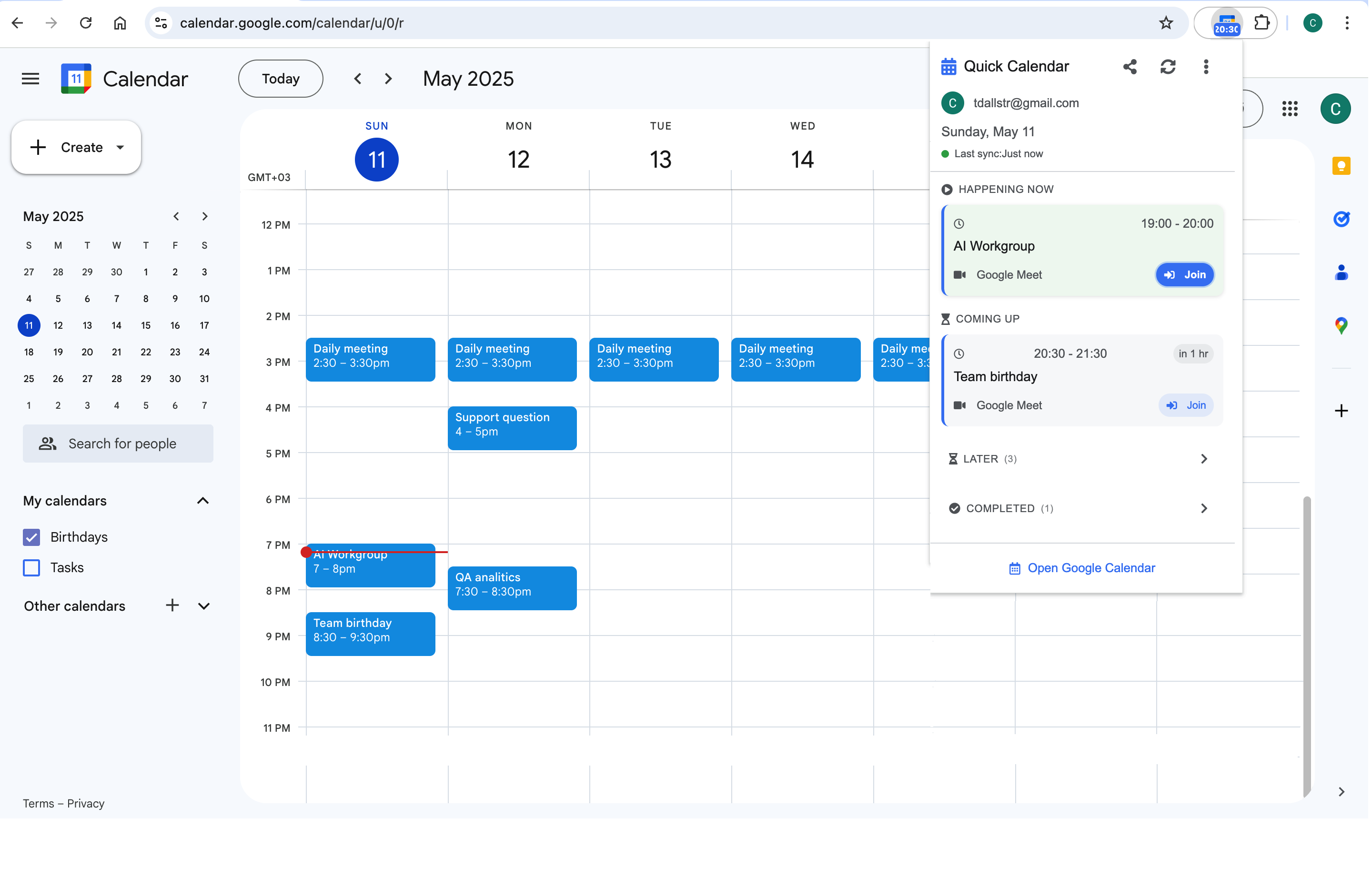
Passes 2–4 are scanning work, and a paging surface beats the grid for speed: walking a series’ instances or a week’s seams in the toolbar timeline of Calendar Extension for Google Calendar™ keeps each pass inside its time box — the audit stays 90 minutes instead of becoming an afternoon.
Frequently asked questions
Insights gives the denominators; production is a memory-and-notes question: scan the series’ recent instances for captured decisions (event descriptions, the notes doc). If neither you nor the notes can name last month’s output in thirty seconds, that is the answer — production that leaves no trace isn’t production.
One pass, lighter touch: check that anchors (health, family, recovery) exist and hold — the self-directed inventory covers it. Auditing leisure for "productivity" misses the point; the personal audit question is presence and hold-rate, not yield.
Aggregate before you approach: "your meetings" is a fight; "I’m at 19 hours and these three series produced no decisions last month" is data with options attached (shrink, re-cadence, delegate attendance). Name series, not character — the calendar gives you that precision; use it.
Quarterly is the maintenance floor; real triggers are role changes, team reorgs, a new manager, or two consecutive weeks that feel like the old baseline again. The re-audit is cheap (the method exists, the baseline exists) — run it whenever the felt-numbers gap reopens.