How to run the check
Open week view for the last four weeks (Workspace users: Time Insights does some counting for you). For each sign below, score honestly: 0 = not me, 1 = sometimes, 2 = most weeks. The scoring matters because burnout self-assessment fails exactly when it’s needed — the calendar’s version doesn’t flatter.
The seven signs
1 · Meetings before you’re awake and after you’re done
Events regularly outside your stated working hours — the 8:00 that crept in front of your 8:30 start, the 18:30 "quick sync". Threshold: 3+ out-of-hours events a week. This is the classic load-creep signature: the day expanded and nobody decided it.
2 · Zero white space on any weekday
Scan for days with no unscheduled gap longer than 30 minutes. One such day a week is a crunch; three is a pattern. Recovery happens in the seams — a calendar without seams is running on reserves.
3 · Your own name is missing
Count events that exist for you rather than for others: focus blocks, lunch, the run, learning time. Threshold: fewer than 3 such events a week. A calendar that is 100% other people’s requests is the resentment factory.
4 · The Sunday-night schedule scan
Behavioral, but calendar-visible: opening next week’s calendar Sunday evening "to prepare" — actually to pre-worry. If Monday is regularly pre-lived on Sunday, dread has entered the loop.
5 · Serial reschedules of the same personal item
The dentist moved four times; the gym block dragged forward daily like a prisoner. Serial rescheduling of self-care while meetings never move is priority inversion in its purest recorded form.
6 · Meeting recovery debt
Count back-to-back chains of 3+ meetings. Threshold: 2+ chains a week. Microsoft’s EEG study is clear on this: across four consecutive meetings, stress-linked brain activity kept rising, while 10-minute breaks kept it flat. Chains are borrowing; the debt lands in the evening.
7 · Friday-you leaves nothing for Monday-you
Weeks that end with no plan, no protected first block, no note — Monday begins in archaeology. A functioning weekly close is often the first ritual burnout eats, which makes its absence a leading indicator rather than a lagging one.
Reading the score
0–3: normal load noise; fix the one or two flagged items. 4–7: early-stage pattern — the calendar interventions below genuinely help at this stage. 8+: the calendar is a symptom log now; interventions still help, but pair them with the conversation (manager, doctor, both) that a schedule can’t substitute for.
Mapping signals to fixes
Signs 1 and 6 → hard edges and buffers (working hours set, speedy meetings, standing buffers after clusters). Signs 2 and 3 → one daily protected block plus lunch marked Busy — modest, defensible, yours. Sign 5 → personal items get meeting-rank; the dentist reschedules a meeting, not vice versa. Signs 4 and 7 → the 15-minute Friday reset, which both ends the week cleanly and makes Sunday scanning pointless. Re-score in four weeks; the number should move.
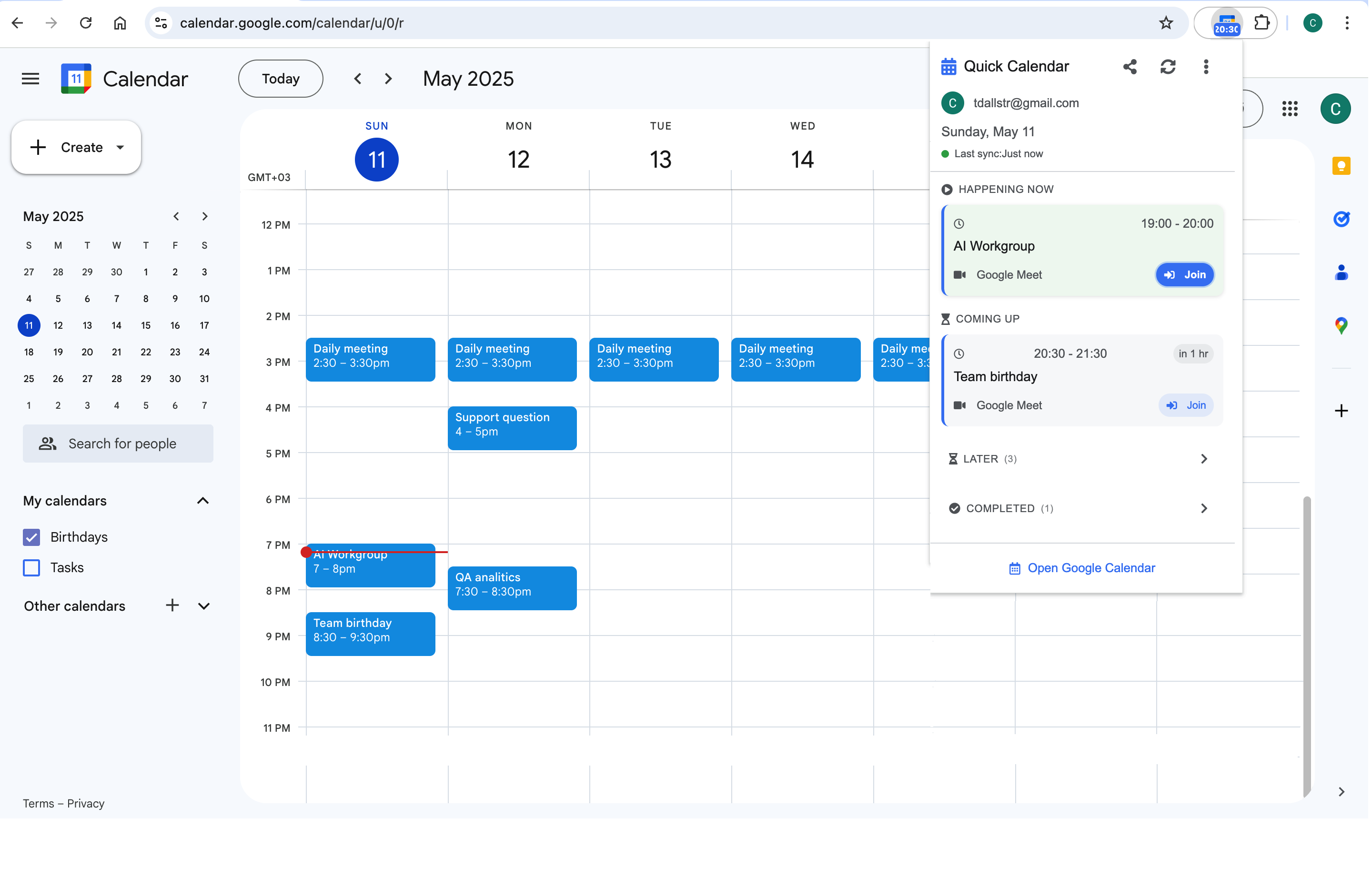
Several signs feed on checking behavior itself — the Sunday scan, the anxious mid-evening look. A toolbar glance like Calendar Extension for Google Calendar™ answers "when does tomorrow start" in two seconds without opening the full week’s wall, which is precisely the difference between checking and pre-living.
Frequently asked questions
One heuristic does: seasons have end dates. A launch month scoring 6 with a visible finish line is crunch; the same score for three consecutive months with no boundary event is the pattern. Add the boundary test to any score: "when does this configuration end?" No answer is itself an answer.
Run the trend, not the snapshot: re-score monthly. Feeling fine at 8+ usually means reserves are covering the gap — the calendar shows the input side before the output side fails. People rarely regret acting a month early; the opposite regret is common.
Sign 3 — the missing name. Out-of-hours meetings and chains measure load, but zero self-directed events measures agency, and loss of agency is the burnout literature’s most consistent thread. It is also the cheapest to fix: two blocks and a lunch, this week.
The aggregated version, yes: "three weeks running I’m at 4+ out-of-hours events and two meeting chains — I want to fix the pattern before it fixes me" is a strong, blameless opener. Bring the proposed fixes too; managers respond better to a plan needing endorsement than a problem needing invention.