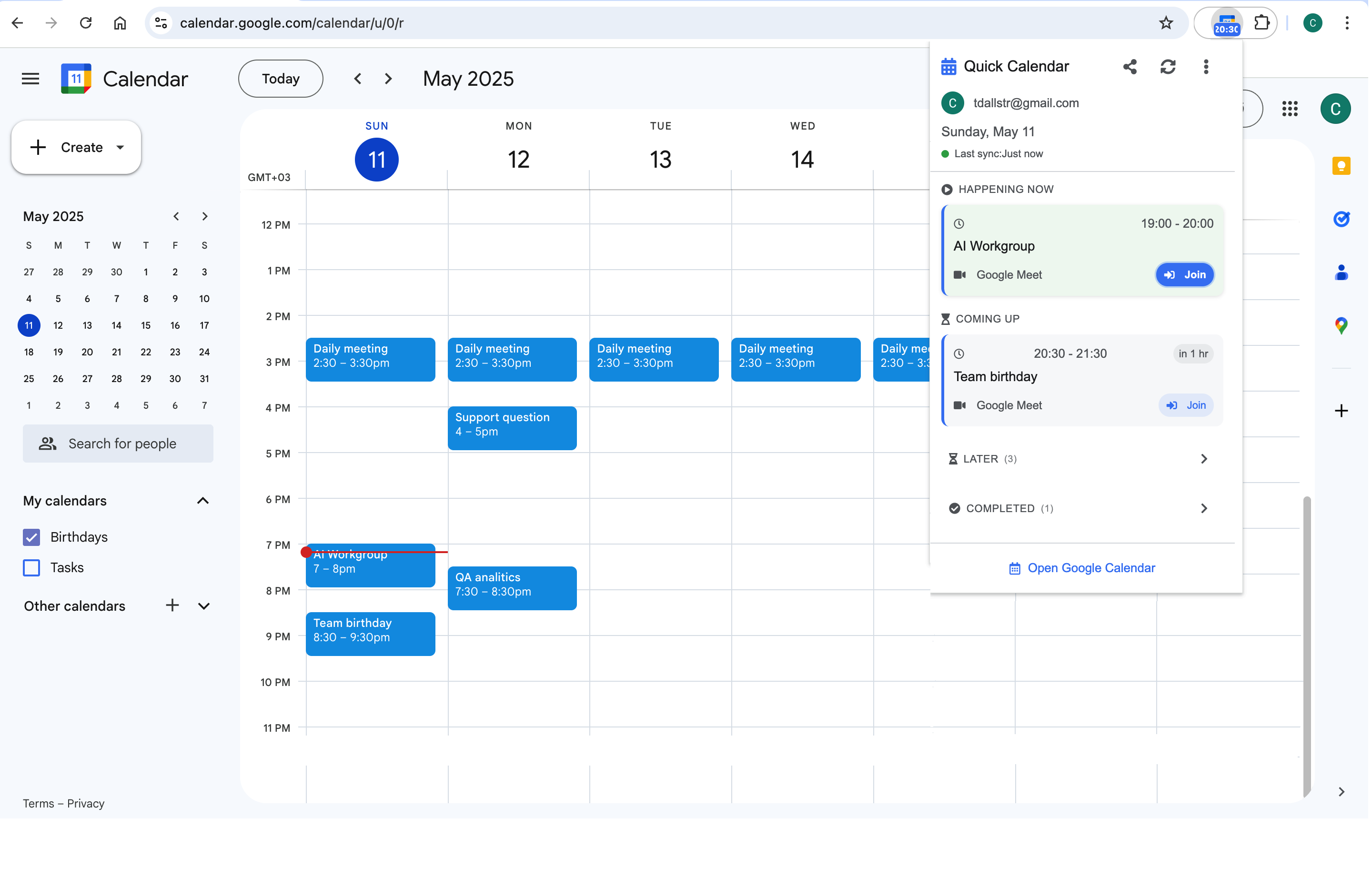
Short answer (data checked September 18, 2026): for glancing at your day from the toolbar, the most-installed option is Checker Plus for Google Calendar™ (300,000 users, 4.4★); for a lighter popup, Button for Google Calendar or our own Calendar Extension for Google Calendar™. For booking links, Calendly; for tasks next to the calendar, Todoist. Pick by job, not by feature count.
The shortlist at a glance
Numbers below are copied from each extension's Chrome Web Store listing on September 18, 2026. User counts are rounded by Google; ratings move weekly, so treat them as a floor check, not a ranking.
| Extension | Job | Users | Rating | Price | Last updated |
|---|---|---|---|---|---|
| Checker Plus for Google Calendar™ | Glance | 300,000 | 4.4 (2.1K) | Free + in-app purchases | Sep 16, 2026 |
| Button for Google Calendar | Glance | 100,000 | 4.1 (209) | Free | Sep 6, 2026 |
| Calendar Extension for Google Calendar™ (ours) | Glance | 7,000 | 4.5 (44) | Free | Sep 18, 2026 |
| G-calize | Enhancer | 200,000 | 4.2 (219) | Free | Aug 16, 2026 |
| GCalPlus | Enhancer | 70,000 | 3.8 (160) | Free | Jul 18, 2026 |
| Calendly Browser Extension | Booking | 700,000 | 4.3 (152) | Free extension; Calendly account required | Aug 25, 2026 |
| Todoist for Chrome | Bridge | 600,000 | 4.7 (51.4K) | Free | Aug 1, 2026 |
| Toggl Track | Bridge | 400,000 | 4.4 (1.5K) | Free | Sep 16, 2026 |
Hire by job, not by feature count
Extension regret comes from feature-list shopping: the tool with fourteen capabilities wins the comparison table and then does your actual job worse than the tool built for it. The four jobs below cover nearly every real hiring decision; identify yours first and the field shrinks to two or three candidates.
Job 1 · "Show me my day without a tab" (glance surfaces)
The highest-frequency job: what’s next, when, how long, join. What distinguishes candidates: popup speed (sub-second or it fails the job), a real timeline with a now-line (lists hide the day’s shape), countdown chips (arithmetic done for you), join-link parsing across Meet/Zoom/Teams, and multi-calendar merge.
- Checker Plus for Google Calendar™ (Jason Savard; 300,000 users, 4.4★ from 2.1K ratings): the feature-dense choice — upcoming events, meeting notifications, and snoozing without opening Google Calendar. Some features sit behind in-app purchases.
- Button for Google Calendar (BrowseCraft; 100,000 users, 4.1★): a lighter popup that checks your schedule and joins Zoom, Google Meet, and Microsoft Teams calls in one click.
- Calendar Extension for Google Calendar™ (ours; 7,000 users, 4.5★ from 44 ratings, free): a day timeline with time-to-event chips, quick add, and one-click joins, with a deliberate handoff to the full calendar for session work.
Our stake, declared: we build the third option, so it is listed with the same Chrome Web Store fields as its neighbors and no ranking. It is also the smallest of the three by installs. Evaluate it with the same protocol below; glance tools argue in the first five minutes or not at all.
Job 2 · "Make the calendar page itself better" (enhancers)
For power schedulers with a named gap in Google’s own UI — bulk edits, extra views, layout fixes. What distinguishes candidates: update cadence (they ride Google’s DOM; staleness is breakage), scope restraint, and single-purpose clarity.
- G-calize (200,000 users, 4.2★): recolors text and backgrounds for specific weekdays, today, and holidays; version 2.3.3 added cloud sync for color settings.
- GCalPlus (70,000 users, 3.8★): “Extra Options for Google Calendar” — expanded month views, busy/free highlighting, and event duplication.
A good enhancer does one thing Google won’t; a bad one does nine things fragilely. Check the changelog before the feature list.
Job 3 · "Let outsiders book me" (scheduling layers)
Booking links with routing, buffers, and forms. What distinguishes candidates: how honestly they respect your existing calendar (busy blocks, working hours, multi-calendar conflicts) and what they cost at your actual volume.
- Calendly Browser Extension (Calendly LLC; 700,000 users, 4.3★): finds and shares scheduling links and adds available times into emails; works with free and paid Calendly accounts.
- Google Calendar appointment schedules (built in, no extension): per Google’s help center, any personal Google Account or Workspace account can create an appointment schedule, while “some appointment schedule features require an eligible Google Workspace or Google One subscription.” Schedules can’t be created from the Android or iOS apps.
The pre-check that saves money: try Google’s native appointment schedules first for the solo case — dedicated tools earn their fee at team routing volume, not before.
Job 4 · "Connect the calendar to my other systems" (bridges)
Task-tool syncs, time trackers, CRM loggers. What distinguishes candidates: failure loudness — a bridge that breaks silently (the task-sync that quietly stopped Tuesday) costs more than it ever saved.
- Todoist for Chrome (Doist; 600,000 users, 4.7★ from 51.4K ratings): adds tasks while you browse and shows them in list, board, and calendar views.
- Toggl Track (Toggl OÜ; 400,000 users, 4.4★): a timer that integrates with 120+ web tools, with idle detection and a Pomodoro mode — useful for turning calendar blocks into tracked time.
Prefer one-way flows, visible sync status, and vendors whose changelog mentions the calendar API by version.
A warning about older "best of" lists
Lists written before 2026 often still recommend Clockwise’s extension. Its Chrome Web Store listing is now titled “Clockwise (deprecated)” with the notice: “This extension is no longer supported. Please uninstall it.” Check the “Updated” date on any listing before installing, including ours.
The evaluation protocol (any job, twenty minutes)
Shortlist two or three per job, then per candidate: read the permission prompt against the feature list (scope greed ends the evaluation); find the privacy policy and its processing location; run the five-minute hands-on (glance tools: three timed opens + one join; enhancers: the one feature on your real calendar; booking: one end-to-end test booking); check recency (last update, developer responses to reviews); and confirm the exit (uninstall, verify the calendar is untouched). Twenty minutes replaces both the listicle and the regret.
What no extension should be hired for
Two anti-jobs, honestly: extensions don’t fix over-scheduling (a glance surface shows the overload faster; only declining fixes it), and they shouldn’t replace the full calendar for session work — planning wants the big grid. Tools that promise either are selling past their species. The right extension makes a well-run calendar cheaper to live with; the calendar’s hygiene remains yours.
Frequently asked questions
You shouldn’t, on authority — which is why this one ships method instead of rankings: jobs, distinguishers, and a protocol that takes twenty minutes to run yourself, on our tool and its competitors identically. A vendor confident in the protocol’s outcome can afford to publish it.
As a floor, yes: recent reviews trending positive plus developer responses signal maintenance. As a ranking, no — ratings reward broad appeal, and your hiring decision is job-specific. A 4.3 tool that nails your job beats a 4.8 generalist at somebody else’s.
Yes — the jobs are complementary by design (a glance surface plus a booking layer is a common pair). The rule is one per job: two glance surfaces or two bridges doubles permission surface and halves clarity about which one broke.
On triggers, not calendars: a breakage week, a permission-expansion prompt (re-read it — expansions deserve fresh scrutiny), a pivot announcement from the vendor, or your own job changing (new role, new meeting volume). Absent triggers, a working tool owes you nothing annual.