Sort by write access, not by demo
Every AI calendar pitch shows the same demo: a beautiful week arranging itself. The evaluation that predicts your actual experience is unglamorous: what can this tool write to, and what happens when its model of your priorities is wrong? Four categories emerge, in ascending order of trust required.
Category 1 · Readers (summarize, never touch)
Meeting summarizers, agenda extractors, "your week in review" analytics. They read the calendar (and sometimes the calls) and produce text; the schedule is untouchable. Risk profile: privacy only — the productivity risk is zero because nothing moves. If you adopt one AI category first, it is this one; the evaluation is purely "is the summary good and where does my data go?"
Category 2 · Placers (schedule new things inside constraints)
Tools that place — "find 3 hours for this before Friday, mornings preferred" — including AI-flavored booking links and the task-schedulers that put chosen to-dos into open slots. The AI decides where, you decided what and whether. This is the sweet spot of the whole field: placement is genuinely tedious for humans, constraints keep the AI on rails, and a bad placement costs one drag to fix. Working rule: placers earn their subscription when you accept 80%+ of their suggestions; below that, you are paying to veto a robot.
Category 3 · Rearrangers (move what already exists)
Defragmenters and "optimize my week" agents: they consolidate scattered meetings, defend focus time by relocating lower-priority items, rebalance load across days. Here the trust question bites, because your calendar is a web of other people’s expectations — every autonomous move generates notifications, confusion, or silent double-bookings when the AI misjudges what was immovable. Adopt only with: approval-before-move settings, a clear activity log, and a two-week probation where you review every proposed change. Most people discover in probation that they accept ~half the moves — which is exactly the argument for keeping approval on permanently.
Category 4 · Negotiators (talk to other humans as you)
Agents that email your contacts to find times, reschedule conflicts by "talking" to the other side’s assistant (human or AI), and manage the back-and-forth autonomously. The demos are seductive; the failure modes are social, not technical — a tone-deaf nudge to a client, a double-negotiation loop between two bots, an important contact who realizes they’ve been talking to software. In 2026 these are justified at genuine EA-replacement volume (dozens of external schedulings weekly) and premature everywhere else.
The questions that filter the field
Five, regardless of category: What exactly does it write to? Can I require approval per change? Is there a full audit log? Where is calendar data processed and retained? What is the uninstall story — does my calendar survive the breakup intact? Any vendor answering vaguely on two of five has answered.
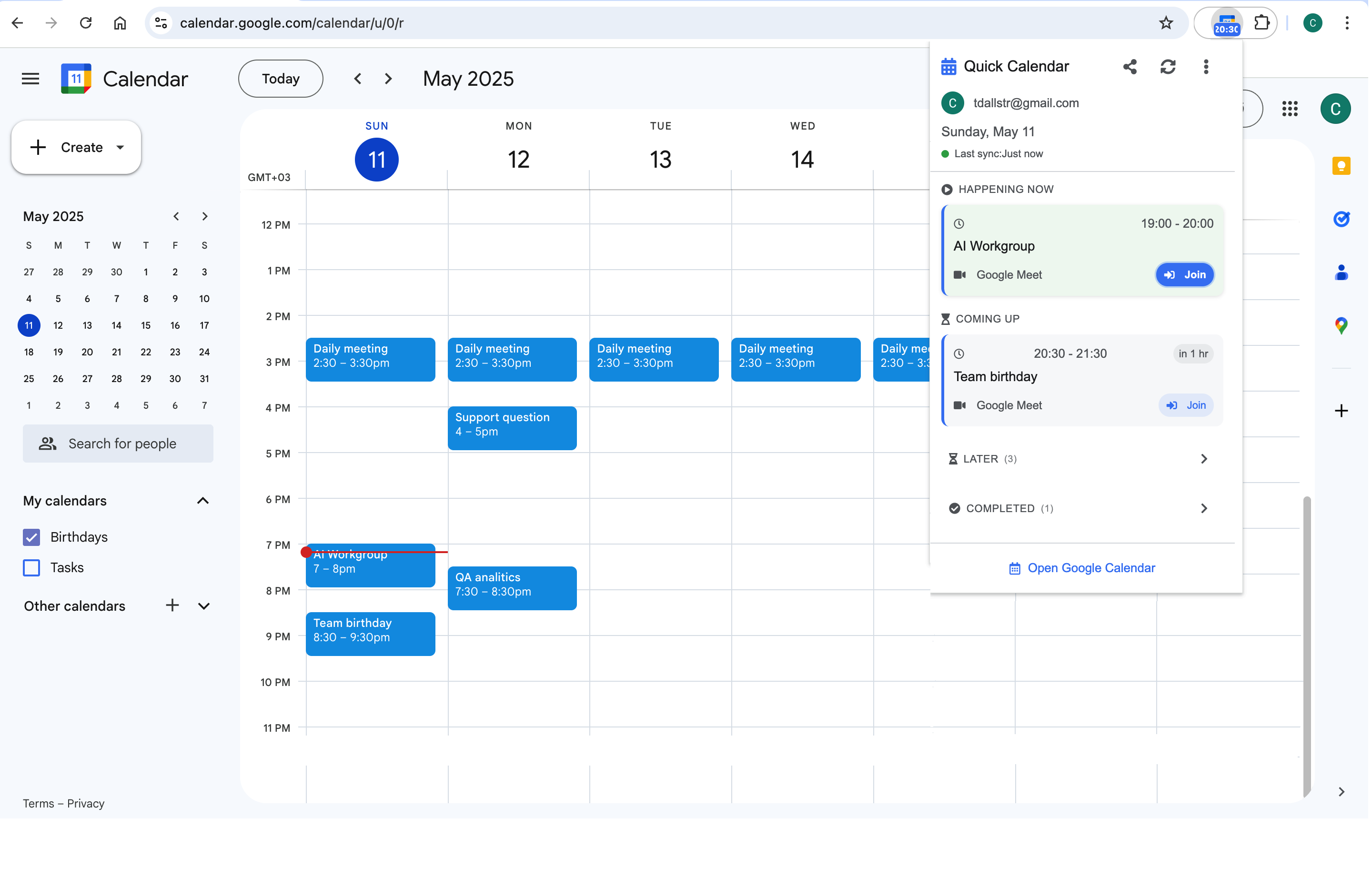
One more honest observation: a large share of "AI calendar" value — what’s next, how long until it, join fast — needs no model at all, just a better surface. A toolbar view like Calendar Extension for Google Calendar™ delivers that layer deterministically: same glance, zero write access, nothing to trust.
Frequently asked questions
Treat them as what they are — a third party attending the call. Check where audio/transcripts are processed and retained, whether they train on your data, and whether legal/HR calls should be excluded by policy. Category-1 tools are the safest AI class, but "safe" here is a data question, not a scheduling one.
They blend 2 and 3: task placement plus week rearrangement. The practical evaluation is the same — turn approval on, run the two-week probation, and measure your acceptance rate. The brand matters less than which category’s permissions you actually enable.
Clean up first, always: every category reads your calendar as ground truth. Fake-busy blocks, zombie recurring meetings, and unmarked personal time become the AI’s facts — and its mistakes. The 90-minute detox is the prerequisite, not the alternative.
A useful bar: 80% for placers (Category 2), 60% for rearrangers with approval-on (Category 3) — below those, the review overhead exceeds the placement savings. Measure it honestly for two weeks; the number decides better than the feeling.