Balance is a booking policy, not a mood
Work events have organizers, deadlines, and notifications; life events have intentions. That asymmetry — not villainous employers — is how weeks fill to 55 hours: every unclaimed evening is claimable, and work is the only side claiming. The counter-policy is parity: life events get entered, sized, and defended exactly like meetings. Not because dinner needs project management, but because on a calendar, whatever isn’t booked belongs to whoever books first.
The parity rules
- Life events are real events: the gym slot, the Wednesday dinner, the school run — recurring, marked Busy, on the grid. Titles can be Private to colleagues (they see Busy); the grid-space is the point.
- They reschedule like meetings, not like hopes: a conflict with the gym block gets the same treatment as a conflict with a client call — a counter-proposal, not a silent surrender. The serial-reschedule pattern (personal items dragged forward daily) is the single clearest early sign the policy has collapsed.
- The day has edges: working hours published, plus a concrete end-of-day anchor ("pickup", "run", "cook") — abstract quitting times lose negotiations; named commitments win them.
The three guardrail events
Beyond parity, three specific recurring events do disproportionate protective work. The transition block (15 minutes at day’s end): the airlock between work-brain and home-brain — WFH especially, where no commute enforces it. The weekly non-negotiable: one life event per week that outranks everything short of genuine emergency — the standing dinner, the Saturday ride. Its function is jurisprudence: one absolute commitment teaches you (and your org) that such a thing can exist. The empty block: 2–3 weekend hours deliberately titled "unplanned" and defended against yourself — balance includes protection from your own scheduling enthusiasm.
The monthly ten-minute audit
Feelings drift; counts don’t. Once a month, scan the last four weeks and tally three numbers: out-of-hours work events (target: under 3/week), life events that actually happened vs. planned (the life-side credibility ratio — below 70% means work is eating the parity), and evenings with zero non-work entries (five blank evenings a week means life isn’t losing negotiations — it isn’t entering them). Each number maps to a fix already named: edges, defense, entry.
What the calendar can’t balance
The honest boundary: if the audit shows work claiming 55+ hours structurally — not in seasons, but as the resting state — no booking policy fixes a load problem. What the calendar does is make that fact undeniable and specific, which converts "I feel overwhelmed" into "here are four weeks of evidence" — the version of the conversation (with a manager, or with yourself about the job) that actually goes somewhere.
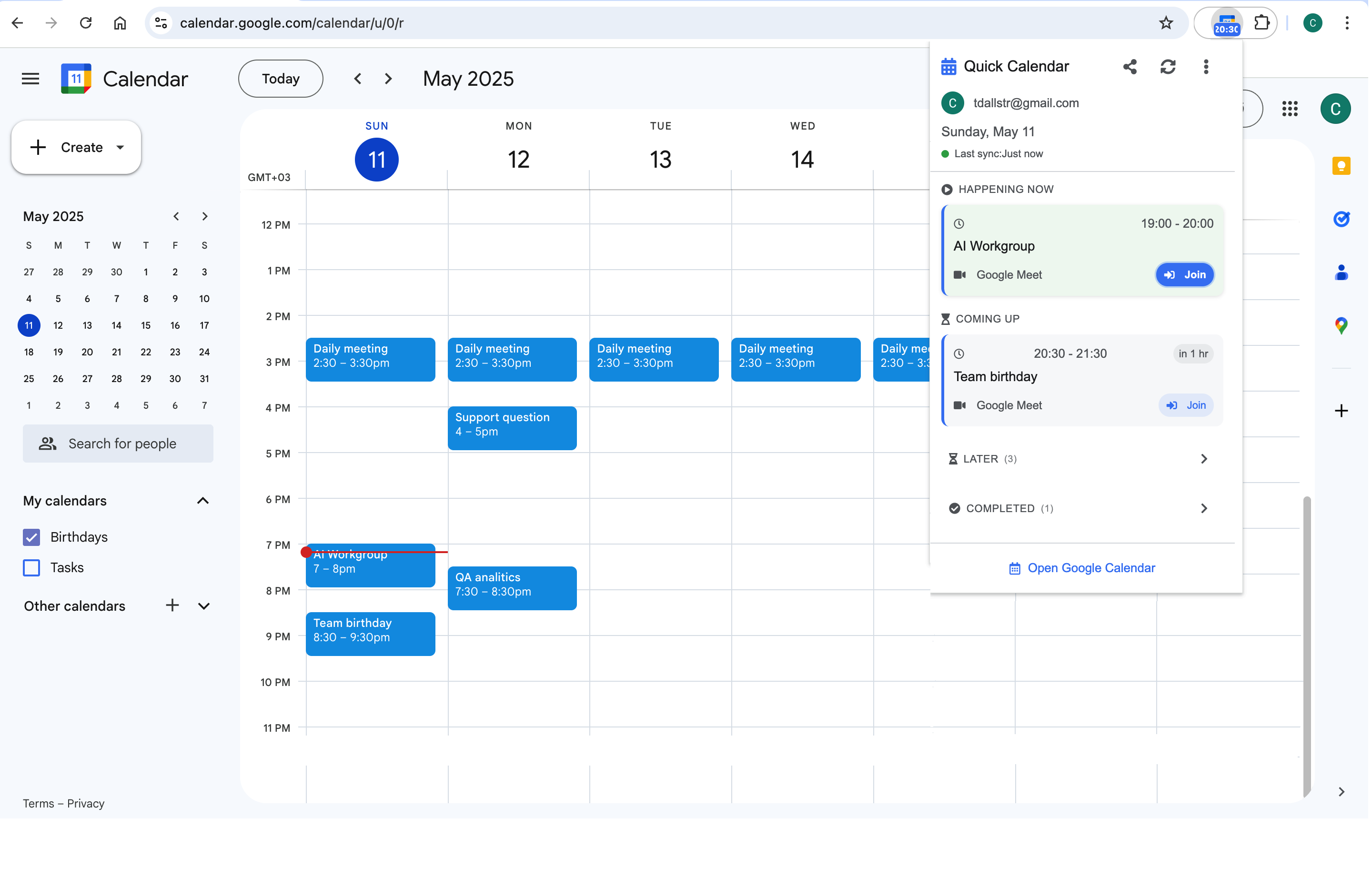
Parity also needs the glance layer: seeing tonight’s "Dinner — Sam" while triaging a 17:40 meeting request is what makes the counter-proposal reflexive. A toolbar view like Calendar Extension for Google Calendar™ keeps the whole day — both sides of it — in the same two-second look.
Frequently asked questions
Grid-space must be visible; content needn’t be. Mark personal events Private — teammates see Busy, the find-a-time respects it, and your evening stays yours in both senses. The mistake is marking them Free to "not block anyone", which is parity surrendered at the settings level.
The empty block is the spontaneity defense: it reserves space without content. What kills spontaneity isn’t booking it a container; it is the container being colonized by errands and catch-up work because nothing marked it claimed. Structure at the boundary, freedom inside it.
A shared family calendar carries the joint immovables (pickups, dinners, trips) — both people’s work scheduling then routes around one authoritative layer instead of two memories. The parity rules apply to it doubly: joint events are the least reschedulable class on the grid.
It bends, visibly and temporarily: the weekly non-negotiable survives even crunch (that is what non-negotiable means), the rest downgrades with an end date — "until the launch on the 15th". A suspension with a date is a season; without one, it is the new policy, and the audit will say so within a month.