The calendar replaces architecture
Offices enforced boundaries physically: arrival started work, the commute ended it, a closed door meant busy. Remote work deletes the architecture but not the need — and the calendar is the only structure left standing that colleagues, household, and future-you all consult. Treat it as load-bearing.
Structure 1 · Hard edges, published and enforced
Set Working hours (Settings → Working hours & location) to your true intended day — say 8:30–17:30 — and let the built-in warning nag anyone scheduling outside it. Then add the piece Google doesn’t provide: a recurring 17:30 event titled with your actual next commitment ("Kitchen duty", "Run", "Pick up kids"). Abstract end-times lose negotiations; concrete ones don’t, including negotiations with yourself.
Structure 2 · Synthetic commutes
The commute was terrible and also load-bearing: it forced a mental state change twice a day. Rebuild it as two 15-minute recurring blocks — "Walk in" before your first work block, "Walk off" after the last. Fill them with anything embodied and non-work: an actual walk, dishes, stretching. WFH veterans consistently report this single structure does more for evening detachment than any app; the day needs an airlock, not a hard cut.
Structure 3 · Lunch is a meeting with yourself
At home, lunch degrades into eating over the keyboard unless it owns grid space. Recurring block, 45 minutes, marked Busy, titled "Lunch" without apology. Colleagues book over invisible lunches, not visible ones — and if yours still gets booked, that is a working-hours conversation with one specific person, not a system failure.
Structure 4 · The household treaty
Cohabitants can’t see your status ring; they see you at a desk, apparently interruptible. Two mechanics fix most of it: a shared family calendar carrying the immovables from both sides (their appointments block your scheduling too — that is the treaty’s other half), and a visible signal tied to calendar state — headphones on during Busy blocks, door open otherwise. The calendar defines the boundary; the signal broadcasts it locally.
Structure 5 · Make off-hours structurally unreachable
Boundary discipline decays if enforcement relies on nightly willpower. Automate the edges: notification schedules on your phone (work apps silent after 18:00), Slack’s notification hours matched to your working hours, and — the calendar’s contribution — never accepting recurring meetings outside your published day without a compensating adjustment ("yes to the 18:00 with Sydney, so I start at 10:00 Thursdays"). Every uncompensated exception is a precedent with your name on it.
The tell that it’s working
One metric, checked monthly: how often did work events appear outside your published hours? Zero is unrealistic; twice a month is healthy exceptions; twice a week means the published day is fiction and needs renegotiating — either with your team (load) or with yourself (honesty about when you actually intend to work).
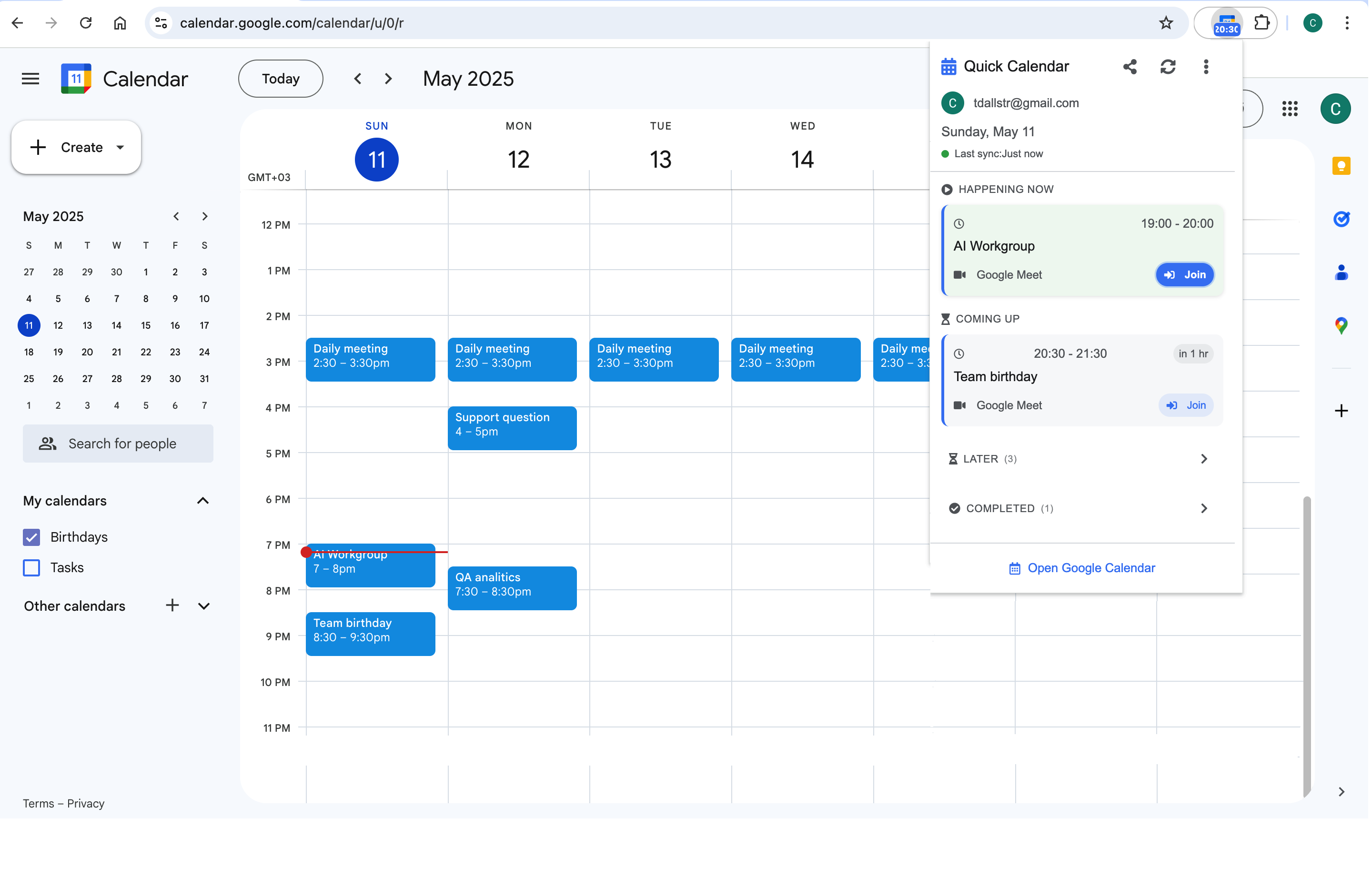
Boundaries also shrink a sneaky WFH habit: the after-dinner "quick calendar check" that turns into forty minutes of pre-living tomorrow. A toolbar glance like Calendar Extension for Google Calendar™ satisfies the actual need — "when does tomorrow start?" — in two seconds, no tab, no inbox ambush on the way out.
Frequently asked questions
Compensate structurally, not heroically: accept the 19:00 and move your start to 10:30 that day, on the calendar, visibly. Boundaries survive timezone reality when exceptions are paid for; they die when late calls silently extend the day.
Entries. The block does two jobs intention can’t: it stops the 16:45 meeting from bleeding to 17:30 (the walk-off is visibly next), and it survives low-willpower days on autopilot. Fifteen minutes of grid space is cheap rent for a working off-switch.
The shared calendar is the negotiation table: household immovables go on it from both sides, and both sides schedule around it. Most "interruption" conflicts are actually visibility conflicts — they guessed you were free because nothing said otherwise.
Detail-visibility is a choice: those blocks can be marked Private (colleagues see Busy) while staying honest for you and your household calendar. But teams increasingly read a visible 17:30 "Run" as exactly what it is — an end-of-day boundary working as designed.