The worst-day test
Any scheduling habit you adopt will meet a brutal week within a month. The design question is not "does this work when I’m disciplined?" but "what does this cost on a day with six meetings and a fire?" Every habit below has a full version and a minimum viable version — the MVV is what makes it survive, because shrinking a habit preserves it while skipping teaches quitting.
Habit 1 · The morning look (2 minutes, MVV: 20 seconds)
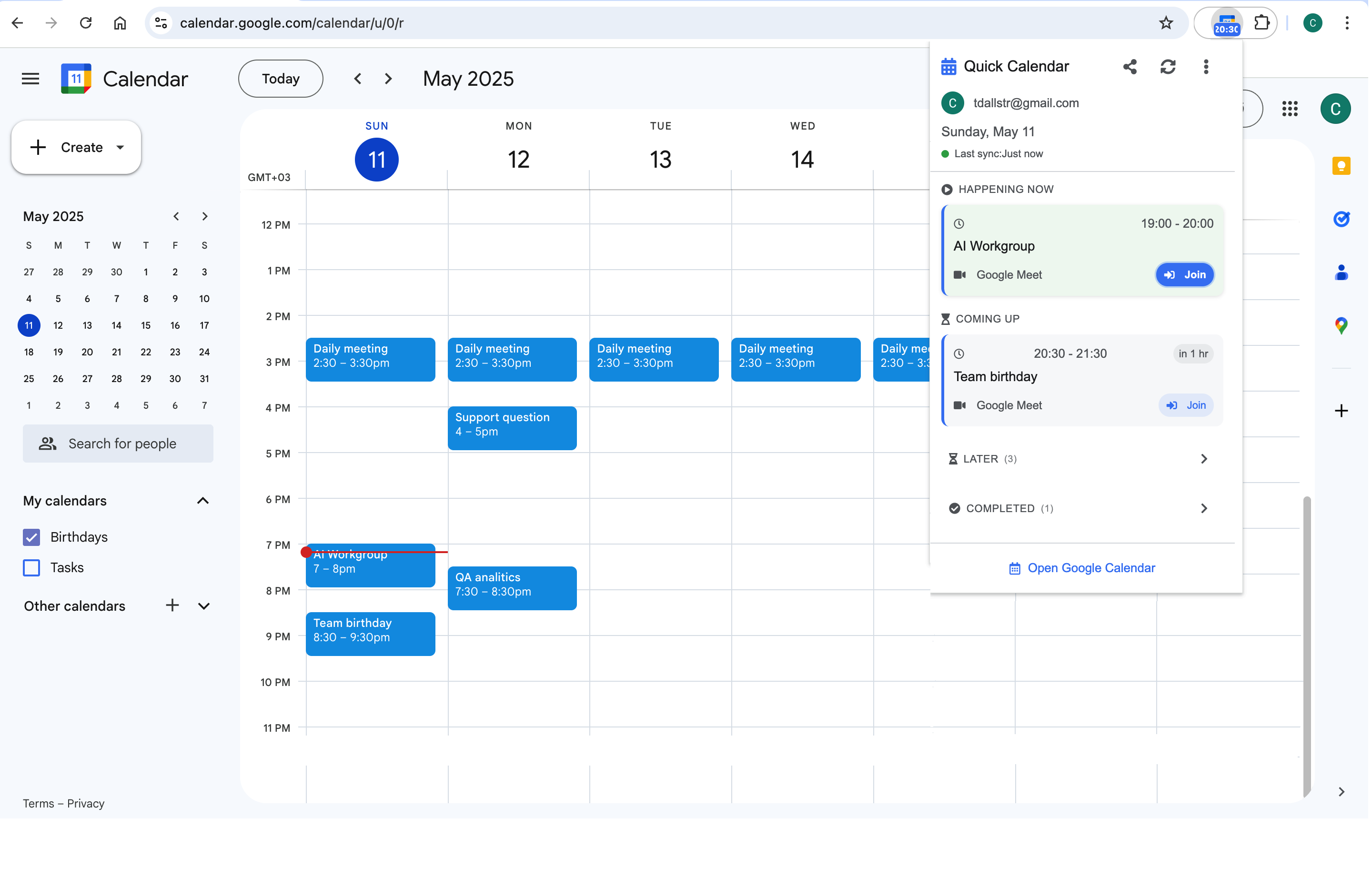
Before the first task, read today once: what’s immovable, where the gaps are, what single thing must ship. Not planning — orientation. The MVV is a glance at a day strip with coffee in hand: even that prevents the 10:58 discovery of an 11:00 meeting. Sustainable because it attaches to an existing anchor (the first coffee) rather than requiring a new one.
Habit 2 · Estimate +25%, always (0 minutes — it’s a multiplier)
Chronic over-scheduling is chronic under-estimating. The fix that costs nothing: whatever time you were about to give a task, add a quarter. A 60-minute draft becomes 75; a "quick" review becomes 40. This habit is uniquely sustainable because it has no daily cost at all — it is a correction applied at the moment of scheduling, and the payoff (days that end on time) reinforces it automatically.
Habit 3 · One protected block, not five (weekly placement: 3 min)
The unsustainable version protects fifteen hours of focus a week and dies defending them. The sustainable version places one non-negotiable deep block per day — 90 minutes, best hours, set to Busy — and lets everything else stay flexible. One block survives meeting-heavy cultures; a wall of blocks invites a siege. MVV on brutal days: 45 minutes, still held.
Habit 4 · Decline-or-shrink on arrival (10 seconds per invite)
Process each invite the moment it appears with one question: does this need me for its full length? Three exits: accept as-is, propose the shorter version ("can we do 15?"), or decline with a one-line note. The sustainable core is doing it on arrival — invites processed immediately never pile into a dreaded backlog, and organizers get answers while plans are still soft.
Habit 5 · The Friday shrink-wrap (15 min, MVV: 5)
End the week by making next week honest: delete the fictions, place two big rocks, buffer the worst seams. The full ritual is fifteen minutes; the five-minute MVV is steps one and two only. What makes it sustainable is the payoff’s timing — Monday-you inherits a real plan, and that felt relief on Monday is what funds next Friday’s repetition.
Why these five reinforce each other
They form a loop, not a list: the Friday shrink-wrap places the blocks (H3), the +25% multiplier sizes them honestly (H2), decline-or-shrink protects them during the week (H4), and the morning look (H1) catches what moved overnight. Break one on a bad week and the others hold the structure — which is the actual definition of a sustainable system: graceful degradation instead of collapse.
Habits 1 and 4 live or die by access cost — a twenty-second morning look is only twenty seconds if the day is one glance away. A toolbar timeline like Calendar Extension for Google Calendar™ keeps both habits under their MVV budgets: today’s strip on one click, new invites visible next to the real day.
Frequently asked questions
The attachment trick shortcuts the usual answer: habits anchored to existing routines (coffee → morning look, Friday close → shrink-wrap) typically feel automatic in two to three weeks. Free-floating habits ("review calendar daily, sometime") take months or never.
The +25% multiplier — it costs zero minutes, requires no ritual, and directly attacks the over-scheduling that makes every other habit feel impossible. Realistic days create the slack the rest of the system grows in.
Ninety held minutes a day is 7.5 deep hours a week — more than most calendar-heavy roles currently get, and crucially it is reliable, so you plan real work into it. Five aspirational blocks that survive 40% of the time deliver less and teach you to distrust your own calendar.
Nothing, if you re-enter at the MVV level: Monday, do the 20-second look and nothing else; add the invite rule when it feels free. Sustainable systems are defined by cheap re-entry — the expensive part of most productivity methods is the guilt-powered restart, and MVVs delete it.