The diagnostic: are you planning or hiding?
Four tells separate planners from overplanners. You re-plan the same day more than once before it starts. Your planning sessions exceed 20 minutes but your follow-through rate stays under half. The calendar gets more detailed as deadlines get scarier (detail as anesthetic). And the plan’s failure at first contact triggers a full re-plan instead of an adjustment — because the plan was the deliverable, and now it is broken.
Why the brain loves it
Planning delivers a real completion signal — the tidy grid produces the same "progress" sensation as progress, at a fraction of the emotional cost of the actual work. That makes it the perfect avoidance behavior: socially praised, personally soothing, and infinitely extensible. Naming the mechanism matters because the fix is not "plan better"; it is capping the soothing activity and redirecting the anxiety it was absorbing.
The planning diet
- Budget: 15 minutes weekly, 5 daily, hard stop. Timers, not vibes. Everything a knowledge-work week needs from planning fits inside that budget — two rocks, honest blocks, a purge, a first-block note. What doesn’t fit was decoration.
- Resolution limit: nothing under 30 minutes gets scheduled. Fifteen-minute micro-slots ("9:00 emails, 9:15 review Dana’s PR, 9:30 …") are the overplanner’s signature and the brittleness itself — one phone call shatters six dominoes. Coarse plans bend; fine plans break.
- One pass, no polishing. The plan is written once, left ugly, and edited only by events. Re-opening the plan to improve it is the habit loop firing; the response is doing the first planned thing instead — which is what the anxiety was avoiding.
- Plan the next step, not the cascade. Overplanners schedule step 4’s contingencies before step 1 exists. The calendar gets the next concrete block per project; the future gets a milestone. Cascades live in your head rent-free and in plans as fiction.
The replacement behavior (this part is load-bearing)
Capping planning without replacing it just relocates the anxiety. The redirect: when the urge to re-plan hits mid-day, start a 15-minute timebox on the scariest planned item — first contact only, no completion pressure. The urge to plan is nearly always fear of a specific task wearing an organizer’s costume; fifteen minutes of contact deflates it more reliably than any amount of scheduling around it. Keep the swap explicit: "I want to re-plan → I timebox the thing I’m planning around."
What a right-sized plan looks like
Two or three blocks with output names, meetings as they are, one shallow batch, visible white space, and a first-block instruction for tomorrow. It fits on a day strip, survives a surprise, and took five minutes. It is also — this is the hard part for recovering overplanners — slightly unsatisfying to look at. That dissatisfaction is the anesthetic wearing off, and it passes within two weeks.
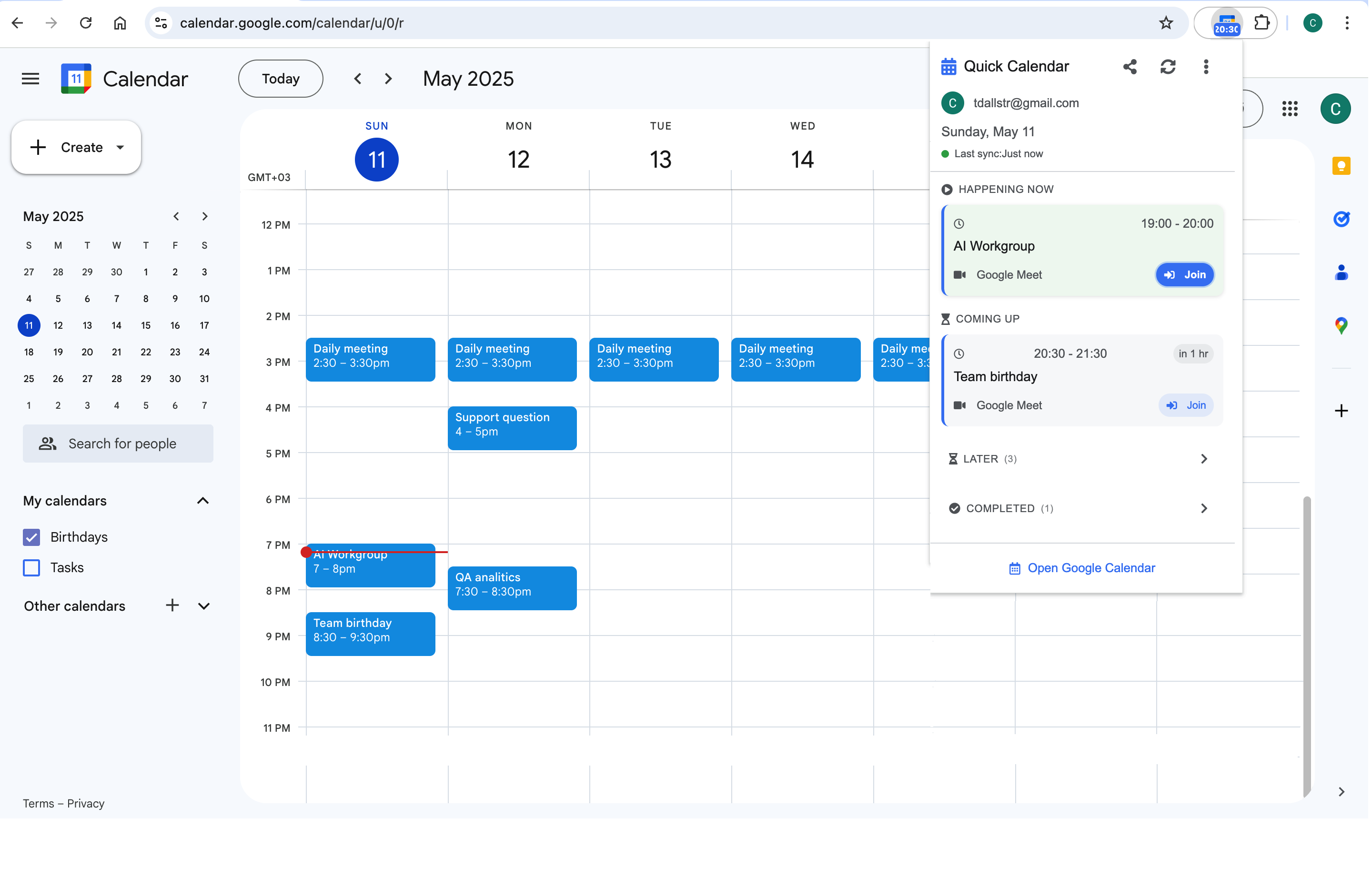
Overplanning feeds on the full-grid view — Month view especially is a re-planning invitation. Living out of a glance surface instead (the day strip in Calendar Extension for Google Calendar™, one click) structurally starves the habit: you can check a plan in two seconds, but you can’t polish one there.
Frequently asked questions
Complexity lives in the work, not the schedule: the plan only decides when the next concrete steps happen, which is a small decision set even in complex roles. Roles with genuinely heavy coordination needs spend more time in shared planning (sprint ceremonies) — which is precisely why the personal layer can stay thin.
External structure genuinely helps — the distinction is structure-as-scaffold (visual timers, body doubles, coarse blocks with alarms) versus re-planning-as-ritual. The follow-through-rate test still applies: structure that gets executed is scaffold; structure that gets rebuilt daily is the avoidance loop, ADHD or not.
Enjoyment plus follow-through = a hobby that pays; keep it. The diet targets the anxious version: planning that spikes near deadlines, produces brittle grids, and substitutes for starting. If your Sunday 30 minutes is genuinely pleasant and Monday executes it, you were never the patient.
The one-slot repair: move the single collided block to the day’s next honest gap, demote the day’s least important item if needed, and continue — 60 seconds, no full redesign. Plans are budgets, and budgets absorb line-item changes without re-drafting the whole sheet.