Why recurring meetings outlive their purpose
Three forces immortalize a dead series: default recurrence ("Ends: Never" is one click and eternal), diffuse ownership (nobody feels licensed to kill what everyone attends), and the sunk ritual — after month six, attendance is identity, not utility. None of these is anyone’s fault, which is why the fix is a scheduled process rather than waiting for courage: the audit runs quarterly, on the calendar, 30 minutes.
The one question, and the four verdicts
For every recurring series you own or attend: what did the last month of instances produce? Not "is it useful in principle" — produced, concretely: decisions made, blockers cleared, information that changed someone’s actions. The answer sorts each series into four verdicts:
- Keep — it produces. Shrink it a notch anyway (60→45, 30→25); production rarely fills the container it was given in optimism.
- Reshape — it produces, monthly-ish, while meeting weekly. Halve the cadence: weekly→fortnightly is the audit’s single highest-yield edit, cutting cost 50% while losing almost nothing.
- Convert — it transfers information without generating agreement. Same cadence and deadline, async medium: the thread or doc inherits the slot’s job, a 15-minute on-demand call inherits its exceptions.
- Kill — nothing produced, nobody would re-create it today. Proceed to mechanics.
Kill mechanics: ending a meeting without a funeral
For series you own, the announcement that works is purpose-framed and revival-friendly: "This served its purpose — pausing the series. Anyone can revive it with an agenda when there’s a decision to make." "Pause with revival rights" gets zero pushback where "cancel" gets nostalgia; unrevived pauses become deaths quietly, which is the point. Then edit the series → Ends → today. For series you merely attend: your verdict applies to your attendance — exit with the standard note ("notes cover me; one-off invite if my part comes up"), and let the owner run their own audit. Three exits in a quarter is an audit the owner didn’t schedule.
Prevention: the end-date rule
The audit shrinks over time if new series stop being immortal at birth: every recurring meeting gets an end date at creation — eight weeks, ~10 instances. Renewal is then a 30-second decision at expiry instead of a quarterly excavation. Teams that adopt the rule find the audit becomes mostly a formality within two quarters; the meetings that renew are the ones that would have survived anyway, and the rest simply… stop, without anyone having to kill anything.
The audit’s ledger
Keep one line per audit in a running note: date, series touched, hours/week recovered. Two reasons: the ledger is the argument next quarter when someone proposes re-adding a weekly ("we recovered 4.5 hours in March; what changed?"), and it converts the audit from chore to visible win — teams repeat what they can see paying.
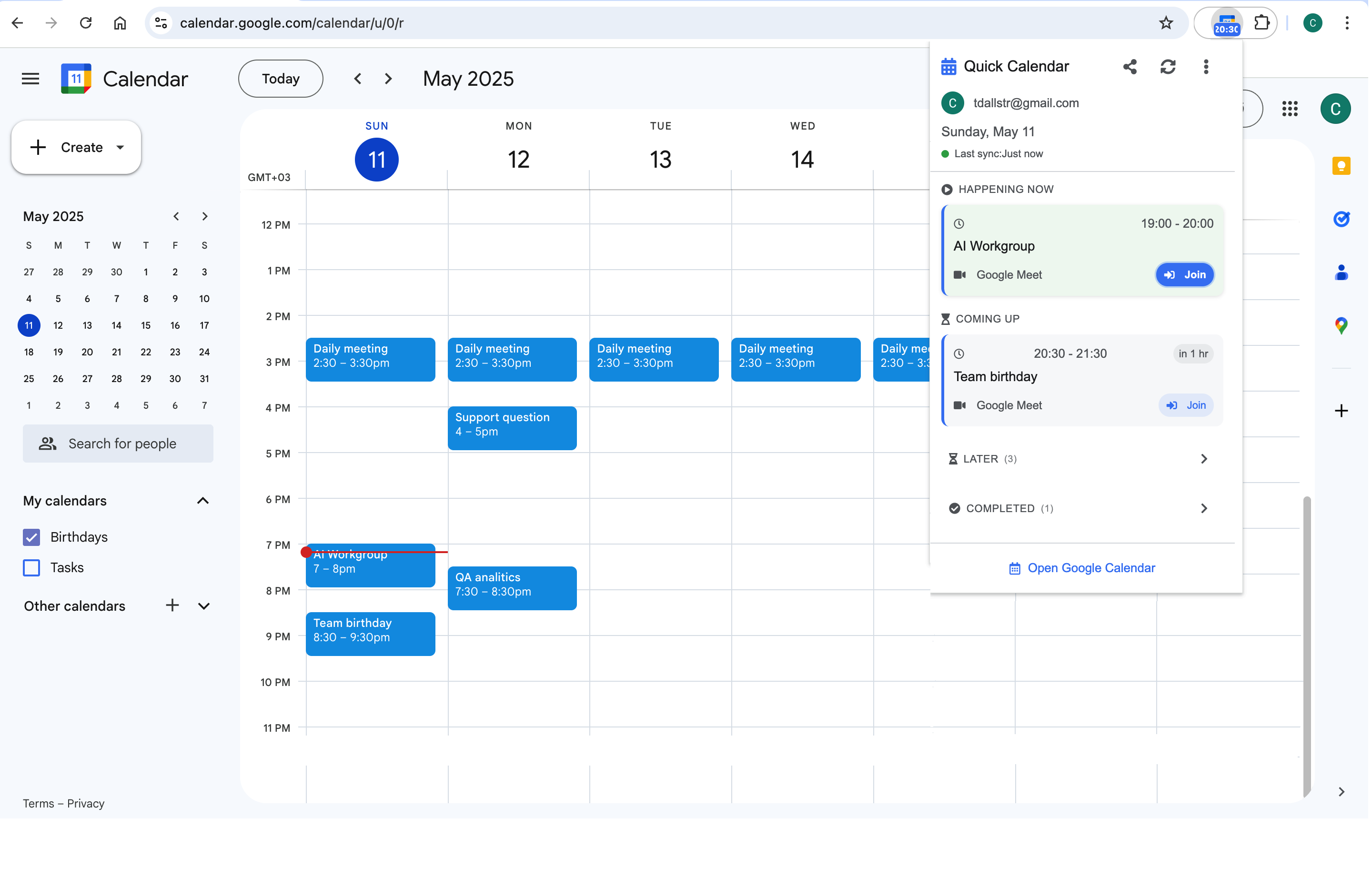
Audit verdicts need usage data, and your calendar has it: scanning a series’ recent instances — did it happen, did it shrink, what did its notes say — is a five-click job per meeting in the toolbar timeline of Calendar Extension for Google Calendar™, which keeps the whole quarterly pass inside its 30-minute box.
Frequently asked questions
Name the value honestly and budget it deliberately: a fortnightly 25 for relationship maintenance is a legitimate line item. What the audit kills is the unexamined version — an hour weekly delivering "vibes" that a deliberate 25 fortnightly delivers equally. Convert vague value to named value, then size it.
All-hands are transfer-and-culture vehicles, audited on different criteria: is the information better than a doc, and does the ritual carry culture people actually feel? Shrink and de-frequency before killing (monthly 25 beats weekly 60), and move the pure-transfer content async — the culture segment rarely needed the hour.
Audit the format, never the existence: 1:1s survive every healthy audit, but their cadence and length flex (weekly 25 for new reports, fortnightly for veterans who prefer it). Ask the other person in the 1:1 itself — the audit conversation is itself relationship maintenance done right.
Orphaned series are pre-failed audits — the finding is the ownerlessness. Post the question in the meeting’s channel: "who owns this series?" Silence for a week is a verdict; anyone then has standing to propose the pause-with-revival-rights ending.