First: declare it, to yourself
The overbooked week’s biggest cost is denial — attempting the impossible schedule as-is, failing publicly all week, and apologizing serially. The protocol starts with the declaration: this week, as booked, will not happen; the only question is which version of it does. That reframe converts you from the week’s victim to its editor, and everything below is editing.
The 25-minute triage pass
Minutes 0–5 · Find the one thing
Of everything booked, which single outcome matters most in a month’s retrospect? One, not three. Give it the week’s best surviving 90-minute space immediately — before triage frees anything — because the one thing funded first is what makes the rest of the editing feel like strategy instead of loss.
Minutes 5–15 · Grade every remaining commitment
Fast pass over each event, four grades, gut-level: Attend (you are load-bearing), Shrink (attend 15 of the 60; send input and skip the rest), Move (matters, but not this week — propose next week now, while apologizing is cheap), Drop (decline with the one-liner; if it stings, remember declining Monday reads as planning, declining Thursday reads as drowning). Typical distribution on a truly overbooked week: a third survives as Attend; the rest splits across the other three.
Minutes 15–22 · Execute the messages
Send every decline, shrink-notice, and move-proposal in one batch, now. Batch execution matters psychologically (one unpleasant sitting instead of a week of dread) and socially (organizers get maximum notice). Template for all of them: reason, one line, honest; alternative, concrete; no third sentence.
Minutes 22–25 · Armor what remains
The surviving schedule gets crash-protection: 10-minute buffers after the two worst clusters, lunch restored as a Busy block, and tomorrow’s first block given a written instruction. Do not fill freed space with rescheduled ambition — freed space this week is the recovery.
During the week: the two standing orders
New requests get next week by default. The sentence: "This week is committed — Tuesday next week?" No triage re-litigation per request. The Wednesday pulse: sixty seconds — is the one thing still alive? If it lost its block, rescue it visibly (move something graded Attend if necessary). A week where everything slipped but the one thing shipped is, on review, a good week.
After: the five-minute inquest
Friday, ask where the overbooking came from — because it has a source, and sources repeat. The usual three: a yes-reflex under social pressure (fix: decline-or-shrink at invite arrival), invisible load (accepting into a week you hadn’t looked at — fix: the glance before any yes), or structural under-capacity (every week looks like this — fix: the manager conversation, with this week as the exhibit). One sentence in a note; next month’s you will use it.
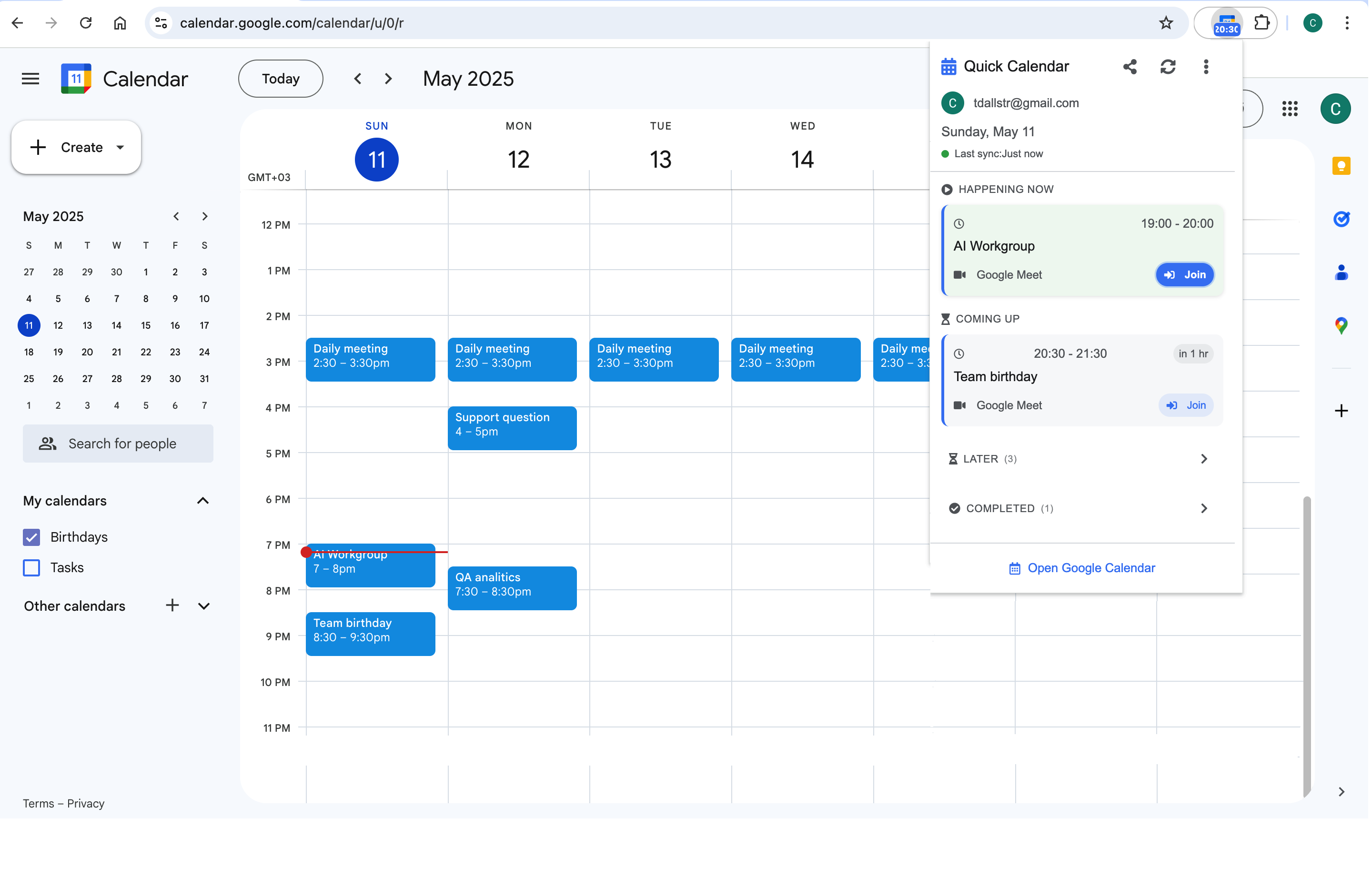
Standing order #1 runs on seeing the week’s true density before answering anything. A toolbar glance via Calendar Extension for Google Calendar™ puts the loaded day strip one click from the request you’re about to answer — which is how "Tuesday next week?" becomes reflex instead of retreat.
Frequently asked questions
Two tests, both required: the outcome changes if you specifically are absent, and the meeting produces a decision or unblock this week. "I usually go" and "they expect me" fail both. Expect the honest pass to demote more than feels comfortable — that discomfort is the overbooking talking.
Same grammar, plus the escape hatch: "This week collapsed and I’m protecting X per our priorities — can I send written input, or does this need me enough to bump something?" Seniors handle explicit trade-offs well; what they punish is silent no-shows in week-of chaos.
The weekend buys ~8 hours once, at recovery cost, and teaches your org the overbooking clears itself — guaranteeing a rerun. Triage buys more hours, is repeatable, and sends the accurate signal. Reserve weekend spending for true single-event crunches with end dates, not as the overbooking pressure valve.
Then it explicitly moves to next week’s rock slot the same day — with a message to whoever awaits it. The failure mode isn’t losing the one thing to a genuine emergency; it is losing it silently and discovering the loss on Friday. Visible re-planning preserves the credibility that quiet slippage spends.