The five-minute standard prep
Run this in the buffer before any recurring call — it is deliberately small enough to survive busy days:
- Minute 1 — read your own last notes. Not the doc history; your three lines from last time. Continuity is the difference between a series of meetings and the same meeting repeated.
- Minute 2 — check the commitments. What did you owe this call? Done, or arriving with a status and a date. Nothing erodes a recurring meeting faster than amnesia about its own action items.
- Minute 3 — write your one line. The single thing you need from this instance: a decision, an unblock, a heads-up delivered. If you cannot write the line, consider skipping this instance (see below) — attendance without an agenda item is spectating.
- Minutes 4–5 — scan the shared agenda and add your line to it. If no shared agenda exists, your line in the chat thread creates the norm by example.
Store the checklist where it fires itself
Checklists die in drawers. Put this one inside the recurring event’s description — edit the series once ("All events") and every future instance carries it. The event becomes self-documenting: prompts at the top, links (notes doc, dashboard) below, and every new attendee inherits the ritual without onboarding. This is also where the meeting’s standing goal line lives, so drift is visible against it.
The two-tier upgrade for consequential calls
Client calls, exec reviews, negotiations — same skeleton, heavier build, ~15 minutes the day before rather than in the buffer:
- Outcome sentence sharpened: "leave with sign-off on scope" beats "discuss scope".
- The three questions they will ask — written down with your answers. This single habit outperforms slide-polishing on nearly every consequential call.
- Pre-reads sent 24h ahead, attached to the calendar event (guests find them where they find the meeting).
- Logistics swept: the right link, the right room, the right attendee list — checked the day before, when fixes are free.
The skip protocol (prep’s honest sibling)
Minute 3 sometimes reveals you have nothing for this instance and it has nothing for you. The professional move is the declared skip: "Nothing on my side this week and no open items — skipping this one; notes will catch me up." Declared skips keep recurring meetings honest twice over: your absence is planned-around, and organizers get a weekly signal about who the meeting still serves. Three consecutive skip-worthy weeks is data the meeting’s end-date review should hear about.
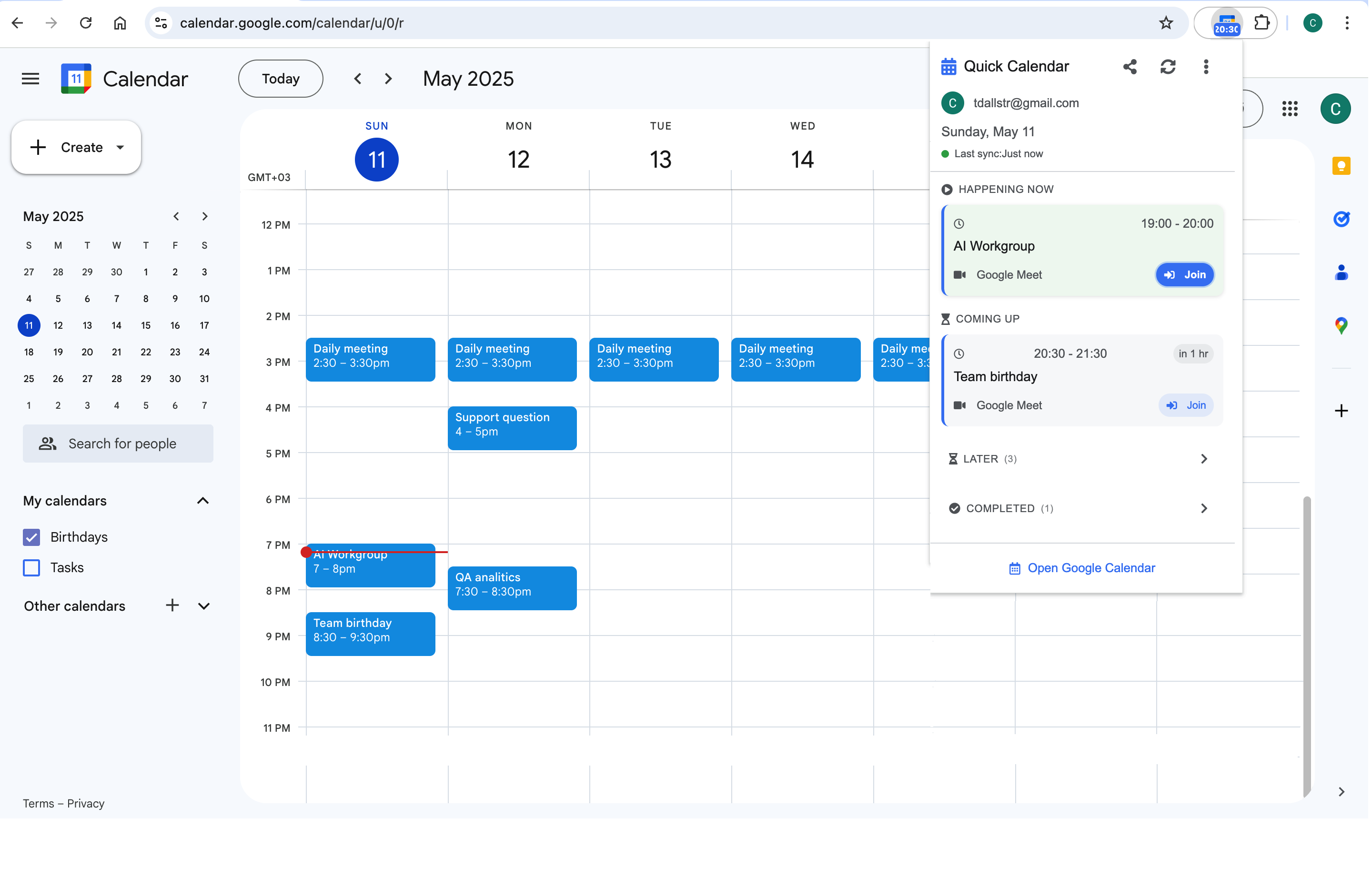
The five-minute prep needs a five-minute space to live in — which is what a visible time-to-next-event chip protects. A toolbar view like Calendar Extension for Google Calendar™ shows the countdown while you are still in the previous task, turning "the sync is in 10" from a surprise into the prep window it was supposed to be.
Frequently asked questions
One running doc per recurring meeting, newest at top, linked from the event description — one click from prep. Per-meeting scattered docs and memory both fail the minute-1 test; the running doc is the only format that makes continuity cheap.
Fully — minutes 1–3 are attendee moves (your notes, your commitments, your line). Only minute 4’s agenda-tending assumes influence, and adding your item to someone else’s agenda usually reads as engagement, not overreach.
It is the day-before pass, not the total: the pre-read you send did the heavy lifting earlier. The checklist’s job is the last-mile conversion — outcome sentence, their three questions, logistics — which is exactly the layer people skip after over-investing in slides.
Structure beats exhortation: shared agenda in the invite (their line takes 30 seconds), pre-reads attached to the event, and the meeting starting from the agenda rather than a re-cap. People prep when the meeting visibly consumes prep — and visibly wastes none of it.