Clear it, don’t announce it
Skip the proclamation; just make one day structurally meeting-proof. Pick your calendar’s already-lightest day (four weeks of history will nominate one — usually mid-week). Then evict what’s there: recurring meetings get moved with a bland, unremarkable note ("shifting our sync to Tue 14:00 — works better with my focus schedule"), one-offs get rescheduled at eviction time. Quiet mechanics attract less immune response than announcements; colleagues adapt to what the calendar shows faster than to what memos claim.
The enforcement stack
- All-day Focus time block (Workspace) or 9:00–17:00 Focus/Busy block, recurring weekly on the chosen day.
- Auto-decline on, with a message that does the diplomacy: "Wednesdays are my deep-work day — I’m free Tue/Thu and happy to make time then. Truly urgent: message me." The machine refuses so you never have to type it warm.
- Working location honest (if hybrid): meeting-free day pairs naturally with a home day — the commute savings compound the focus gains.
- One escape hatch, pre-defined: external commitments you don’t control (clients, interviews) override the day, and get a 25-minute buffer on each side as the toll. Everything internal reschedules — no exceptions in the first four weeks, or the day never consolidates.
Handling the three predictable pushbacks
"But this is the only slot that works for everyone" — usually means the only slot this week: "Next Tuesday 10:00 works — or I can send written input for tomorrow." Written-input offers resolve half of these without a meeting. The senior override — make the cost visible, once: "Can do — it breaks my focus day, so the analysis moves to Friday. Prefer that, or Thursday for the call?" The chronic re-booker — one direct conversation beats twenty declines: "Wednesdays are how I ship the actual work; what recurring slot on Tuesday can I give you instead?" Chronic bookers mostly want guaranteed access, and a standing slot buys them off completely.
Spending the day (this part decides whether it survives)
Meeting-free days die two ways: eroded by exceptions, or squandered into "catching up on email" until they feel pointless. Prevent the second with structure: the day gets one headline deliverable (named the Friday before, in the block’s description), a morning 2.5-hour session on it, a real lunch, and an afternoon split between the deliverable and a batched shallow-work box. The evidence that defends the day later is the string of Wednesday-shipped work — keep an informal list; it is your renewal argument when anyone (including you) questions the arrangement.
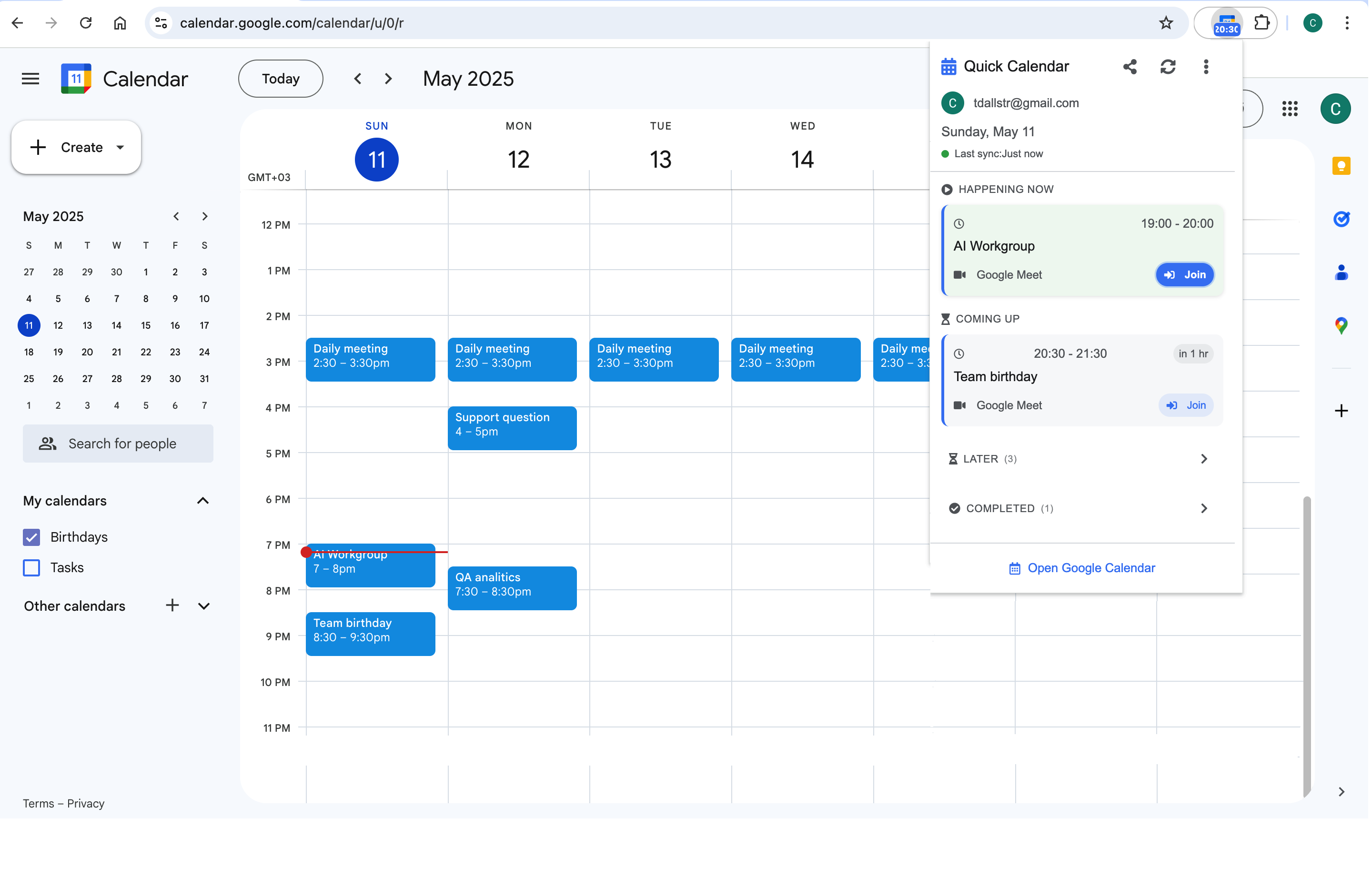
On the day itself the calendar goes quiet, but invites keep landing — Thursday’s and Friday’s. One toolbar glance at lunch, via Calendar Extension for Google Calendar™, catches what accumulated without opening the tab-shaped door back into reactive mode; the timeline shows the new items, the RSVP can wait until 16:45.
Frequently asked questions
Load decides: under ~12 meeting-hours a week, a full day usually evicts cleanly; above that, daily protected mornings (9:00–12:00) distribute the same focus with less eviction fighting. Mornings are also the safer start in meeting-dense cultures — graduate to the full day once they hold.
Name it. "Deep-work day" reads as discipline and invites imitation; vague unavailability reads as evasion and invites probing. The message is also your policy documentation — every decliner learns the alternative days without asking you.
Choose a different day — seriously. The meeting-free day is infrastructure, and infrastructure routes around immovable objects rather than through them. If every weekday carries an immovable, the conversation is about total load, not day choice.
It is the reciprocity test: your day earns exactly the respect you extend. Check their working hours and visible blocks first, offer async input as the default, and if it must be a meeting, offer two slots on their terms. People notice — protection cultures are built from these small symmetries.