The four permission levels, translated
| Level | They can see | Right for |
|---|---|---|
| See only free/busy | Blocks of "busy" — no titles, no guests, no locations | Cross-team scheduling, external partners |
| See all event details | Titles, guests, descriptions, attachments — everything not marked Private | Your team, your manager |
| Make changes to events | All details, plus create/edit/delete rights | An assistant who manages your day |
| Make changes and manage sharing | Everything, including who else gets access | Almost nobody — this is ownership in all but name |
The rule that prevents most regret: start one level lower than feels natural. Upgrading someone later is one click; discovering a contractor has been reading your interview loop titles for a month is not reversible.
Setup for the three common cases
Share with a specific person
In the left sidebar, hover the calendar → three-dot menu → Settings and sharing → Share with specific people or groups → Add people. Pick the person and the permission level. They get an email and the calendar appears in their sidebar under "Other calendars".
Share with your whole team
Same screen, but add a Google Group address instead of individuals. Membership then manages itself — people joining the group inherit access, leavers lose it. Sharing with ten individuals is how orphaned access happens after every reorg.
Open availability to an entire Workspace org
In Settings and sharing → Access permissions for events, tick "Make available for [your organization]" and choose See only free/busy. This is the setting that makes "find a time" work for colleagues without exposing a single event title.
The two-layer trap: calendar vs. event privacy
Sharing is layered, and the layers interact in one direction only. A calendar shared with "See all event details" still hides any event whose own visibility is set to Private (event → visibility dropdown). Use this for the handful of genuinely sensitive entries — medical, interviews, comp conversations — instead of downgrading the whole calendar to free/busy and breaking your team’s context.
Three mistakes that leak detail
- Sharing the primary calendar when a purpose-built one would do. If a client only needs to see project milestones, create a "Milestones" calendar and share that. Your primary calendar is your whole life; slices of it rarely need an audience.
- "Make changes" as a courtesy. Edit rights get granted because the dialog is open and it feels collegial. Every person with edit rights is someone whose mis-drag becomes your missed meeting.
- Forgetting that descriptions travel. "See all event details" includes descriptions and attachments — the doc link, the dial-in PIN, the candidate feedback pasted into the invite. If the calendar is broadly shared, the invite body is a broadcast channel.
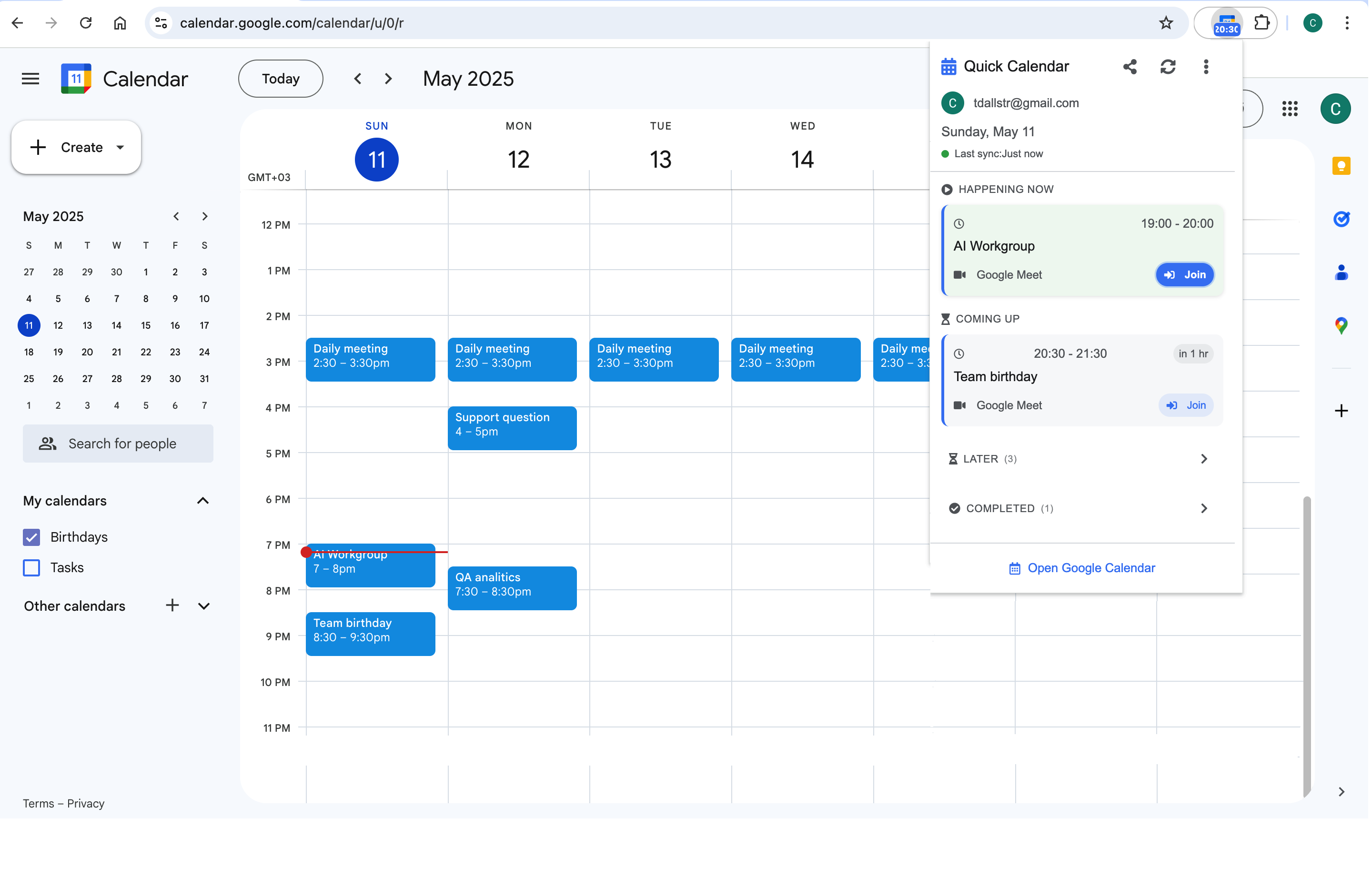
Shared calendars multiply the number of sources your day comes from — which is exactly when a merged, at-a-glance view helps. Calendar Extension for Google Calendar™ shows all subscribed calendars in one toolbar timeline, so a colleague’s shared calendar informs your day without living in another tab.
Frequently asked questions
No — Google Calendar has no view log for shared calendars. You can audit who has access (Settings and sharing → Share with specific people) but not what they looked at. Treat "See all event details" as permanently visible to everyone on that list.
Three usual causes: the invitation email went unnoticed (the calendar must be added, it does not force-appear); they are checking the mobile app, which hides new shared calendars until enabled under Settings → your calendar name; or your Workspace admin restricts external sharing to free/busy, silently downgrading what you granted.
If you shared with individuals, their access dies with the account — but nothing cleans up the stale entry. Sharing with a Google Group avoids the problem entirely, since membership is managed in one place and offboarding removes access automatically.
Yes — edit-level access overrides event privacy, showing full details of Private events. Event-level privacy only holds against "See all event details" and below. If an event must stay hidden from an assistant with edit rights, it needs to live on a separate, unshared calendar.