Enabling Keyboard Shortcuts in Google Calendar
Google Calendar keyboard shortcuts must be enabled before they work. Go to Settings (gear icon) > General > Keyboard shortcuts, and toggle them on. Once enabled, pressing the question mark key (?) shows all available shortcuts in a modal overlay. You do not need to memorize them — you can look them up any time without leaving the calendar.
Navigation Shortcuts
- T — Jump to today
- D — Switch to day view
- W — Switch to week view
- M — Switch to month view
- Y — Switch to year view
- K or P — Move to the previous period
- J or N — Move to the next period
- / — Jump to the search field
Creating and Editing Shortcuts
- C — Create a new event (opens the full event editor)
- Q — Quick-add an event using natural language
- E — Edit the selected event
- Delete or Backspace — Delete the selected event
- S — Save a draft event
The Q shortcut (quick-add) is especially powerful. You can type 'Team standup Tuesday 9am 30 minutes' and Google Calendar creates the event with the correct date, time, and duration without opening a form.
Building a Shortcut Habit
Learning all shortcuts at once is unnecessary. Start with three: T for today, C to create, and W for week view. Use those until they are automatic, then add the next-period navigation (J/N) and search (/). Within a week of deliberate practice, keyboard navigation becomes faster than mouse navigation for common tasks.
How Schedule Calendar helps
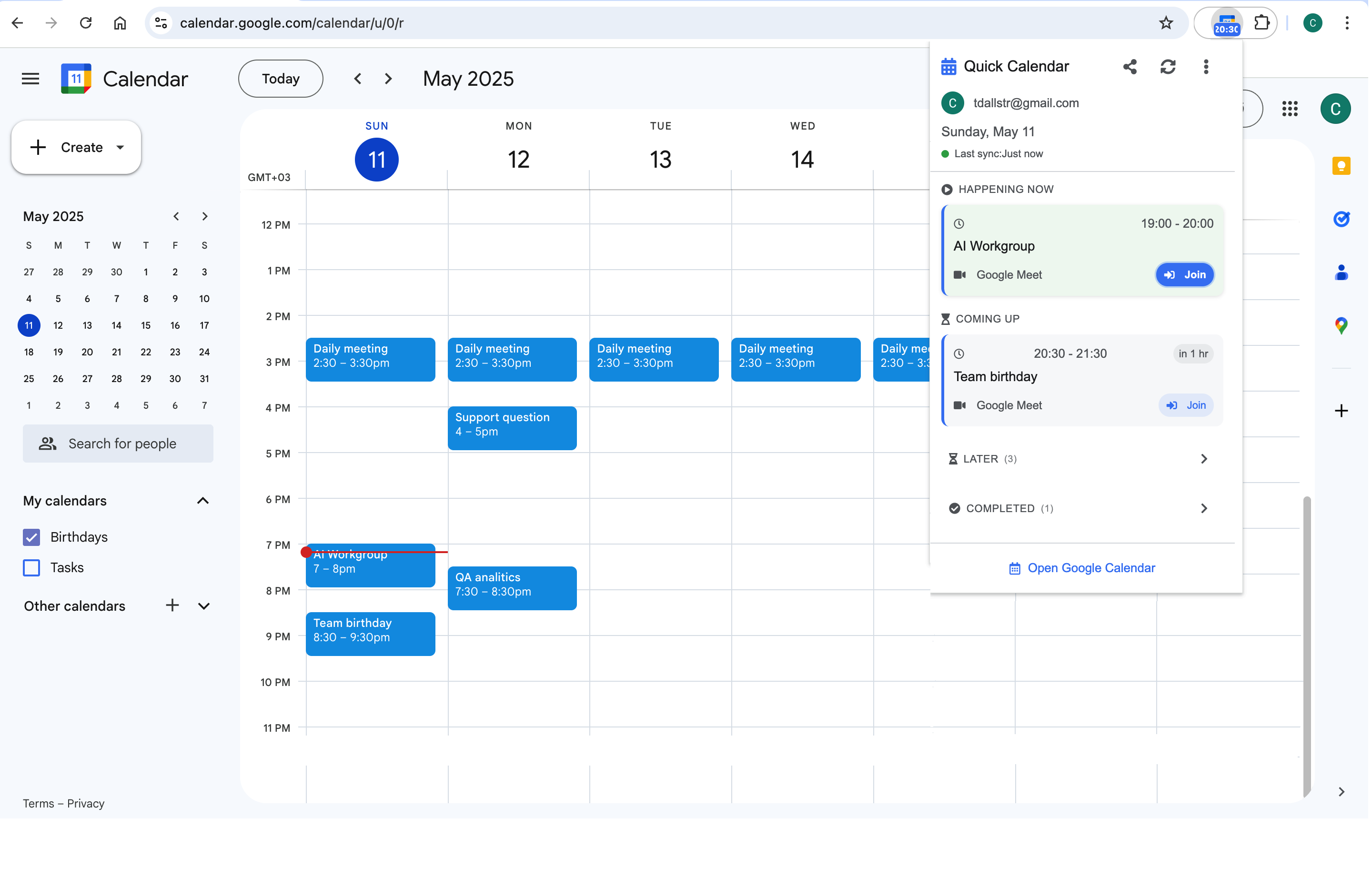
For the most common calendar check — what is my next event? — Schedule Calendar eliminates even the need to open Google Calendar. A click on the toolbar icon shows your upcoming events instantly. This is faster than switching tabs, pressing T to go to today, and scanning the day view. Keyboard shortcuts in Google Calendar and Schedule Calendar in the toolbar work together to cover different use cases without overlap.
Frequently asked questions
Go to Google Calendar Settings (the gear icon in the top right), then General, then scroll to Keyboard shortcuts and toggle them on. After enabling, you can press the ? key at any time while in Google Calendar to see the full list of available shortcuts.
The most time-saving shortcuts are: T to jump to today, W to switch to week view, C to create a new event, Q to quick-add an event using natural language, and / to jump to search. These five shortcuts cover the most frequent Google Calendar tasks and are worth learning first before moving on to less common ones.
Yes. Press C to open the full event creation form, or Q to use the quick-add feature where you can type a natural language description like 'Coffee with Maria Friday 2pm' and Google Calendar will parse it into a properly formatted event. The Q shortcut is faster for simple events that do not need detailed editing.
Press T to jump immediately to today's date in whatever view you are currently using. This works in day, week, month, and year views. It is the fastest way to reorient when you have been navigating back and forth through past or future dates.
Shortcuts need to be explicitly enabled in Settings before they work. Go to Settings > General > Keyboard shortcuts and toggle them on. Also confirm that your cursor is not focused in a text field — shortcuts do not trigger when you are typing in an input. If shortcuts are enabled and your cursor is free, they should work.
Most Google Calendar keyboard shortcuts use the same keys on Mac and Windows. The shortcuts use standard keyboard characters (letters and basic punctuation) rather than system-specific modifier keys, so D for day view, W for week view, and T for today work the same on both platforms. Check the ? overlay in Google Calendar for any platform-specific differences.