The search box and what it actually matches
Press / (or click the magnifier) and search matches against titles, descriptions, guest names and emails, and locations — across all calendars you can see, past and future both. That scope is the point people miss: your calendar is a searchable log of every meeting you’ve attended for years. "When did I last meet Dana?" is a two-second query, not a scroll through spring.
Operators worth knowing
- Quoted phrases: "quarterly review" finds the exact phrase, not every event containing either word.
- Date bounds: the advanced dropdown (arrow in the search box) exposes date-range fields; typed operators like before:2026-05-01 and after:2026-01-01 also work for bounding an era.
- The who/what/where fields: the same dropdown splits queries by participant, keyword, and location — "meetings with alex@ at the office in Q1" is a filled form, not a wish.
- Calendar scoping: the dropdown restricts search to one calendar — the trick for questions like "what did the milestones calendar say shipped in May" without personal-event noise.
Five archaeology patterns
The recurring real-world uses, as recipes. The precedent hunt: guest’s name + keyword → the last time this topic met, and what its notes doc said. The series autopsy: search a recurring meeting’s title, scan the result list’s density — the fade-out pattern (weekly, weekly, monthly, gone) is the kill-or-keep evidence. The billing reconstruction: freelancers scoping a client name + date bounds get the billable-meeting list an invoice dispute needs. The room claim: location search shows who actually uses the contested room. The "what was I doing on…": date navigation (key: G) beats search here — search finds events; G finds days.
The two blind spots
Knowing what search can’t see prevents the confused ten minutes. Blind spot one: attachments’ contents. Search matches event text, not the contents of attached docs — the meeting whose agenda doc contains "pricing" won’t surface for a pricing query unless the event text says it too. (The fix is upstream: key decisions belong in the event description, which is searchable.) Blind spot two: declined and deleted history. Events you declined can drop from your view and thus your search (check "show declined events" in settings); deleted events are searchable never — the Trash is browsable for 30 days but not indexed.
Making future-you’s searches work
Search quality is written at creation time. Three habits pay compound interest: put the decision or outcome in the event description after important meetings (one line — the searchable archive is then real); keep consistent naming for series and projects ("Falcon:" prefix beats four creative variants); and let guests stay on events (guest lists are the who-index — stripping them "for tidiness" deletes the answers to next year’s questions).
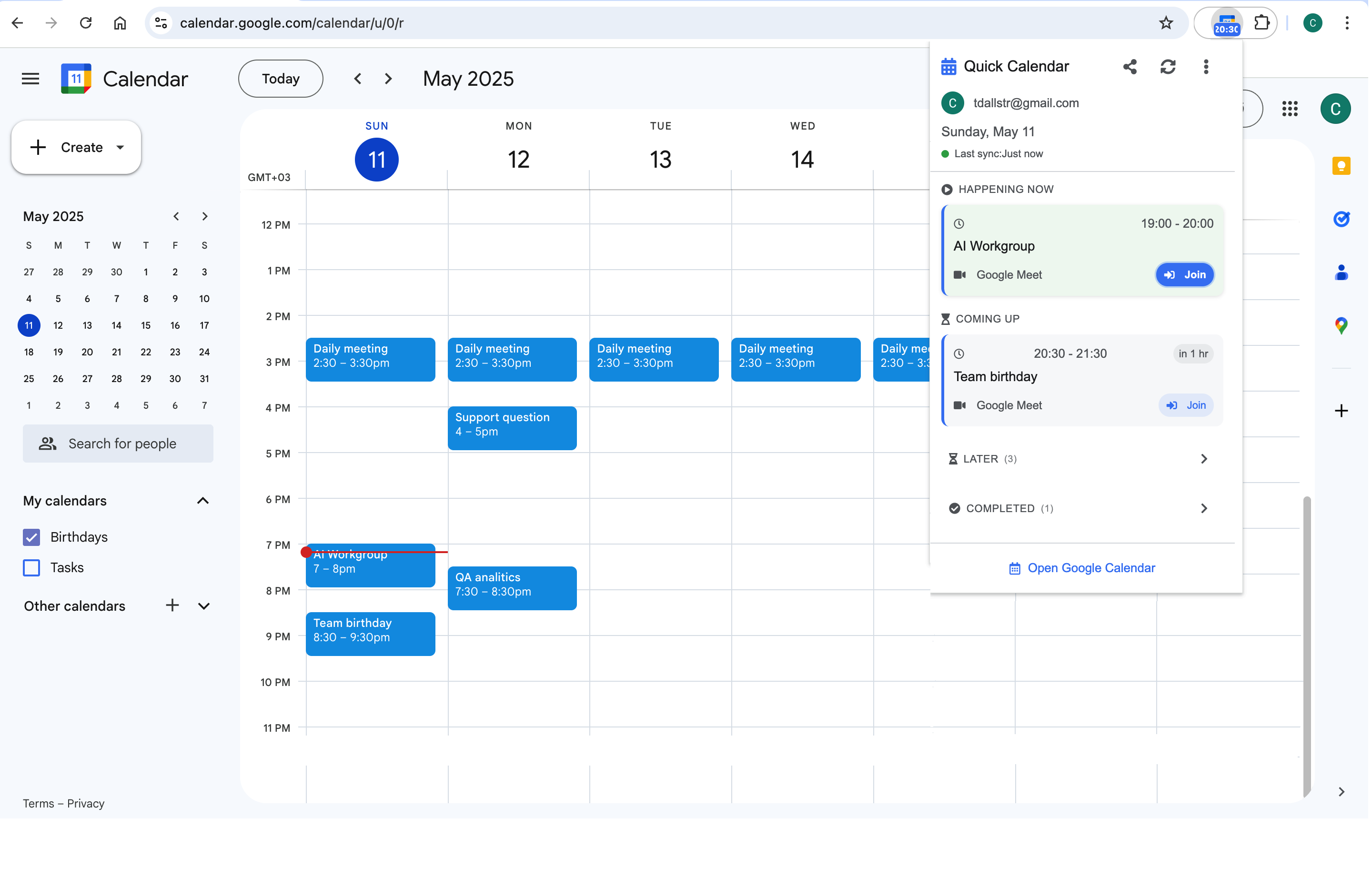
Search is for the past; the present has a faster door. For "what’s next and when" — the thirty-a-day questions — a toolbar strip like Calendar Extension for Google Calendar™ answers without any query at all, keeping the search box for the questions that actually need one.
Frequently asked questions
Only to the depth they’ve shared: detail-level shared calendars are searchable like your own; free/busy calendars return nothing useful (there is no text to match). The practical route for "when is Dana free" is not search at all — it is the Meet-with / find-a-time surface.
Yes, with the same text scope but without the advanced dropdown — plain queries only, so quoted phrases and names do the heavy lifting. For genuine archaeology (date bounds, calendar scoping), the desktop is the tool; mobile search is for "where is tonight’s dinner".
The checklist, in order: declined events hidden (Settings → View options → Show declined events); the event lived on a calendar now hidden or unsubscribed; it was deleted (check Trash within 30 days); or the memory is of an invite email, not an accepted event — search Gmail for it instead.
Not directly from search. The workable paths: date-bounded search and manual capture for small sets; the calendar’s .ics export filtered in a spreadsheet for large ones; and on Workspace, Time Insights covers the "how much time with whom" aggregate without listing every event.