What Goals actually does
In the mobile app: + → Goal, pick a category (Exercise, Build a skill, Family & friends, Me time, Organize my life), set frequency ("3 times a week"), duration ("30 minutes"), and preferred window ("mornings"). The engine then places sessions into open calendar space, watches for conflicts, and — its best trick — reschedules automatically when something books over a session, and learns from your "did it / didn’t" feedback and manual moves.
The sorting line: habits yes, projects no
Goals is built for frequency-shaped commitments — things that succeed by happening N times a week, where any reasonable slot works: exercise, language practice, reading, calls home. For these, auto-placement is a feature: you genuinely don’t care whether the run is Tuesday 7:00 or Wednesday 7:30, and the automatic rebooking absorbs life’s chaos without negotiation.
It fails on outcome-shaped work — "write the proposal", "learn enough SQL for the migration" — because those need deliberate placement (peak hours), explicit displacement (what gets declined to make room), and named session outputs. Machine-placed work blocks skip all three, which is why they get dismissed like snoozed alarms. Work goals want manually placed, output-titled blocks; the robot is for habits.
Setup that survives month two
- Start with one goal, not five. Multiple goals compete for the same open slots and the engine’s placements start feeling like colonization. Add the second after the first has a four-week streak.
- Tell it your real windows. "Mornings" to the engine means your calendar’s open mornings — if 7:00–8:00 is sacred but unblocked, the goal will land there. Either accept it or block the sacred time first; the engine only respects what the calendar shows.
- Feed the feedback loop honestly. Marking sessions "Done" / "Didn’t" is what teaches placement; users who ignore the prompts get static suggestions and then blame the feature.
- Let it defer, never delete. When a conflict books over a session, the engine reschedules — resist manually deleting sessions in busy weeks. Deletion reads as "stop trying"; deferral keeps the cadence alive at reduced intensity.
When to graduate off the feature
Goals is training wheels in the best sense: after a habit has survived three months of auto-placement, it usually has a natural slot it keeps landing in — at which point converting it to a plain recurring event (same time, weekly) makes it sturdier: recurring events are visible on desktop, shareable, and not subject to the engine’s occasional creative relocations. The feature’s highest use is discovering the slot; recurrence is how you keep it.
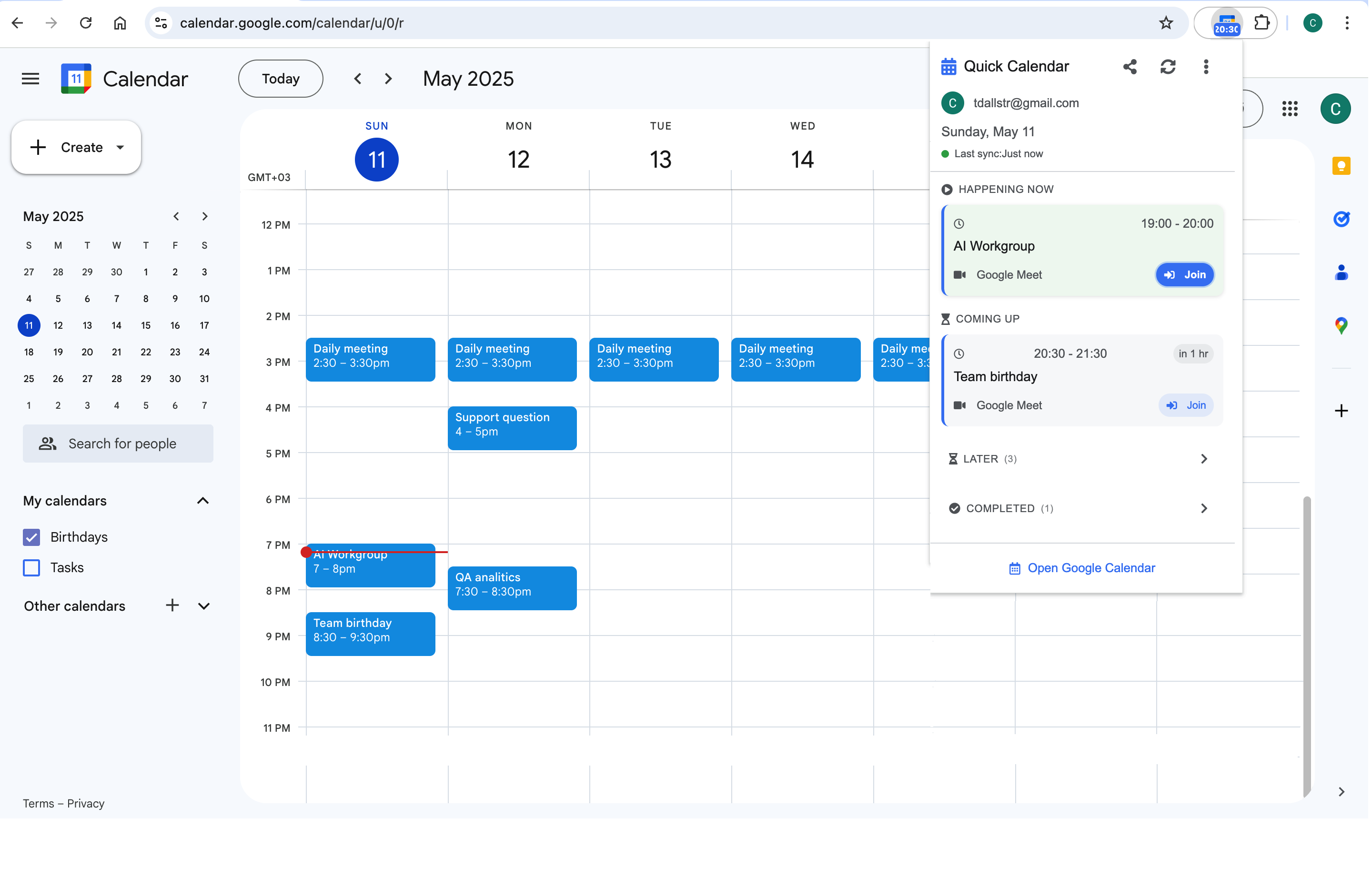
Habit sessions live or die by the transition into them — noticing that "Spanish, 19:00" is next while you’re still browsing. A toolbar glance like Calendar Extension for Google Calendar™ shows goal sessions in the same timeline as everything else, with the minutes-until chip doing the gentle nagging the phone notification does too late.
Frequently asked questions
The feature is mobile-app-only for creation and management — desktop shows the scheduled sessions as regular-looking events. Manage cadence and windows on the phone; treat desktop as read-only for goal sessions.
They occupy calendar space like normal events, but by default they’re on your calendar with your visibility settings — colleagues with free/busy access see busy time. Be deliberate: a daily "Me time" hour marked busy is honest, but know that it participates in scheduling like any commitment.
Three levers, in order: correct the preferred window in the goal’s settings; move a few sessions manually (it learns from moves more than from settings); and block the times it should avoid — the engine treats open calendar as fair game, so unstated constraints don’t exist for it.
Frequency-shaped habits → Goals (auto-placement earns its keep). Deadline-shaped items → Tasks (they sit on a date, drag onto time when chosen). Committed rhythms — the standup, the graduated habit, the focus block → recurring events. Most calendar mess comes from using one of these for all three jobs.