Profile hygiene first — most "sync bugs" are this
Chrome profiles each carry their own Google session, and half of all "my calendar is missing events" reports are really "wrong profile": the work profile showing the personal calendar or vice versa. The fix is structural: one Chrome profile per Google identity (Profiles menu → Add), each with its own icon and color. Calendar, Gmail, and Meet then agree about who you are per-window, and the u/0 vs u/1 account-index roulette in URLs stops mattering.
The toolbar layer: calendar without a tab
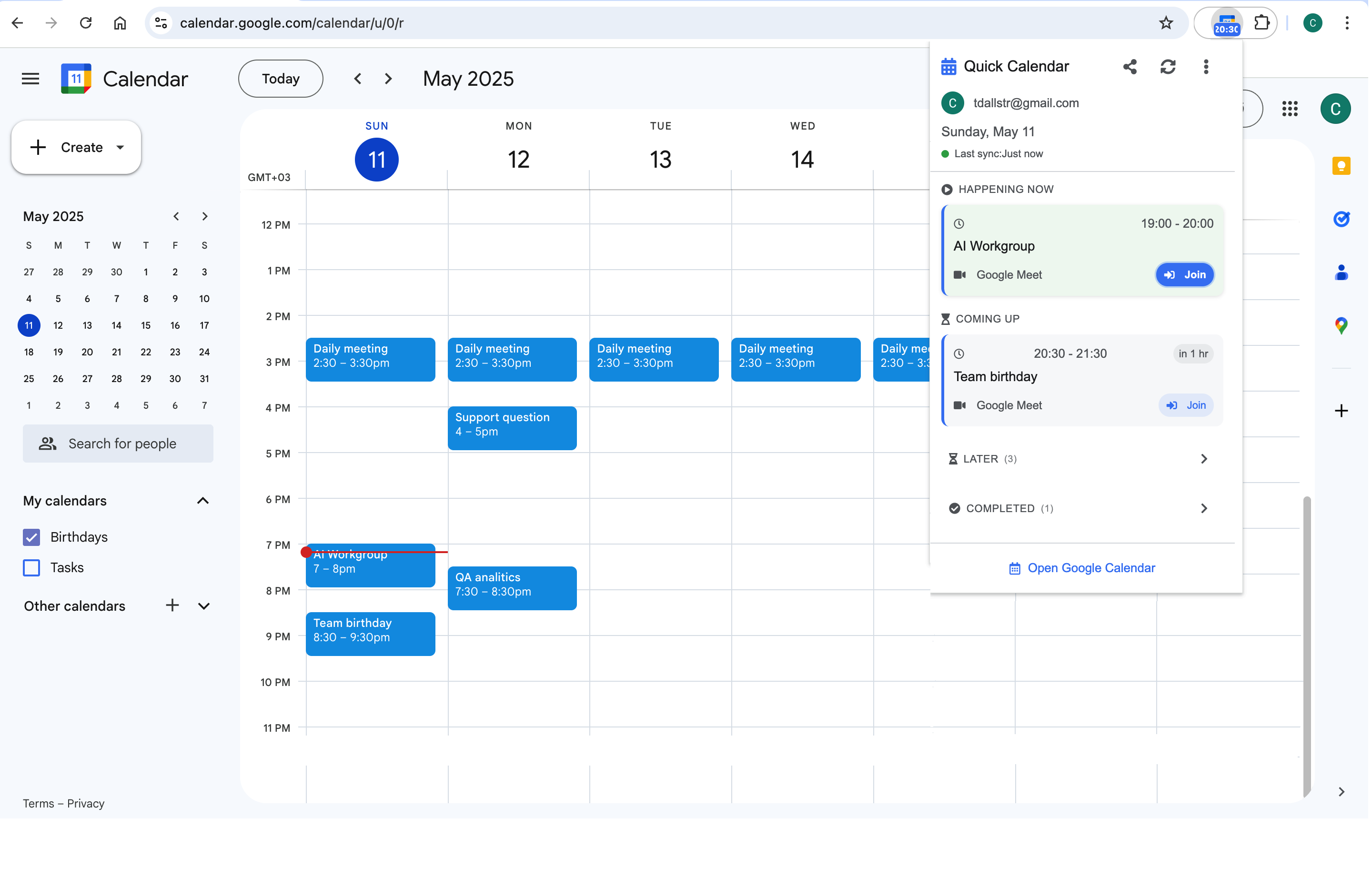
The Chrome-native answer to "stop keeping a tab open" is moving the calendar into the toolbar. Calendar Extension for Google Calendar™ renders today as a popup — day strip, timeline with a now-line, time-to-event chips, and join buttons for Meet/Zoom links — one click from any page, then gone. The division of labor that results: the popup answers questions (what’s next, how long, join), the tab makes plans (weekly layout, invite writing). Most users find the tab drops from all-day-pinned to opened twice daily on purpose.
Keyboard paths worth the muscle memory
- Reaching the calendar: Chrome’s omnibox is faster than any bookmark — type cal and let autocomplete finish, or set a custom site-search keyword (Settings → Search engine) so c + Tab + Enter opens it cold.
- Inside the calendar: C creates, T jumps to today, D/W/M/X switch views, / searches, ? shows the rest. Ten minutes of deliberate use makes the tab visits you still take three times shorter.
- Back out: Ctrl/Cmd+W. The tab is a session, not a residence.
Chrome-specific behaviors that bite
Notifications need two permissions
Calendar’s desktop notifications require Chrome to be running and calendar.google.com to have notification permission (lock icon → Notifications → Allow) and your OS to allow Chrome notifications. Three switches, any one of which silently kills reminders — check all three when banners vanish.
Offline exists, per profile, opt-in
Calendar Settings → Offline → enable. Chrome then caches your schedule for flights and dead cafés — read-only weeks and event details, no creation. Little known: it must be enabled per profile, and it quietly disables when cookies for Google domains get cleared.
Meet tabs multiply
Joining calls from calendar events leaves a trail of dead Meet tabs. Two mitigations: join from the toolbar popup instead (the join button opens exactly one tab), and pin the one live Meet tab during the call so it survives your mid-call tab triage.
A sane default day
Morning: one popup glance with coffee — orientation, not planning. Through the day: chips answer "how long until"; join buttons handle calls; new invites get the ten-second triage as they land. Twice a day, deliberately: the full tab for planning sessions. The calendar stops being a place you keep and becomes a thing you consult — which was always the point of putting it in the browser.
Frequently asked questions
It reads the same Google Calendar backend, so a full Google outage affects both. What it does remove is tab-state fragility — no more "the pinned tab logged itself out overnight" — since each popup open is a fresh, authenticated read.
Cleanest with the profile-per-identity setup: each Chrome profile’s extension instance reads that profile’s account, so work and personal never bleed. Single-profile multi-account setups inherit Google’s account-index quirks regardless of which surface you use.
Two native-ish paths: the toolbar popup’s quick-add (fastest for "block 30 min at 3"), and the omnibox trick — a custom search engine pointed at Google Calendar’s event-creation URL turns typed text into a draft event. For anything with guests, the full editor remains the right tool.
Almost entirely — Chromium underlies all three, so profiles, site permissions, and most extensions work identically. Verify the extension’s store listing supports the browser, and check notification permissions separately; Chromium forks love relocating that particular setting.