What free already covers (more than the ads admit)
Run through this list before paying for anything, because paid tools love re-selling it:
- Booking pages — Google’s appointment schedules give outsiders a self-serve booking link that honors your busy time. Calendly’s core loop, included.
- Focus protection — Focus time events with auto-decline (Workspace), Out of office with auto-decline (everyone). "AI protects your deep work" is often this checkbox with branding.
- Meeting shortening — Speedy meetings ends 30/60-minute meetings at :25/:50 by default.
- Time analytics — Time Insights (Workspace, left sidebar) already charts your meeting load and top co-attendees.
- Cross-timezone sanity — secondary timezone columns, per-event timezones, working-hours warnings.
- Task-on-grid — Google Tasks drags onto the calendar from the side panel.
The four honest reasons to pay
- Scheduling volume is the job. Recruiters, sales teams, agencies: round-robin routing, pooled availability, no-show automation. Native booking covers one calendar’s worth of needs; pipelines justify Calendly/Cal.com tiers.
- You bill by the hour. Freelancers and firms that invoice time need calendar→invoice flows (Harvest-class tools). The subscription pays for itself in one recovered unbilled hour a month.
- You run someone else’s calendar. EA workflows — delegated inboxes, priority rules, multi-exec views — outgrow native delegation fast. The buyer is really the executive’s hourly rate.
- Compliance says so. Legal holds, audit trails, retention policies: enterprise problems, enterprise line items.
Notice what is not on the list: "I want to be more organized." Disorganization survives subscriptions untouched — it yields to settings and habits, both free.
The subscription math
Before paying, run three numbers. Frequency: how many times a week will the paid feature fire? (Below three, it is a toy.) Minutes saved per fire — honestly, versus the free workaround, which is often "one extra click". Maintenance cost: minutes a week spent keeping the tool configured, synced, and re-authenticated. Tools regularly fail the third number: a $12/month assistant that saves 20 minutes and demands 25 of upkeep is a paid hobby. Frequency × savings − maintenance, priced at your hourly rate, versus the subscription. Ten minutes of arithmetic retires most checkouts.
The free tier that isn’t: your data
One caution specific to free third-party tools (as opposed to free-tier Google): calendar access is intimate data — who you meet, when, how often, about what. A free tool with server-side processing and a vague privacy policy is charging you; the currency just isn’t dollars. Prefer read-only scopes and local processing, and treat "we may use data to improve our services" in a calendar app as a price tag.
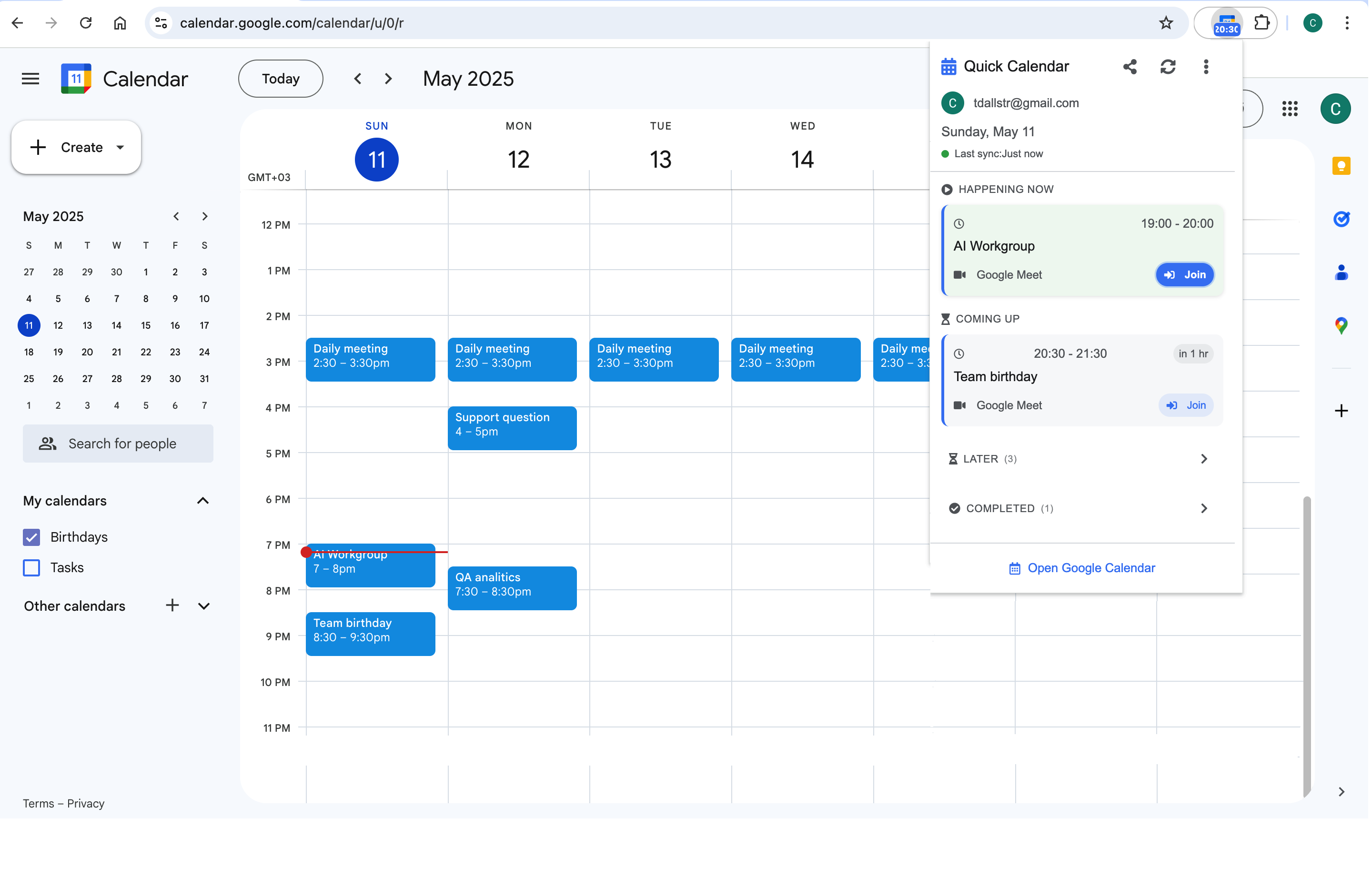
The gap that remains after tuning free Google Calendar is not features — it is access speed: the thirty daily "what’s next" checks still cost a tab each. A free toolbar surface like Calendar Extension for Google Calendar™ closes exactly that gap, which is why the honest stack for most people is tuned-free plus a glanceable surface, total monthly cost zero.
Frequently asked questions
The notable Workspace-only items: Focus time as an event type, Time Insights, appointment schedules with multiple booking pages, and working location. Core scheduling, sharing, Out of office, and speedy meetings are identical. For solo use, personal-tier plus good settings covers ~95% of paid-tool pitches.
Run the math with real numbers: they fire often (good frequency) but their savings depend on how much you trust auto-placement — every override you make is negative savings. Users who accept machine placement wholesale report real gains; chronic overriders pay to argue with software.
Fifteen minutes of settings: Speedy meetings on, default duration 25, working hours set, invitation gate to "sender is known", notification tiers per event type. That bundle replicates the headline benefit of most $10–15/month tools.
Three checks in two minutes: the permission prompt (read-only vs. edit scope), the privacy policy’s processing location (local vs. their servers), and whether a named developer or company stands behind it. Any "free" tool failing two of three is monetizing something, and it is probably you.