The overlap budget: the design decision everything follows
A team spread across 6+ hours shares a small window where everyone is awake and working — typically 2–3 hours. The foundational choice is what that scarce window is for: teams that default it to meetings converge on "all overlap is meetings, all focus is fringe hours", which taxes exactly the coordination-heavy people hardest. The deliberate version budgets it: at most half the overlap window is meetable; the rest is protected as shared focus or slack. Write the budget down ("overlap = 15:00–17:30 CET; meetings live in 15:00–16:15") — an unwritten budget is just the old default with better intentions.
Focus norms with teeth
Three mechanisms convert "we value focus" into behavior:
- Focus blocks are calendar-real and auto-defended: Workspace Focus time events with auto-decline on, message set ("deep work — free after 15:00 my time; urgent → Slack"). On distributed teams the auto-decline matters double, because the colliding invite often arrives while you sleep — the machine declines at 3:00 so you don’t negotiate at 9:00.
- A team quiet zone: one shared no-meeting stretch per day (often each zone’s morning, by definition non-overlapping) — codified on the team calendar so newcomers inherit it. The point is legitimacy: individual focus blocks survive better inside a team norm than as personal eccentricities.
- Status broadcast: calendar-to-Slack sync so focus state shows where interruptions originate. Distributed interruption is asynchronous — the ping at your 14:00 was sent at their 8:00 — so the status must persist, not just appear during the block.
The async substrate (focus’ other half)
Focus time on distributed teams is only as good as the async layer that absorbs what meetings used to: decisions in docs with comment deadlines ("objections by Thu 12:00 UTC"), threads that expect answers within a working day rather than an hour, and recorded walkthroughs for anything demo-shaped. Every practice that removes a "quick sync" from the overlap window returns that time to the focus budget — the two systems are one system.
Fringe hours: the distributed-only asset
Each zone’s non-overlap hours — the EU morning before the US wakes, the US afternoon after Europe logs off — are structurally interruption-proof: nobody who could ping you is awake. Architect around them deliberately: place your deepest block in the fringe (not the overlap), and treat the overlap as coordination-and-shallow territory. This inverts the co-located pattern and is the single biggest practical difference in distributed focus design; people who carry office habits into distributed work put focus in the overlap and get eaten.
Measuring whether the design holds
Quarterly, three numbers from the calendars: overlap meeting share (is the budget’s ceiling holding?), focus-block hold rate per person (below 70% = the defense layers need work), and after-hours event creep (the failure mode where "flexible" becomes "always"). Ten minutes with Time Insights or a manual tally — and the numbers, not sentiment, drive the next iteration of the budget.
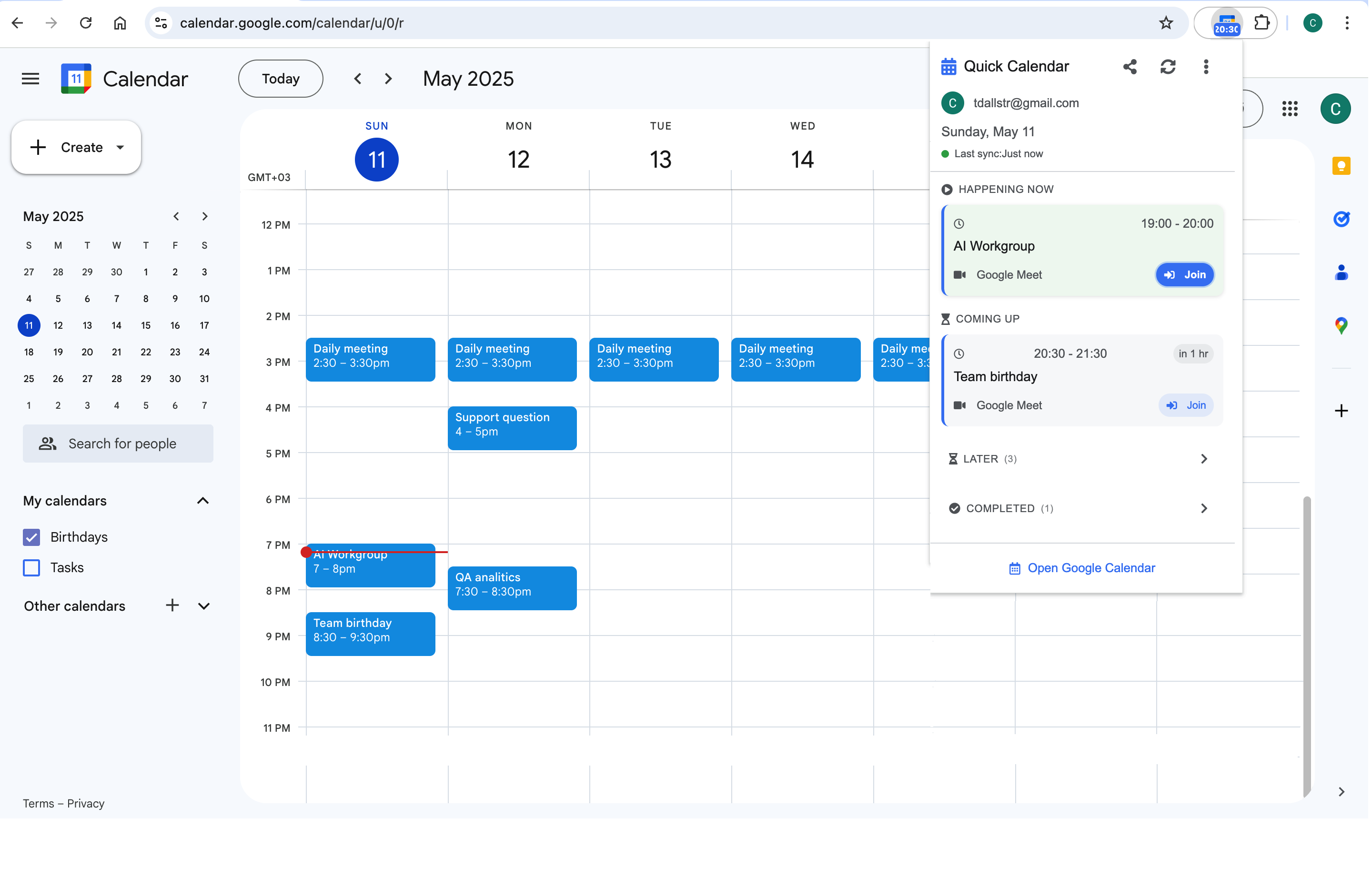
Distributed days hinge on a zone-aware glance: is the overlap open yet, how long until the cross-zone call, is my fringe block still intact after the overnight invite wave? A toolbar strip like Calendar Extension for Google Calendar™ answers all three in local time, one click — the instrument panel for working a day that other people’s nights keep editing.
Frequently asked questions
Even more strictly — at 90 minutes, one standing meeting can consume the team’s entire synchronous capacity. Sub-2-hour overlaps usually mean meetings go fortnightly-rotating or split into zone-pair editions, and the overlap’s default state becomes "available for ad-hoc," which is scarcer and more valuable than any recurring booking.
Onboard it explicitly — it is counterintuitive to office-trained instincts: "your mornings are your deep hours; the overlap is for people." Pair it with calendar mechanics on day one (focus block placed, auto-decline on, quiet zone subscribed) so the norm arrives as configuration, not folklore.
True for coordination-heavy roles — their design inverts: fringe hours host their focus block (the one, defended absolutely), and their overlap is honestly meeting territory. The budget still protects them: half-meetable overlap means even coordinators get slack between calls instead of a 150-minute gauntlet.
Unwatched recordings are theater; watched artifacts are usually not the recording but its distillate. The pattern that works: record everything, but the owner posts a 5-line summary with decisions and timestamps — the recording becomes the appendix. Async substitutes for attendance only when someone does the compression.