The formula: acknowledge, reason, path
Almost every graceful decline has the same skeleton: acknowledge the meeting matters → give one honest reason → offer a path that still moves the work. The third part is what separates "declined" from "difficult": you are not refusing the work, only the meeting.
Two things to delete from your drafts: apologies ("so sorry, I feel terrible") and fake reasons. One honest sentence — "I'm heads-down on the release until Thursday" — survives follow-up questions. A vague "conflict" invites them.
Seven scripts you can paste today
1. The invite has no agenda
"Happy to join if I can prep — could you add a line on what decision or outcome you need? If it turns out you mainly need my numbers, I can send them ahead and skip the slot."
2. It lands on your focus block
"I keep 9–11 for build work, so I'll pass on this slot. I'm free 13:00–15:00 most days if that works — otherwise notes are enough for me."
3. Eight attendees, and you are number eight
"Looks like this is covered without me — I'll drop off to keep the group tight. Tag me in the notes if anything lands on my plate."
4. A recurring meeting that has drifted
"I've noticed the last few of these haven't needed my input, so I'll step out of the series. If a specific week does need me, a one-off invite always works."
5. A same-day invite
"Too late for me to move things today, so I'll miss this one. If it's urgent, I can do 15 minutes async in the thread right now."
6. The organizer outranks you
"I have a commitment then that's hard to move. If you need me specifically, I can shift it — but if my part is the project update, I can send it before the meeting." (Offering the escape hatch — "if you need me specifically" — lets them decide, which is what rank actually wants.)
7. A 1:1 you need to move, not cancel
"I need to move Thursday's 1:1 — proposing a couple of times for the same week so we don't skip it." Then use Propose a new time rather than a plain decline; a rescheduled 1:1 reads completely differently from a declined one.
The Calendar mechanics most people skip
- Decline with a note. Open the event and choose No, then use Add note in the RSVP menu — the note lands in the organizer's copy of the event and in their email notification. A bare "No" is what reads as cold; the note is the politeness.
- Propose a new time. In the RSVP options next to Yes/No/Maybe. The organizer gets your suggestion as a one-click accept — far lower friction than "does another time work?" email tennis.
- Decline one instance, not the series. When declining a recurring event, Google Calendar asks: This event, This and following, or All events. Choosing "This event" skips one week without the social weight of leaving the series.
- Check the guest list before declining. If the event shows "optional" next to your name, decline freely — the organizer already told you the answer.
When declining is the wrong move
Four cases where you accept even when you'd rather not: kickoffs and postmortems for work you own; anything where your absence forces a repeat meeting; the first instance of a new recurring series (judge it before opting out); and meetings where you are the disagreement — declining a decision meeting you disagree with just moves the decision out of your reach.
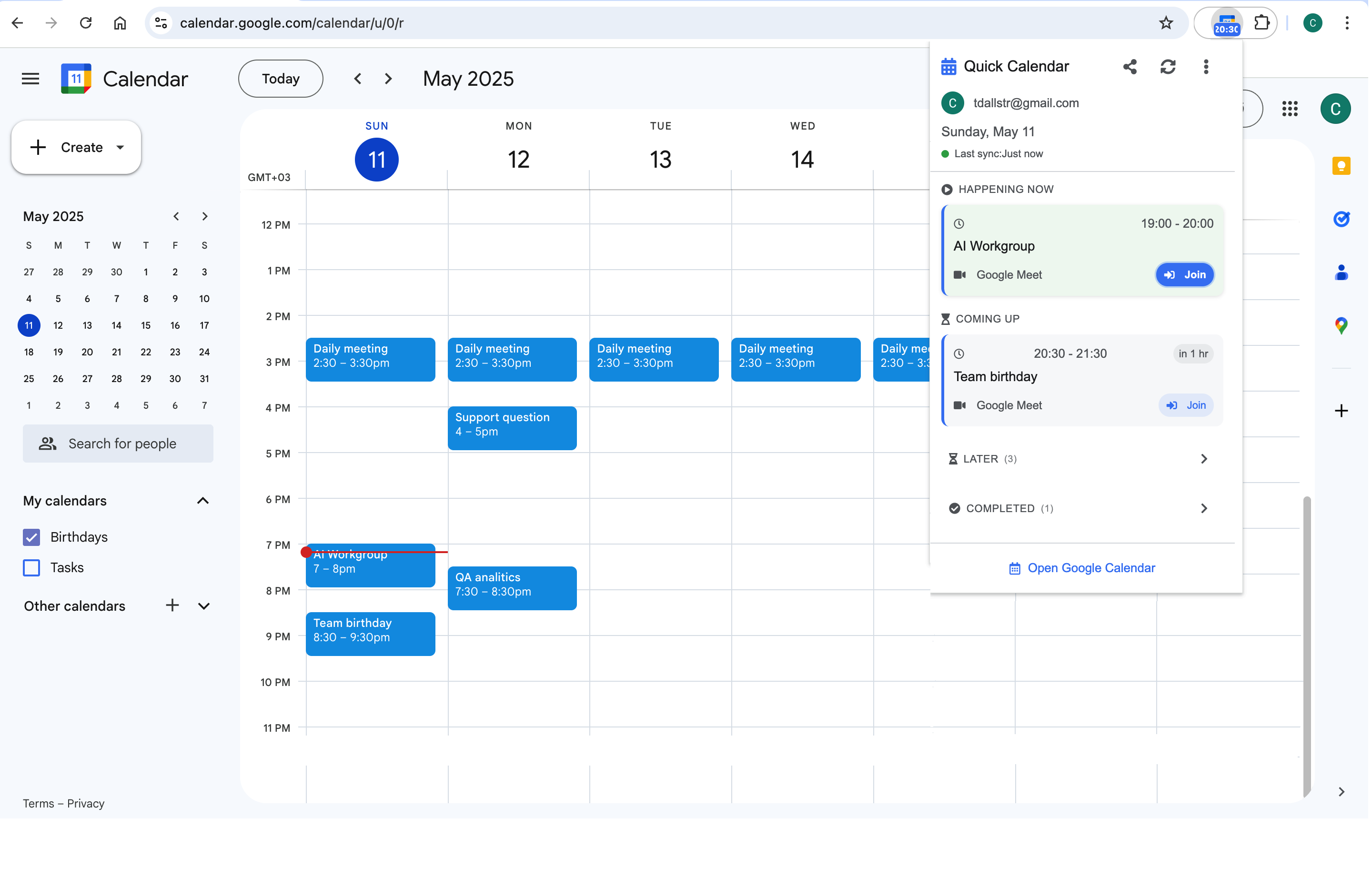
Declining well also depends on answering fast — an invite that sits unanswered for two days is its own small rudeness. A toolbar view of today, like Calendar Extension for Google Calendar™, surfaces new invites next to your real availability, so the yes/no takes thirty seconds instead of living in a tab you meant to open.
Frequently asked questions
Yes. The RSVP note appears on the event in the organizer’s calendar and in the email notification they receive. Other guests can usually see it on the event too, so write it as a public reason, not a private message.
No — the organizer is notified of RSVP changes. That is why the drift script names the pattern ("the last few haven’t needed my input") rather than leaving silently; the notification arrives with context instead of looking like an exit.
As a placeholder while you resolve a real conflict, yes — for a day. As a permanent answer, it is worse than a decline: the organizer plans around a ghost. If you are still on "Maybe" when reminders go out, convert it to a decline with a note.
Make the trade explicit rather than the refusal: "I can join, but it moves the release check to Friday — your call." Managers rarely insist once the cost is visible, and when they do insist, you have learned the meeting really was the priority.