Make the calendar do the arithmetic
Four settings turn Google Calendar into a timezone instrument:
- Secondary timezone (Settings → Time zone → display secondary): your grid gains a second hour-column — Berlin left, New York right — and every slot reads in both without mental math. Label them ("Me" / "NYC team").
- World clock (Settings → World clock): pick your collaborators’ cities; the sidebar shows their now, including a subtle day-boundary warning when it’s already tomorrow there.
- Per-event timezones: the event editor’s time-zone link pins an event to a zone — essential for travel ("board meeting, 14:00 Singapore") so the event moves correctly with your device instead of drifting.
- Working hours, everyone, honestly: the whole fairness machinery below runs on colleagues’ published hours being true. An unset working-hours field is a silent vote for being scheduled at 6:00.
The fairness patterns (this is the actual problem)
Any recurring cross-zone meeting sits on someone’s edge. Three patterns distribute the pain deliberately instead of by seniority-gravity:
- Fixed-but-compensated: the meeting stays at the overlap’s least-bad slot permanently (predictability wins), and the edge-carriers get visible compensation — the 18:00-holders start late those days, on the calendar. The compensation being scheduled is what keeps it real.
- Seasonal rotation: the slot alternates quarterly, not weekly — "whose 7:00 is it this quarter" beats weekly roulette, because bodies adapt to stable schedules and never to rotating ones.
- The split double: past ~7 hours of spread, one live meeting punishes someone structurally. Run the same agenda twice (EU edition / US edition) with a shared doc as the spine, or go async-first with a fortnightly all-zones call at the least-bad hour. A meeting nobody is asleep for beats a "unified" one that a third of the team attends as zombies.
The three DST traps
Daylight saving is where timezone scheduling actually breaks, because zones shift on different dates. Trap one: the US springs forward two-three weeks before Europe — every EU↔US recurring meeting silently moves an hour relative to one side during the gap windows (mid-March and late October–early November: audit those weeks explicitly). Trap two: events created in the wrong zone anchor: a "9:00 call" created while traveling anchors to the travel zone forever — per-event timezones are the fix. Trap three: zones without DST (most of Asia, parts of Australia offset by half-hours) mean your "stable" 16:00 Singapore sync moves for you twice a year while never moving for them. Calendar handles the math correctly in all three cases; the trap is human expectations, so the audit is a calendar-week scan, not a formula.
Etiquette across the date line
Three courtesies that cost nothing: state zones explicitly in every proposal ("Thu 15:00 CET / 9:00 ET" — naked times start wars), respect the working-hours warning as a stop sign (ask, don’t book: "this lands at your 19:00 — okay once, or alternate?"), and put your own travel on the calendar with working location so the team’s arithmetic about you stays current.
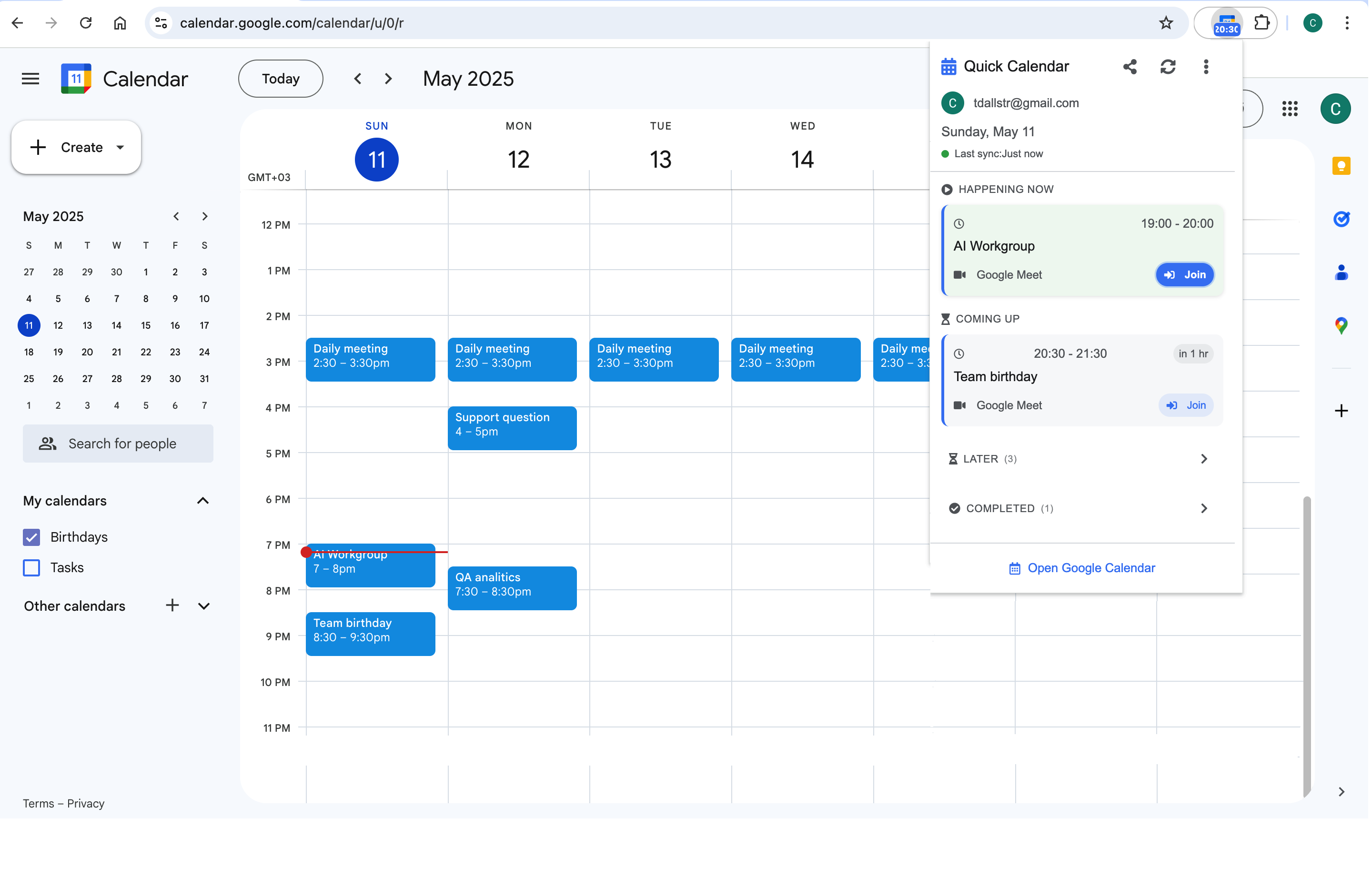
Cross-zone days breed a specific glance: "what time is this call for me, and how long until it?" A toolbar strip with countdown chips — Calendar Extension for Google Calendar™ — answers in your local frame automatically, which on split-zone days is worth more than any mental conversion habit.
Frequently asked questions
The classic corridor is 15:00–17:00 CET / 9:00–11:00 ET — morning-fresh for the US, late-but-inside-hours for Europe. The equitable move is not finding a "perfect" slot (none exists) but keeping the corridor’s load balanced: EU takes the 17:00s, US takes the occasional 8:00, visibly.
Accept that no live slot includes everyone humanely: go async-first (docs and threads as the primary medium), hold zone-pair syncs in their natural corridors, and reserve the all-hands for a fortnightly rotating-least-bad slot with recordings as first-class citizens. The triple-zone "daily standup" is a hazing ritual, not a process.
Recurring events anchor to their creation timezone: when DST shifts asymmetrically (the March/October gap windows), one side moves relative to the other by design. Check the series’ timezone in the editor — anchoring it to the zone that hosts the meeting’s constraint (the client’s, the majority’s) is the deliberate choice.
Well, mostly — booking pages render in the visitor’s local zone automatically, which kills the classic "wait, whose 3pm?" failure. The residual check is your own availability windows on the page being zone-anchored correctly, especially around your travel; one mis-anchored window books a 5:00 you agreed to in writing.