The convention stack (cost: one team meeting)
Small teams coordinate through three shared objects, all free:
- One team calendar for absences and travel. Named owner, narrow charter (leave, travel, public holidays — nothing else), shared to the team Google Group with edit rights. The moment project events sneak on, it stops being readable and starts being ignored.
- One milestones calendar. Releases, deadlines, demo days — the five-to-ten dates a quarter everyone plans around. Subscribed by all, writable by leads. Separating it from absences keeps both legible at a glance.
- A sharing tier, spoken aloud once: event details visible within the team, free/busy for everyone else. Ten people scheduling blind against each other is the single biggest self-inflicted coordination tax in small teams — and it is a settings decision, not a software purchase.
Settings that multiply at team scale
Individually nice, collectively transformative — adopt them together in one 15-minute session: Speedy meetings (the whole team gets seams between calls), default duration 25, Working hours set truthfully (find-a-time becomes trustworthy), and end dates on all new recurring series (the team meeting-load stops ratcheting). A ten-person team adopting these typically drops 10–15% of total meeting hours in a month without cancelling anything explicitly.
What about the tools everyone asks about?
Booking links (Calendly-class): needed by whoever meets outsiders weekly — sales, recruiting, support escalations. Google’s built-in appointment schedules cover the first person’s needs free; buy a dedicated tool when routing (round-robin, pooled availability) enters the picture. Shared scheduling AI: at ten people, find-a-time with honest calendars does what the AI promises. Standalone team calendars (Teamup-class): justified only when non-Google external collaborators need write access without Google accounts. Meeting-cost dashboards: a spreadsheet and one retro slide replicate them at this scale.
The two real growth triggers
Pay attention when either of these appears — they mark where conventions stop scaling. Trigger one: external scheduling volume — more than ~10 outsider bookings a week across the team justifies a booking product with routing. Trigger two: resource contention — shared rooms, equipment, or on-call rotations being fought over in chat means it is time for real resource booking (Workspace’s, if you’re on it; a dedicated tool if not). Everything else — focus protection, meeting hygiene, load visibility — stays a conventions problem at any size that still fits in one standup.
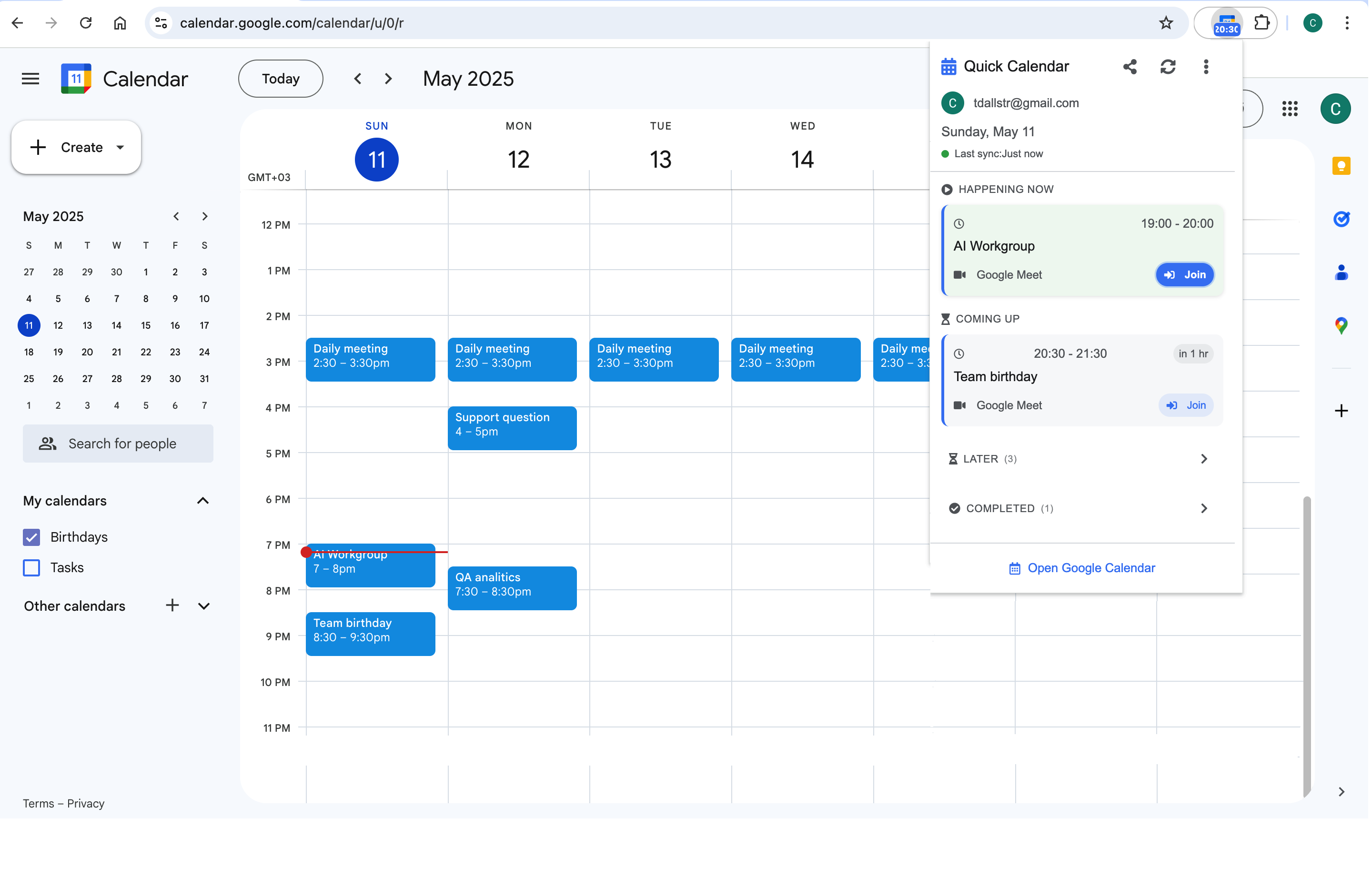
Small teams live in the browser and coordinate all day — which makes per-person glance cost a real line item. A toolbar view like Calendar Extension for Google Calendar™ gives everyone the same two-second answer to "what’s next / who’s out / when’s the demo" from the shared calendars, without ten pinned tabs across the team.
Frequently asked questions
Ownership means gardening, not authority: someone who already notices stale events. Rotate it with sprint duties if that fits the culture — but name it. The unowned shared calendar is the one that silently fills with 2024’s holidays and one abandoned workshop series.
The calendar-relevant Workspace gains: Time Insights, Focus time events, appointment schedules, resource booking, and admin control over sharing ceilings. A team of 3 can thrive on free accounts with conventions; past ~6 people or first external compliance question, Workspace pays for itself in coordination alone.
Charter it narrowly and visibly: dates and coverage, not reasons. "Out — back Monday, Dana covers" is coordination; requiring justification is management theater. Teams keep the calendar honest exactly as long as it stays consequence-free to use.
Two items: the absences calendar (self-interest adopts it — nobody likes being scheduled during someone’s vacation) and truthful working hours. Skip the rest until the first coordination failure makes the case for you; conventions adopted after a felt pain stick better than ones installed preemptively.