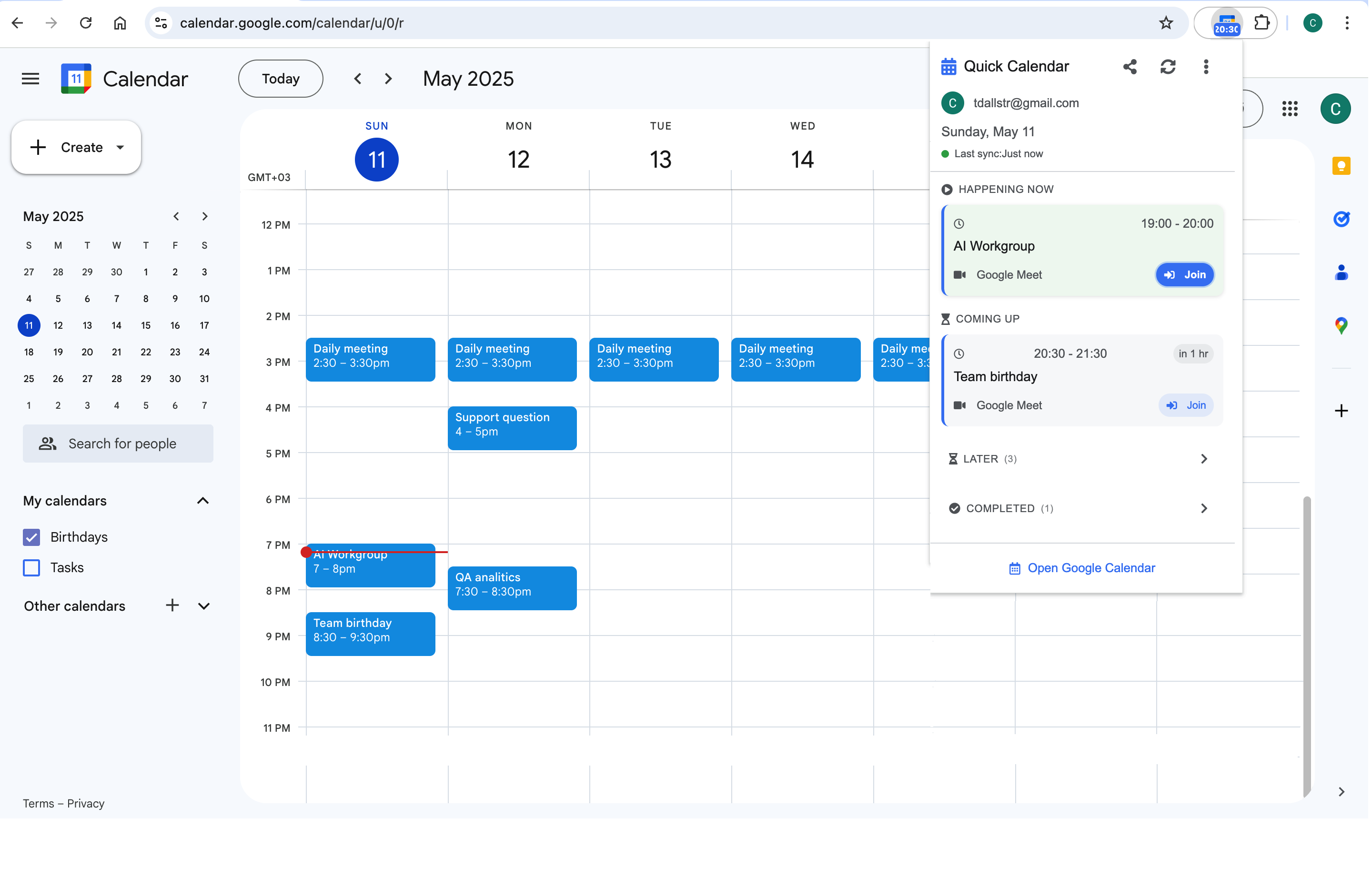
Boundaries are a visibility problem first
Before assuming bad manners, check what your calendar actually shows a colleague using "find a time". If your protected morning renders as blank space, people are not crossing a boundary — they are parking in what looks like an empty lot. The first hour of boundary work is purely mechanical:
- Working hours: Settings → Working hours & location. Once set, out-of-hours proposals trigger a warning on the scheduler’s side — a boundary that enforces itself politely.
- Focus time that shows as busy: create the block with the Focus time event type (Workspace accounts) or as a normal event set to Busy, not Free. A block marked "Free" is a suggestion, not a boundary.
- Titles that carry the reason: to detail-level teammates, "Deep work — release prep" reads as legitimate; "Busy" reads as negotiable. Give the boundary a job title.
- Lunch is an event. Every calendar-culture company has someone who books 12:30s. The only defense anyone respects is the recurring block that was there first.
The social layer: three scripts
When someone books over a visible focus block
"I keep 9–11 for build work — moving us to 13:00. If it truly can’t wait, ping me and I’ll make the call." Reschedule-with-alternative, done unapologetically, teaches the pattern faster than any policy doc. Accepting "just this once" teaches the opposite pattern equally fast.
When a colleague treats every gap as bookable
"My open slots fill fast, so if you need me regularly, let’s set a weekly 15 minutes and I’ll always be prepared for it." This converts ambient claiming into one bounded, predictable slot — most serial bookers actually prefer it.
When the breaker outranks you
Make the trade visible instead of defending the boundary: "Can do — it displaces the API review to Thursday. Still want the slot?" Seniors override boundaries they can’t see the cost of; they rarely override a named trade-off twice.
Boundaries that bend without breaking
Rigid boundaries collapse at the first real emergency, and then stay collapsed. Build the exception in: a boundary held four weeks out of five is sustainable; the boundary that survives is the one with a published escape hatch ("ping me if it truly can’t wait") that gets used rarely and honored instantly when it is. What kills boundaries is not exceptions — it is exceptions becoming silent, unacknowledged defaults.
The reciprocity clause
Boundary-setting reads as prima-donna behavior exactly when it is one-directional. Pair every boundary you claim with one you grant: respect others’ visible focus blocks in your own scheduling, propose times inside their working hours, and decline your own meetings’ attendees who don’t need to be there. Teams adopt calendar norms by imitation, not by memo.
Held boundaries change the texture of the day — more long gaps, fewer surprises. A toolbar view like Calendar Extension for Google Calendar™ helps on the enforcement side too: new invites surface next to today’s protected blocks, so you catch the 9:30 booking against your 9–11 before it settles in as a fact.
Frequently asked questions
Blocking becomes hoarding when it is opaque or excessive. Two to three titled focus blocks a week, visible to detail-level teammates, with a published exception path is the opposite of hoarding — it is telling the team exactly when you are interruptible, which makes the interruptible time more usable.
On Google Workspace, Focus time events can auto-decline conflicting invites (with a message you set) — enable it in the event’s options. Use the feature after you have socialized the boundary, not as the way people discover it; an auto-decline is a wall, and walls read better with a sign on them.
Start bilateral, not unilateral: agree with two or three close collaborators to honor each other’s blocks, and let results advertise. Cultures shift when a subgroup visibly ships more with fewer interruptions — not when one person declares independence.
Track it for a month: a boundary overridden more than once a week is not a boundary with exceptions, it is a slot with a preference. At that point renegotiate the boundary itself — smaller, different hours, different day — rather than defending a fiction.