What the dread actually is
Anticipatory stress is the nervous system rehearsing demands before they arrive — useful for a presentation, corrosive when a whole week gets pre-lived every Sunday. Calendars are anticipatory-stress machines: they render future demands as a visual density you can feel, on a surface you check 30 times a day. Two properties drive the response — uncertainty (unprocessed invites, unclear commitments) and perceived insufficiency (more visible demand than visible capacity). Both are manipulable, which is the good news hiding in the mechanism.
Lever 1 · Process, don’t re-view (works immediately)
The flinch at an unprocessed invite repeats at every glance until it gets a decision — anxiety is largely deferred decisions compounding interest. The rule: invites get the ten-second triage on first contact (accept / shrink / decline-with-note), holds get confirmed or deleted within a day, and nothing sits in "I’ll deal with it later" — because later, you will deal with it at every single glance in between. A processed calendar can still be full; it stops being unresolved, and unresolved is what hums.
Lever 2 · Shrink the exposure surface (works in a day)
Density-dread scales with how much future you look at, how often. Three exposure cuts: default to Day view (Month view is thirty days of density feelable and unactionable), do the three-checks pattern (morning / midday / close) with an ambient countdown replacing the other 27 anxious re-checks, and kill the Sunday full-week scan — if the evening twinge needs an answer, "when does Monday start?" is one fact, retrievable in two seconds, not a wall.
Lever 3 · Make capacity visible, not just demand (works in a week)
Calendars render what others want from you and hide what you have: the imbalance is the insufficiency feeling. Rebalance the display — buffers after clusters, lunch as a real block, one daily focus block with your name on its output, the empty space defended as shock absorber. A week that shows recovery alongside demand reads survivable, because it is; the anxious version was often a rendering artifact of a grid that only drew the taking side.
Lever 4 · Pre-decide the week’s conflicts (works in two weeks)
The Friday reset is anxiety infrastructure disguised as productivity: fictions declined while cheap, two rocks placed, seams repaired, Monday’s first block armed. Its dread-relevant function is converting open questions ("how will this week possibly work?") into settled ones ("like this, mostly") — and settled questions don’t generate rehearsal. People who adopt the reset report the Sunday symptom fading first, usually within two cycles.
Lever 5 · Fix what the calendar is honestly reporting (works in a month, or requires one)
Sometimes the dread is data: a schedule that genuinely exceeds capacity, a role that generates 25 meeting-hours weekly, a boundary that leaks nightly. The levers above make the signal legible — and then the fix is subtraction (the silent-attendee purge, the load conversation with the numbers in hand), not reframing. Anxiety about an actually-unsustainable calendar is the system working; treat the calendar, not the alarm.
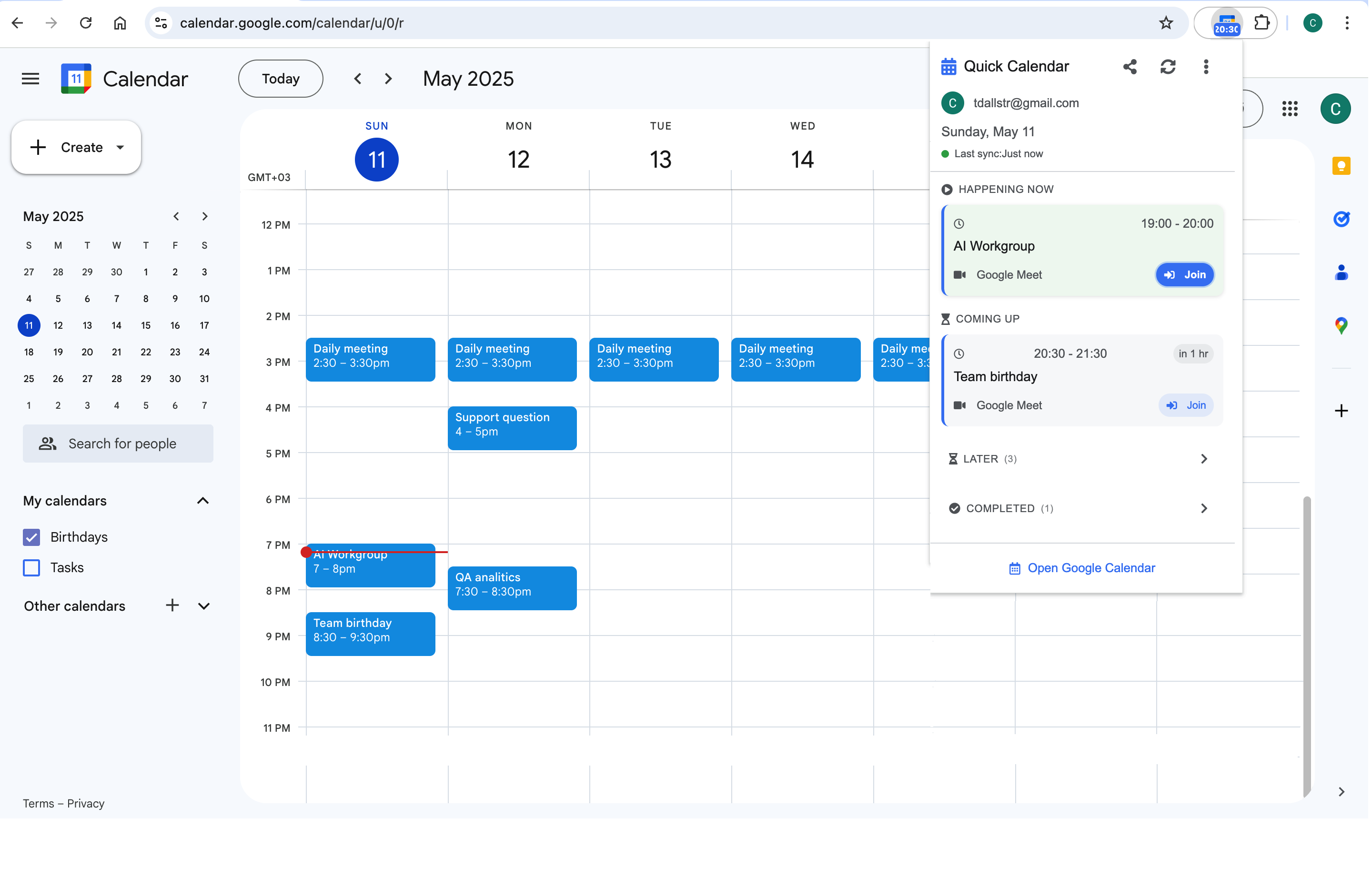
Levers 1 and 2 share a dependency: a glance surface that answers without exposing. A toolbar strip like Calendar Extension for Google Calendar™ shows the next few hours and new invites in one click — the fact you needed, minus the wall you didn’t — which is the exposure diet made practical.
Frequently asked questions
The mechanism (anticipatory stress) is well-studied psychology; "calendar anxiety" is its workplace rendering, not a diagnosis. The levers here are environmental design, not treatment — and if schedule dread persists at disabling intensity regardless of actual load, that is a conversation for a professional, not a settings screen.
Levers 4 and 2 together: the Friday reset removes the open questions Sunday feeds on, and replacing the scan with the one-fact check removes the exposure ritual. Most Sunday dread is Friday’s unfinished decisions plus Sunday’s unnecessary viewing.
It trades anxiety for ambush: under-checking produces 10:58 surprises, which produce hypervigilance, which produces over-checking — the cycle most anxious checkers are already in. The stable point is structured contact (three checks + ambient countdown), not avoidance.
The spike is decision-dread, not load-dread — an invite is an unresolved demand until triaged. Two fixes: the invitation gate (unknown senders can’t write to your calendar at all), and the on-arrival triage habit, which shrinks the unresolved window from days to seconds. The spike fades as the association re-trains.