The physiology, briefly
Microsoft’s Human Factors Lab put numbers to what everyone feels (EEG, 14 participants, 2021): four consecutive 30-minute video meetings produced steadily climbing stress-associated brain activity, while the same meetings with 10-minute breaks kept the curve flat. Sophie Leroy’s attention-residue research (2009) adds the second half: task-switching leaves residue that lowers performance on the next task. A buffer is not slack; it is where the previous meeting finishes happening in your head.
Sizing: not all gaps are equal
- 5 minutes — biological minimum between internal calls: water, stand, one breath. Speedy meetings (:25/:50 endings) manufactures these automatically.
- 10–15 minutes — the working standard after any meeting that produced action items: write the three lines now or lose 40% of them by evening (the notes-decay effect every retro rediscovers).
- 25–30 minutes — after external calls, negotiations, interviews, anything adversarial or performative: the wind-down is real, and the next meeting deserves a person, not an adrenaline echo.
- Zero — legitimately fine between two low-stakes internal syncs on the same project. Buffers are a budget; spend them where switches are expensive.
Mechanics: make the calendar do it
Three layers, cheapest first. Layer 1 — defaults: Speedy meetings on, default duration 25; every meeting you create now ships with a built-in seam. Layer 2 — standing buffers: for your known heavy clusters (the Tuesday gauntlet), recurring 15-minute blocks titled "Buffer — notes & reset", marked Busy. Titled honestly, because mystery blocks get challenged and "Busy" gets booked. Layer 3 — the accept-time habit: when accepting anything back-to-back-making, add your own 10-minute block after it in the same gesture. Buffers created at accept-time cost nothing; buffers needed at 15:00 cost a negotiation.
Defending buffers without apologizing
Someone will book over "Buffer — notes & reset" and feel reasonable. The response that holds: treat it as a real conflict — "I have a commitment until 14:15, can we start then?" — because it is a real commitment: to the previous meeting’s follow-ups and the next one’s quality. Teams that watch a senior person defend buffers adopt them within a quarter; teams where buffers fold on first contact learn they were decorative.
The buffer dividend
Count what changes in a buffered week: action items actually captured (the 10-minute versions), meetings entered with the agenda re-read instead of the previous call still echoing, and — the quiet one — the 16:00 meeting getting the same person the 9:00 got. The cost is 30–60 minutes of grid space a day; the return is that your meeting hours start producing meeting outcomes.
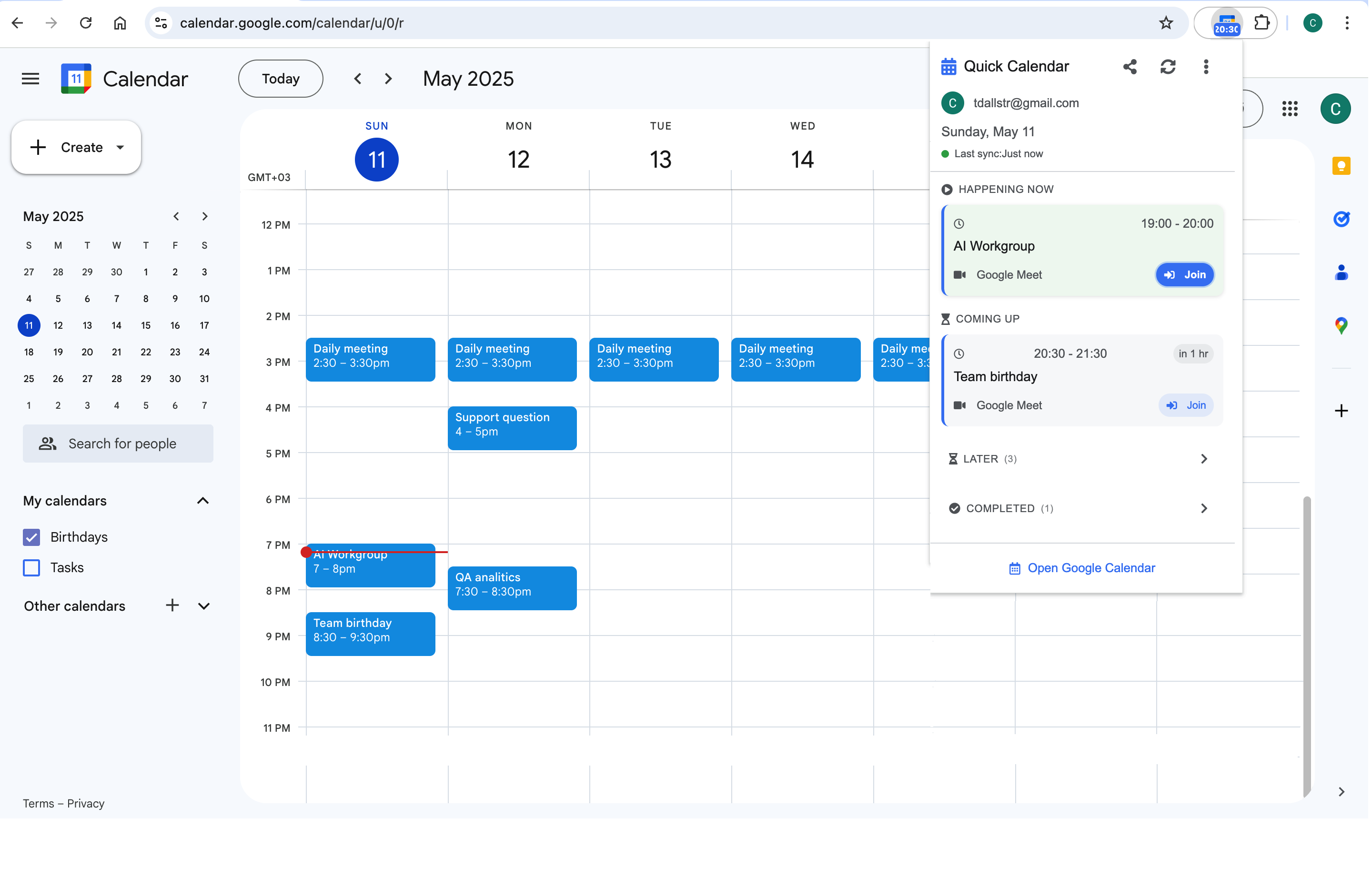
Buffers work best when you can see them coming: knowing there’s a 10-minute seam after this call changes how you spend the call’s last five minutes. A time-to-next-event chip, like the ones Calendar Extension for Google Calendar™ shows in the toolbar, keeps that arithmetic ambient — no tab, no guess.
Frequently asked questions
Marked Busy, they’re protected from find-a-time; against manual over-booking, defense is a two-line reply (see above) applied consistently. If they still fold weekly, hide the title — a plain "Busy" buffer trades legibility for survival, an acceptable price in aggressive cultures.
Speedy endings cover the 5-minute biological tier. You still want the 10–15 after action-item meetings (writing follow-ups needs more than five) and the 25–30 after high-stakes externals. Think of speedy meetings as the floor, standing buffers as the insulation on known hot spots.
In order of payoff: write the action items (three lines, owners, dates), then physical reset (stand, water, eyes off screen), then — only if both are done — a glance at what’s next. What should not happen: email. Email is a context switch wearing a productivity costume.
The transition into a focus block benefits from a small ramp (5 minutes to close threads and silence pings), and the exit needs protection more than the entrance — a 10-minute notification before whatever follows the block prevents the overrun that turns deep work into an apology.