First decide the layer, then the app
Mac users split into three workflows, and the right calendar follows from which one is yours: browser-dwellers (work happens in Chrome/Safari tabs — most Google Workspace people), native-app people (Mail.app, desktop apps, menu bar as command center), and keyboard maximalists (launcher-driven, shortcuts for everything). Apps below are graded against those, not against a feature checklist.
Apple Calendar — the honest default
Better than its reputation: clean views, reliable Google/iCloud/Exchange sync, widgets, and zero cost. Its ceiling is interaction speed — event creation is clicky, natural-language input is limited, and Google-specific features (appointment schedules, Focus time, side-by-side find-a-time) don’t exist here. Right for: native-app people with mixed iCloud+Google lives and modest scheduling volume. Wrong for: anyone living in Google Workspace specifically — you’ll keep opening the web app for the real features anyway.
Fantastical — the keyboard maximalist’s pick
Still the best natural-language event entry on any platform ("lunch with Sam tue 1pm at Verde every other week" just works), excellent menu-bar mini-window, strong widgets, openings/proposals for scheduling. The trade-off is price (subscription, ~$5–7/month) and that its power features duplicate what Workspace users already have in Google’s web app. Right for: keyboard people, multi-account jugglers, anyone whose event-creation volume is high. Wrong for: people who create three events a week — the subscription buys speed you won’t spend.
BusyCal — the tinkerer’s buy-once option
One-time-purchase alternative with deep customization: configurable views, menu-bar access, travel time, weather. Less polished than Fantastical, more adjustable. Right for: native-app people who want control without a subscription. Wrong for: anyone who wants defaults that are already right.
Notion Calendar — for the Notion-native
Formerly Cron: gorgeous, fast, keyboard-friendly, and genuinely good at Google account handling — plus the obvious draw of database-linked events if your team runs on Notion. The trade-off is ecosystem gravity: it wants to be part of a Notion workflow, and outside one it is a pretty Google client. Right for: Notion-first teams and aesthetics-motivated switchers. Wrong for: anyone avoiding another ecosystem’s pull.
The browser-native stack — for where work actually happens
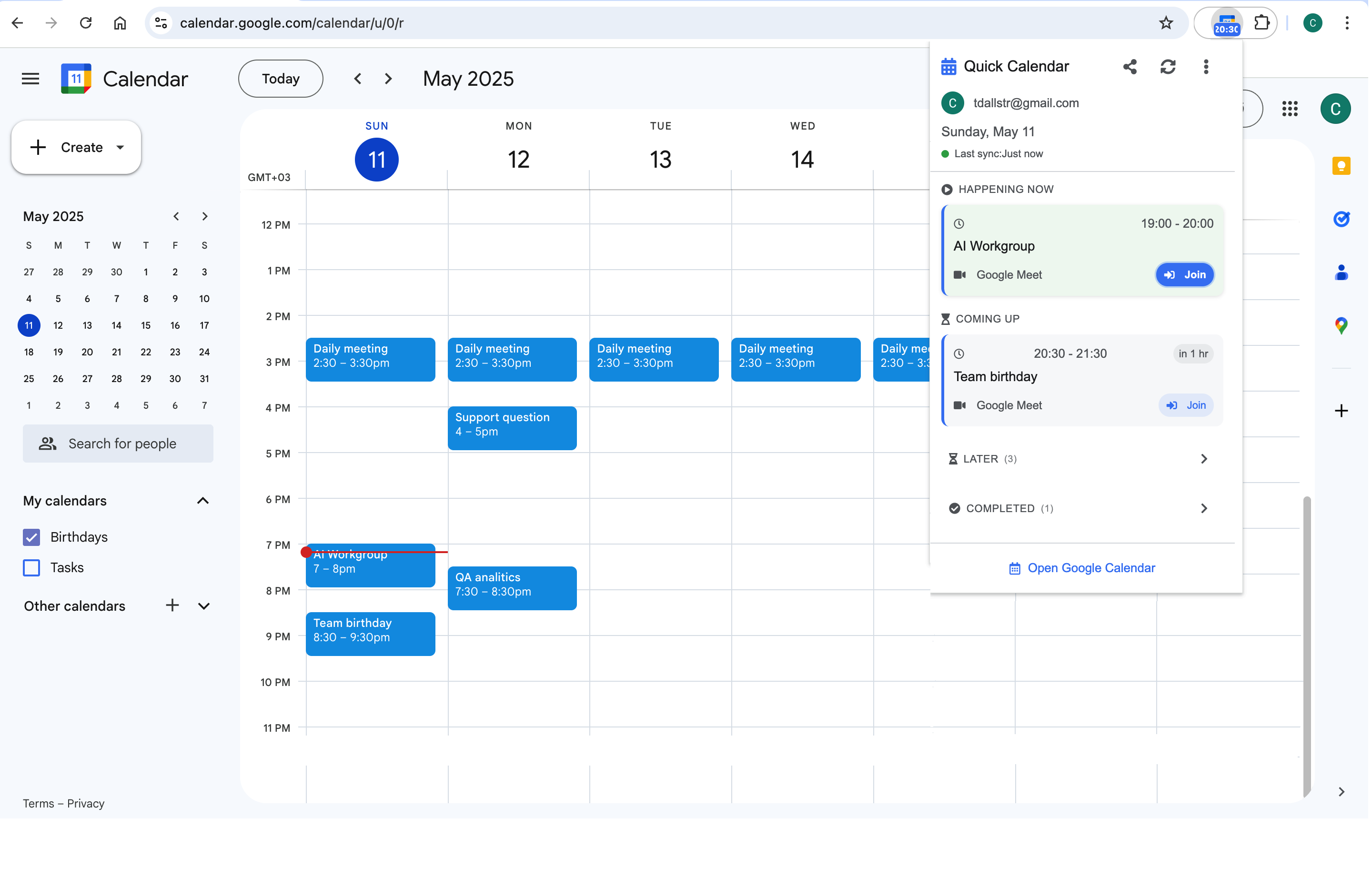
If you are a browser-dweller on Google Calendar, the strongest 2026 setup isn’t a desktop app at all: the Google Calendar web app for sessions (it alone has the full Workspace feature set), plus a toolbar extension for the thirty daily checks. Calendar Extension for Google Calendar™ covers the check layer — one click from any tab: today’s timeline, time-to-event chips, meeting join buttons — which is precisely the job Mac desktop calendars are usually bought to do, minus the app-switch. Right for: Workspace-centric browser-dwellers. Wrong for: offline-heavy or iCloud-centric lives.
The decision in one pass
Workspace + browser-dweller → web app + toolbar extension. High event-creation volume or keyboard-everything → Fantastical. Mixed iCloud/Google, native habits, zero budget → Apple Calendar. Buy-once tinkerer → BusyCal. Notion team → Notion Calendar. There is no "best calendar app for Mac" — there is a best app per workflow, and the workflow question takes ten seconds to answer.
Frequently asked questions
Events, guests, and basic recurrence sync fine. What doesn’t cross: Google-side event colors (Apple shows calendar-level colors only), Focus time/OOO event types, appointment schedules, and Google’s find-a-time grid. If those matter, you need the web app in the loop regardless of which desktop client you run.
Overlap is real: launcher plugins cover a chunk of the natural-language entry value. Fantastical still wins on the mini-window (glance layer), proposals, and multi-account views — but test the launcher-plus-web-app combo for two weeks first; many keyboard people discover it covers 90% at zero cost.
Legitimately great as glance layers for native-app people: next-event countdown, mini month, one-click joins. They are check tools, not session tools — pair one with whatever full calendar you keep. Browser-dwellers get the same layer from a toolbar extension without leaving the browser’s focus.
Partly: Google Calendar’s web app has an offline mode (enable in Settings, per profile) covering read access; extensions vary. If offline editing matters weekly, a native client (Apple Calendar or BusyCal syncing Google) is the pragmatic base, with the browser stack as your online layer.